Common to virtually all Native American Indian tribes is a belief in an all-knowing, all-powerful deity known as the Creator or Master Spirit. This spirit is believed to have made the universe. In many tribes the deity is represented by the sun and is referred to as The Father; these tribes also worship a goddess - Mother Earth. Most tribes also believe in a lesser deity - one closer to the humans - who is called The Trickster (specific names for this god vary tribe to tribe). In some cultures the trickster is evil. In others, he is a helpful spirit - a teacher and a provider. Several other deities - gods of the elements - are also worshipped, such as the Rain god, Thunder god and the god of the Wind.
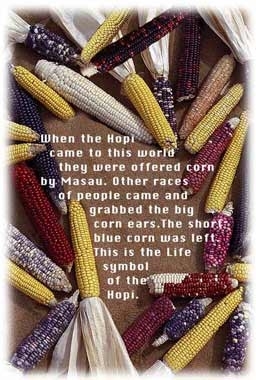 |
| Hopi Corn Legend |
A cosmology is a set of beliefs about how the universe is structured. In many Native American cultures, it was believed to be made up of three layers - the underworld, often considered a dangerous place, the middle world, where humans dwell, and the sky world, inhabited by powerful spirits. Also common to many tribes was the belief that the layers were linked by the World Tree, which had its roots in the underworld, its trunk passing through the middle world, and its top in the sky. The Chumash people of California, described the three world layers as three floating disks. The middle disk (the human world) was believed to be held in place by a giant serpent. Sometimes the serpent would move, causing the earth to shake. This explained why earthquakes happened.
While many Native Americans may have believed in a three-layered world, they did not believe these worlds to be separate. Most tribes believed that powerful spirits, sometimes called "guardian spirits" or "dream helpers" dwelt among them at all times. These spirits provided invaluable guidance and protection, but they could only be seen and communed with through mystical visions. The Vision Quest, which required a long period of fasting, meditation, and physical challenges to purify the body and soul, was usually the first rite of passage for a Native American boy.
Another method of purifying oneself in order to commune with the spirits was the Sweat Lodge. Used by Native American cultures across the continent, the lodge was a small structure with a frame of saplings covered in skins, canvas or blankets. Hot rocks were placed in its center and splashed with water to create a sauna. The Sweat Lodge's intense heat was used to heal the sick as well as cleanse the soul.
While communicating with guardian spirits or dream helpers was something one could do alone, contacting the more powerful deities required the help of a shaman (also known as a medicine man). In times of war, famine, or sickness, the tribe turned to the shaman and his strong spiritual contacts to deliver it from hardship. In ceremonies that often involved drum beating and chanting, the shaman's body would be taken over by spirits. Once the shaman told the spirits what was required, they would depart to perform the needed acts.
In addition to their supernatural powers, shamans were also renowned for their healing abilities and knowledge of the medicinal properties of plants. In fact, more than 200 herbal remedies in regular use today have their origins in the recipes of medicine men.
Giving thanks to their deities and to the earth was vastly important to Native American cultures. Their gratitude was often expressed through elaborate dancing ceremonies or celebrations such as the Sun Dance of the Plains Indians. The purpose of this rite was renewal - renewal of the bond with the Creator (through giving thanks), renewal of the living earth and all its inhabitants, renewal of bonds with friends and family. During the dance tunes were played on eagle bone whistles as participants gave thanks to the sacred bird for giving its life to the tribe. Thanks were also given to the sacred buffalo whose meat and skins were vital to the tribe's survival.
While the belief in an after-life is shared by almost all Native American cultures, beliefs about the nature of that life vary. Some believe in reincarnation with a person being reborn as a human or perhaps an animal. Others believe that humans return as ghosts. Still others believe that the spirit departs for another world. In general, though, is the belief that the spirits of Native Americans live on, and with values such as respecting the earth, working together for the common good, and remaining true to oneself at its core, the influence of Native American spirituality is sure to prove eternal as well.
 |
| From Native Web.com |
Five worlds and five suns were created one after the other. There were the suns of earth, fire, air, water, and rock. The first world was destroyed because its people acted wrongfully: they were devoured by ocelots, and their sun also died. The second sun, the pure orb, saw his human beings changed into monkeys for their lack of wisdom. Next came the sun of fire, whose world was destroyed by flames, earthquakes, and volcanic eruptions because the people living in it were impious and did not sacrifice to the gods. The fourth world perished in a great flood which also drowned its sun.
Before the dawn of the fifth, our present world, all the gods assembled in darkness to decide who should have the honor--and a dangerous honor it turned out to be to light up the fifth world, and with it the fifth sun. One god named Tecciztecatl volunteered, thinking to get much praise from the other gods. After days of purification, the gods built a huge fire on the top of a pyramid and told Tecciztecatl: "Light up the world!" "How?" asked Tecciztecatl, dressed in irridescent hummingbird feathers and jewels of gold and turquoise. "By jumping into the fire, O Tecciztecatl," said the gods. But Tecciztecatl was afraid; he didn't want to be burned up. Four times he tried to immolate himself, and four times the heat, the flames, and his fear drove him back.
Then the lowliest of all the gods, Nanautzin, dressed in humble garments of woven reeds, misshapen, ugly, and covered with scabs, offered to renew the world and light up the sun by jumping into the fire. None of the gods had paid him the slightest attention before, but now they all cried with one voice: "Oh Scabby One, be thou he who brings back the Sun!" Without a moment's hesitation Nanautzin hurled himself into the flames, burning up with a great crackling sound, his blazing garments of reeds lighting up the sky. And ashamed of his cowardice, Tecciztecatl followed his example and was cremated also. At once the sun rose to light up the new fifth world, and it was the despised Scabby One, brave Nanautzin, who by his death had given life to the sun. --Based on Nahua versions of a lost Toltec legend. Source: Richard Erdoes and Alfonso Ortiz, American Indian Myths and Legends, (New York: Pantheon Books, 1984), 166-68.
 |
| from the First Americans Web site |
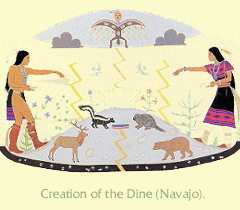
Late in the autumn the people heard the distant sound of a great voice calling from the east. They listened and waited, and soon heard the voice nearer and louder than before. Once more they listened and heard it louder still, very near. A moment later four mysterious beings appeared. These were White Body, Blue Body, Yellow Body and Black Body.
The gods told the people that they would come back in twelve days. On the morning of the Twelfth Day the people washed themselves well. Then the women dried their skin with yellow cornmeal, the men with white cornmeal. Soon they heard the distant call, shouted four times, of the approaching gods. When the gods appeared, Blue Body and Black Body each carried sacred buckskin. White Body carried two ears of corn, one yellow and one white.
The gods laid one buckskin on the ground with the head to the west, and on this they placed the two ears of corn with their tips to the east. Over the corn they spread the other buckskin with its head to the east. Under the white ear they put the feather of a white eagle; under the yellow ear the feather of a yellow eagle. Then they told the people to stand back and allow the wind to enter. Between the skins the white wind blew from the east and the yellow wind from the west. While the wind was blowing, eight gods called the Mirage People came and walked around the objects on the ground four times. As they walked, the eagle feathers, whose tips stuck out from the buckskins, were seen to move. When the Mirage People finished their walk, the upper buckskin was lifted. The ears of corn had disappeared; a man and a woman lay in their place.
The white ear of corn had become the man, the yellow ear had become a woman: First Man and First Woman. It was the wind that gave them life, and it is the wind that comes out of our mouths now that gives us life. When this ceases to blow, we die.
--From the First Americans Web site
 |
| from the Navajo Creation Story Project |
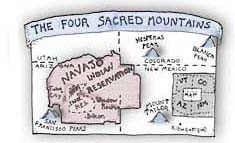
We also honor the Creator of the Universe that lies between the Four Sacred Mountains. For he placed here for us all things we need to live and be happy. He gave us Father Sun who gives light and energy to Mother Earth. Mother Earth nurtures us and gives us all things including the mountains, trees, our animals, grass, food, and the herbs to heal us of our infirmities. We are the children. All things are alive to us. The Holy Ones taught us how to take care of Mother Earth. We honor them in our delight to take care of her. Many peoples of Mother Earth are now hurting her. A future day will come when the peoples of the Earth will come to us, the Navajo, to teach them how to care for Mother Earth. When that day comes, we will be ready. --From An Introduction to the Navajo Culture
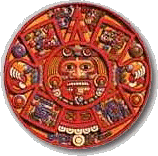
The mother of the Aztec creation story was called "Coatlique," the Lady of the Skirt of Snakes. She was created in the image of the unknown, decorated with skulls, snakes, and lacerated hands. There are no cracks in her body and she is a perfect monolith (a totality of intensity and self-containment, yet her features were sqaure and decapitated).
 |
| from the International School of Amsterdam Web site |
Coatlique was first impregnated by an obsidian knife and gave birth to Coyolxanuhqui, goddess of the moon, and to a group of male offspring, who became the stars. Then one day Coatlique found a ball of feathers, which she tucked into her bosom. When she looked for it later, it was gone, at which time she realized that she was again pregnant. Her children, the moon and stars did not believe her story. Ashamed of their mother, they resolved to kill her. A goddess could only give birth once, to the original litter of divinity and no more. During the time that they were plotting her demise, Coatlicue gave birth to the fiery god of war, Huitzilopochtli. With the help of a fire serpent, he destroyed his brothers and sister, murdering them in a rage. He beheaded Coyolxauhqui and threw her body into a deep gorge in a mountain, where it lies dismembered forever. The natural cosmos of the Indians was born of catastrophe. The heavens literally crumbled to pieces. The earth mother fell and was fertilized, while her children were torn apart by fratricide and then scattered and disjointed throughout the universe. Ometecuhlti and his wife Omecihuatl created all life in the world.
Their sons:
Xipe Totec - The Lord of the Springtime
Huitzilopochtli - the Sun god
Quetzalcoatl - the Plumed Serpent
Tezcatlipoca - the god of Night and Sorcery.
Coatlicue - She of the Serpent Skirt.
When the earth began there was just water. All the animals lived above it and the sky was beginning to become crowded.
They were all curious about what was beneath the water and one day Dayuni’si, the water beetle, volunteered to explore it. He went everywhere across the surface but he couldn’t find any solid ground. He then dived below the surface to the bottom and all he found was mud. This began to enlarge in size and spread outwards until it became the earth as we know it.
After all this had happened, one of the animals attached this new land to the sky with four strings. Just after the earth was formed, it was flat and soft so the animals decided to send a bird down to see if it had dried. It eventually returned saying the land was still too wet. The animals sent the great Buzzard from Galun’lati to prepare it for them. The buzzard flew down and by the time he reached the Cherokee land he was so tired that his wings began to hit the ground. Wherever they hit the ground a mountain or valley formed.
The Cherokee land still remains the same today with all the land forms that the Buzzard formed. The animals then decided that it was too dark, so they made the sun and put it on the path in which it still runs today. The animals could then admire the newly created Earth around them.
In the early times, there was only darkness; there was no light at all. At the edge of the sea a woman lived with her father. One time she went out to get some water. As she was scraping the snow, she saw a feather floating toward her. She opened her mouth and the feather floated in and she swallowed it. From that time she was pregnant.
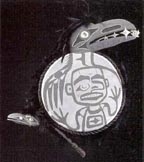 |
| Raven Releasing the Light Drum and Raven Clapper by George Hunt, Jr. www.inuit.com |
Then she had a baby. It's mouth was a raven's bill. The woman tried hard to find toys for her child. In her father's house was hanging a bladder that was blown up. This belonged to the woman's father. Now the baby, whose name was Tulugaak (Raven), pointed at it and cried for it. The woman did not wish to give it to him but he cried and cried. At last she gave in and took the bladder down from the wall and let the baby play with it. But in playing with it, he broke it. Immediately, it began to get light. Now there was light in the world, and darkness, too. When the woman's father came home, he scolded his daughter for taking the bladder down from the wall and giving it to the child. And when it was light, Tulugaak had disappeared.
Page created on 12/31/2014 2:20:35 PM
Last edited 3/20/2019 1:16:05 PM