 |
| Jeff holds a picture of the Huntington's Gene (From Globe and Mail) |
Jeffrey Carroll is my hero because, though he has many reasons to give up, he has not. Jeff has Huntington’s disease—a disease that kills you around the middle of your life, just when you are starting to build a family. It is projected that Jeff’s life will get cut off in about 20 years and he will start showing symptoms in as few as 10 years. Unlike many others before him, who give up when they are diagnosed, Jeff has decided to work toward finding a cure.
 |
| Jeff Carroll, wife Megan, twins Elijah & Billie (From Globe and Mail) |
Jeffrey Carroll’s grandmother died from Huntington’s and more recently, in December of 2007, his Mom died from that disease. His Mom started showing symptoms in 2003 and because Huntington’s disease is hereditary, with a 50% chance that Jeff would have the disease as well, he was tested. On July 21, 2003 he found out he carried the Huntington’s gene.
“And Jeff,” his wife Megan remembers, “asked for a job.” (Globe and Mail)
He wanted to help others who were in the same situation as he is in. Eventually Jeff got in touch with Michael Hayden from the Hayden Laboratory in Vancouver, B.C., which is the largest laboratory in Canada studying Huntington’s disease. It was a difficult decision for the staff at the Hayden Laboratory whether to bring Jeff in to help with research. However, they decided that he would be a significant asset to their research. He had been working on a PhD in biology, but shifted to a PhD in neuroscience, which he is now working toward at the Hayden Laboratory.
“For me, in my planning my career and my life, I have to plan on dying at 45,” he says, before quickly correcting himself. “No, I won't be dead then, but I will be useless as a provider and a father.” (Globe and Mail)
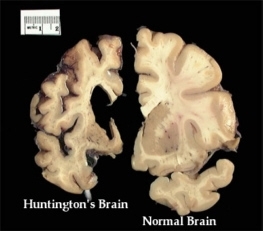 |
| Huntington's Brain vs. Normal Brain (http://hdroster.iu.edu/AboutHD/Images/piHDvC.jpg) |
Huntington’s disease starts out benignly enough: minor slurring of words and memory loss, but eventually it will turn you into a kicking, thrashing, screaming, incontinent monster. Scientists have discovered that this disease occurs in people who have a genetic mutation, which causes more than the normal 35 repetitions of C-A-G on the 4th chromosome. Among other experiments on Huntington's, Jeff and researchers at the Hayden Laboratory are trying to cure mice with the Huntington’s gene by reducing the enzyme Caspase 6. This enzyme cuts the extra repetitions and when they are cut they release a toxin that attacks the brain. If you reduce the amount of Caspase 6 then it won’t cut the gene as soon and consequently won’t release the toxin as soon. This method hasn’t been fully proven as a cure, because they don’t know what other side effects this might cause, if your body will continue to produce Caspase 6, and how much reduction of Caspase 6 they need to do to prolong the onset of the disease. Researchers hope to be able to test this method on humans in about 5 years.
Because Huntington’s disease is hereditary (Jeff’s brother has recently been diagnosed with Huntington’s disease), Jeff’s hopes of having children were squashed. He and Megan decided to try a new high-tech form of In Vitro where each egg gets screened for the Huntington’s gene. They found that two eggs were free of the gene and chose to have those two eggs implanted. He now has two, year-old twins at home.
A trait I admire in people is that they are “doers.” Instead of floating along on the hope something good will happen to them, they try to make a difference. For many people the thought of having a fatal disease like Huntington’s disease is too horrible to think about: when they are diagnosed; they get depressed and “hermitish”—they look to suicide. Some, though, want to just spare their family the burden of having to take care of them or leaving them with the image of the monster this disease turns you into. For people like this, voluntary euthanasia comes up as an option.
“Would you die to spare your kids something so horrible?” Mr. Carroll asks. “I would. If you knew that every Christmas and every Easter and every birthday, they were going to come and congregate around your nursing home bed and talk to you, would you kill yourself? I would.”(Globe and Mail)
`All voluntary euthanasia would do, he said, is eliminate one to two years of rapid deterioration and save his children from remembering him as a “slobbering, incontinent, mutant mess.” (Globe and Mail)
Though Jeff Carroll can see the possibility of euthanasia for himself later, now he is actively working towards a cure. Even though Jeff Carroll probably will not find a cure in time to save himself he will have made a difference in other’s lives by inspiring them to “do” rather than to “float.” He is an inspiration to me because he is still fighting.
Page created on 1/14/2008 12:00:00 AM
Last edited 1/14/2008 12:00:00 AM
Indiana University. "Huntington's Disease Roster." [Online] Available http://hdroster.iu.edu/AboutHD/brainAndHD.asp.
Mayo Clinic Staff. "Mayo Clinic-Huntington's disease." [Online] Available http://www.mayoclinic.com/print/huntingtons-disease/DS00401/DSECTION=all&METHOD=print.
Priest, Lisa. "Hunting Huntington's--Researcher Heal Thyself." Globe and Mail. 13 October 2007. Section F pp. 1,4,5