It was 1978, my college graduation. I was the designated “Class of ’78“ speaker. I was sitting in a metal chair 10 feet from the podium where Bonnie Raitt’s father was delivering the commencement address. This was Southern California after all.
My feet shuffled and my eyes darted along the path to the podium spying for dips and wires that might Jerry Lewis me. The palms of my hands were swampy and my heart was chattering to the tune of Bee Gees' “Staying Alive.” My carefully typed notecards, with their share of phonetic mis-spells and absent commas, were on my lap. Though I had read my speech a quadrillion times, my fear was that the words on those neat little cards would mutate into a jumble of broken lines in need of ICU assembly. I had dyslexia, so to me the fear seemed real enough.
It had happened before. In second grade, 1963. The whole class had been down to the library at the local public school where we were given an introduction to the “Duie Decimal” system and then allowed to check out our first book. Leaving the classroom always rippled us with excitement. Not as exciting as the usual Nuclear Bomb drills, mind you, but still it was out of the classroom.
We were told that after we’d made our choices we’d all be able to read a paragraph from the book we’d selected to the whole class. I was going to get a book on the Civil War.
 |
| Photo from Milipitas Library |
Books were a familiar thing.
My parents read to me almost every night. My mom took week nights reading books like the The Lion, the Witch and the Wardrobe to my twin brother, Sam, and me. My dad took weekends and was at the time reading Treasure Island. I was a good listener and desperately tried to beat Sam to the answer when my dad dropped questions on our sports car-spattered pajamas.
Our home was lined with books. The study was a colorist’s landscape of book bindings. My parents’ bedroom had books piled like fall leaves in heaps by the bed, in corners by the reading chair and lined up like soldiers on the shelves around their bed. There were books in every bedroom. There were even books in the attic sadly awaiting transport to the church’s white elephant sale.
I remember my parents raising eyebrows on a couple who had no visible signs of books in their home. “They’re home is very nice but there are no books!” my mom exclaimed.
The book I chose that day in second grade was above my reading level. Every book in that library was above my reading level. I knew this because the week before I had sat down with my best friend’s 4-year-old brother. He wanted to show off his skills. He read with a fluency that I only imagined. To me, the kindergarten book’s words looked all crooked and broken adding up to not a word.
My teacher, Miss Sterling, came around the library and checked to make sure we were all in the right section. Not to be bothered by the “Duie Decimal" system, I had already chosen my book. It was on the Civil War. I could tell by the picture. I knew something about the Civil War.
 |
| Photo from Classic Toys |
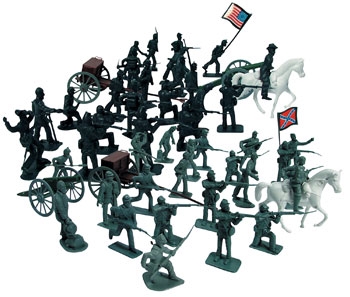
I’d spend hours playing with Confederate and Union soldiers in my room. My general was Lancaster Grant. In every battle among the blocks and Lincoln logs, Lancaster would invariably be on the verge of a great defeat, and then ascending to the highest point of the wreckage on the carpet, the fortunes of battle would just as invariably be reversed. Lazarus-like, the fallen blue soldiers would rise and Lancaster watched as his troops swept to victory.
And so it never occurred to me that I could not read a word of this book. It never occurred to me that I would be standing in front of a classroom of 25 grinning classmates waiting for me, the designated class clown coming out of exile from his assigned far corner of the classroom, attempting to read a bit of a book that might as well have been printed in Mandarin.
To be fair to Miss Sterling, I did have an assigned desk. I just never lasted long in it. There were far too many adventures to be had along the train tracks to school. And I was always late. And I was always getting into fights during recess and PE. And I couldn’t seem to stop talking to Holly Rothschild, who I wanted to kiss, or my best friend, Steve Rosenthal. Words never failed me when there was some reason to make a wisecrack or argue with the teacher about some perceived injustice. And while there were plenty of trips to the principal's office, after a while they got tired.
All of which led me to the solitary of the large corner table where I could spread my blank sheets of paper wide, digging into them with my fat school pencils. Battles would play themselves out. Ships would sink. Planes would blossom in flames. World War 2 would exhaust itself on that table. And when those battles would stop their rage, I’d look out the windows. I’d see the approaching warriors. They’d break through the classroom doors and surround my terrorized classmates. They did not see me in my corner. So with John Wayne bravado, I’d lay waste to their plans. Finally, Miss Sterling would make me a member of her good kids collective.
I never did get to rescue my class from bad men, but I did rescue Cami Harold, a classmate with scoliosis and a painful looking back brace, from teasing. And I was one of the two second grade captains of the kickball team, and I did pick all the kids who would never get picked, including Holly. And I always imagined that somehow I could get this team to win the day by sheer force of my own will. It never happened and I always left the playing field streaking dirt and tears.
I had a “competition inside” of me. I was born the youngest with my twin brother. I swear I came out of my mother’s womb pissed off that I wasn’t already walking, talking and swinging a briefcase like my dad on Madison Avenue. Or kicking back like my older brother in his hood boots, tight jeans and Camel cigarettes dangling from his mouth, playing the upright piano and singing Bob Dylan better than Bob Dylan. Why couldn’t I just skip the "Duie Decimal" years and get on with my life?
I thought fame might get me to grown-up status a little quicker than the adults had planned. So Sam and I started a rock band. We played at a few birthday parties and even in front of the school. The problem was that I didn’t practice much. I figured when the time came my fingers would find their way around the frets like fairies in a forest. Whenever we played about three chords into a song, I’d get totally lost and have to turn down my guitar and fake it for the rest of the set.
When I was five I entered six swimming races at the local club, beginning with the ten and unders. Forget that I had never taken a swimming lesson. I really believed that I would fly through the water like a dolphin, which I had done many times in my dreams. I came in dead last not once, but in all six races. Each time emerging from the waters with a fury of tears and greeted with a consolation prize of Chuckles candy.
The class filed out of the library with our books tucked under our arms. We made it back to the classroom and Wendy got to read her book first. When she was done hands shot up to go next. When I finally got picked I walked up to the front of the classroom. I opened my book. I sounded out the first word. I stumbled on the second. And then threw my book to the floor to the giggles around me and angrily stamped to my corner and pile of fat pencils.
Yet, here I was 15 years later delivering the graduation speech.
To be clear, no group of august professors had appointed me to this moment. I had been elected in a series of American Idol-like tryouts by members of my class.
By this time, I was a solid student. I almost laid claim to academic excellence when my psychology professor recommended me for a Fulbright Scholarship based on a paper I had written about Freud and wisely had paid a graduate student to type. But even at this invitation to the academic establishment, I blanched. I didn’t feel smart enough. SATs, ACTs LMNOPs still required a gift I couldn’t quite grasp.
Since being embraced by the academic establishment was not a part of my dream world, I’d spent the past three years attending college while running a home for teenage unwed mothers and working with street gang members who had been caught with their noses in socks full of leaded house paint. I’d gotten through high school the same way -- working the extra curriculars like a lifeline to become student body president, receive the Citizenship Award, art student prize and athletic prize. My teachers may have liked me, but I was far from the academic hall of fame.
So I got up from my folding chair. My time had come. Beyond my moments at the podium, I was headed to the world’s biggest ad agency in Chicago as a Management Development trainee, aiming for the creative department as a writer.
Walking to the podium, my 6’2" frame was raised to 6’4" by my Frye boots. My square jaw was working up some saliva and my longish hair was sprouting from beneath by mortarboard. I was told that I was selected as class speaker because of my deep voice, my “charisma” and the work I had done in the community. There was no mention of my academic work or the quality of my speech. So to me, the honor was an honor that I received because of assets I’d won in the sperm lotto.
Having said that, I was a long way from that humiliating moment in second grade. And the dozen or so grade school and middle school humiliations. I hadn’t lost my vision and I hadn’t lost a certain degree of magical thinking (I still buy lottery tickets occasionally), but I had learned that to make the magic happen, there were certain things I had to do.
After collapsing in the second grade. I was sent to a Dr. Feinberg, a psychologist who watched me play with soldiers hour after hour in his office. He diagnosed my eagerness to grow up and move on without doing the work.
And I was taken to a private tutor, Mrs. M~, in her warm surburban house where her work table was spotlighted with a bowl of candy…not cheap candy, but good candy red licorice, M&M peanuts, and maltballs. Mrs. M~ asked me what I wanted to learn.
I told her about a family vacation to Jamaica. When we were there, we took a drive through the impoverished mountains far from the luxury of the coastline. I was stunned by the poverty and the schools. The schools didn’t look anything like my school. I told her, “I’m going to start a school for poor people.“
“Well then,“ Mrs. M~ said, “You’ll need to read.” Over the years of going to Mrs. M~’s, she told me time and time again about how all I needed to do was read ten pages a day. If I did that every day for a year, by the end of the year I would have read 3650 pages or ten big adult-size books. By the time I was sixteen, I would have read more than most of the people in the United States. And by the time I graduated from college, more than most people in the world. And before long, I could open my school. For some reason, this all made sense to me, and counting my parents reading to me, and counting summer reading required by my mom and dad and comic books, I pretty much stuck to the program.
I was at the podium and the letters on the notecards were clear and pretty. I only remember two lines from the speech…”a penny saved is a gumball“ and “Life is not about what you plan but the interruptions.”
I don’t know about my classmates, but I didn’t know how prophetic the second thought would be for me.
I lasted in advertising 11 years, or long enough to start my own agency, and then went to Yale Divinity School where I graduated and became a Senior Pastor of a Connecticut church. I wrote and delivered hundreds of sermons, eulogies and wedding meditations, only to mutate again into a drama and art teacher, and now the co-founder of a school and recovery program for adolescents.
Who knew that one page at a time, ten pages a day, 3650 pages a year would be the first step system I would use to move toward an adventurous rewarding life? Mrs. M~ did.
Page created on 10/27/2014 11:43:01 AM
Last edited 10/3/2018 4:24:54 PM