 |
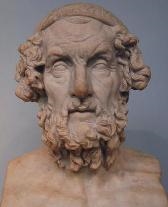
| A bust of Homer (www.livius.org (Marco Prins)) |
There are no cold hard facts about the life of Homer, the accredited author of many famous classical poems and hymns. The writing of the Greeks and the Romans who explained his life hundreds of years later after he had died are literally all we have on the mysterious man. He was said to have composed the brilliantly written classical poems the Iliad, and Odyssey. The Iliad is an epic depicting the siege and fall of the city Troy while the Odyssey depicts the journey of Odysseus (a brilliant and witty Greek general) back to his homeland in Ithaca. What historians have gathered about him was that he was a blind man who memorized all of his poems by heart, and who made the poems into a complicated format known as Dactylic Hexameter Verse. What makes Homer a hero however, is his inspiration of other people to write, and in my case the inspiration to take up Latin, a language that his poems have been well recorded in.
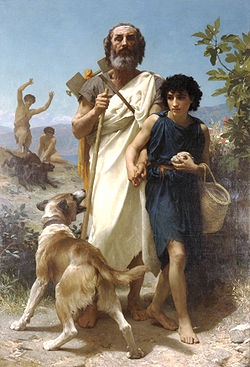 |
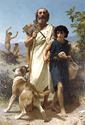
| Homer being led by a young man. (en.wikipedida.org/wiki/homer) |
Homer is most commonly said to be born around the 8th century BCE , on the island of Chios in Ionian Greece. His name coincidentally (or perhaps not so coincidentally, as it describe his affliction) means "prisoner" or in some dialects of ancient Greek "blind". It is remarkable to me, that a person with such an unfortunate disability was not only able to survive in a harsher world than today, but thrive and create beautiful works of literature. While it seems incredible that one blind man could write so many extensive pieces of work in a short time, it has recently come into question whether or not all of Homer's works were actually written by the same man. The accuracy about the claims that Homer might not have come up with all the works are quite possibly true, but it is still inspiring to think that one man could accomplish so much. It is also important to mention that it isn't necessarily the physical man that makes Homer a hero, but perhaps the ideals behind the man and the writing. That a person (or several) would take the time to compose such intricately designed poems of great length and abide by the same restricting format, is a feat of its own. It would only add to the amazement if it were Homer who wrote both poems.
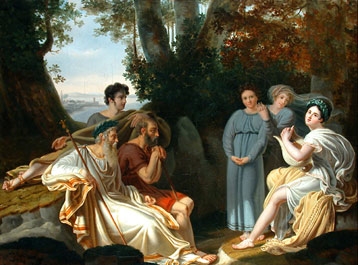 |
| A typical depiction of Homer ( http://www.webexhibits.org/poetry/imagesFolder/sappho_homer.jpg) |
Homer's writing style used Dactylic Hexameter Verse, a very complicated format of poetry. What makes Homer's work so fascinating and impressive was that he continued to use this format for the entire lengths of his poems (sometimes over several hundred verses long), and does so using a fluidity and expression that is unparalleled. The verse itself consists of 6 "feet" of a mixture of short and long syllables, where usually the fifth foot is a Dactyl or "finger/toe" or short syllable part, and the last foot is a double long syllable part or a long syllable followed by a short syllable part. A variety of combinations could be used for the first 4 feet however, and can be between a long and 2 short syllabic part or a double long syllabic part. It is impressive that poems of great length such as the Odyssey and the Iliad were able to maintain this format, and it speaks much about the poetic prowess of the author.
Homer to me doesn't necessarily mean the actual man who wrote great poems, but a concept, the actual works of writing that do exist. Believing that Homer was an actual person only strengthens this, and shows that people with disabilities or disadvantages can still make a large impact on the world, be it literary or otherwise. At any rate, when I first read the translations of Homer's Iliad, I was intrigued. I was curious about the writer, but I was taken in more by the vocabulary and the writing. I wanted more, and I wanted to figure out more about words and language. At any rate, it led me to Latin, and will hopefully lead me towards other languages. Without the hook that the Iliad provided to me, as well as to many other people, my life, and modern literature would not be the same. It is for this reason, that Homer, or the ideas that Homer represented, is my Hero.
Works Cited
Curley, Dan. "Hexametrica: Preface." www.skidmore.edu. Web. 04 Dec. 2011.
"Homer- Ancient Greek Poet." Ancient Greece - History, Mythology, Art, War, Culture, Society, and Architecture. Web. 05 Dec. 2011.
Harris, William. "Reading the Homeric Dactylic Line." Middlebury College: Community Home Page. Web. 05 Dec. 2011.
Lendering, Jona. "Homer." Livius. Articles on Ancient History. Web. 04 Dec. 2011.
"William-Adolphe Bouguereau - Homer and His Guide." Wikipedia, the Free Encyclopedia. Web. 10 Jan. 2012.
"Ancient to Modern : Poetry through the Ages." Webexhibits. Web. 10 Jan. 2012.
Page created on 1/29/2012 12:00:00 AM
Last edited 7/24/2017 5:51:35 PM