"We are free, but not to be evil, not to be indifferent to human suffering, not to profit from the people, from the work created and sustained through their spirit of political association, while refusing to contribute to the political state that we profit from. We must say no once more. Man is not free to watch impassively the enslavement and dishonor of men, nor their struggles for liberty and honor."
|
|
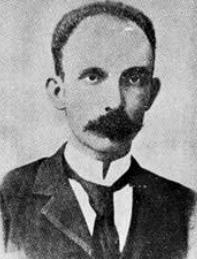
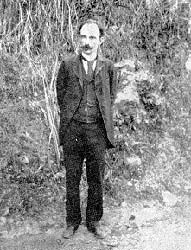
In a nation as divided as Cuba, only one man, José Martí, a poet and freedom hero, has been able to unite all factions. In his short life, Martí struggled against the dual oppressing forces of Spain and the U.S. to gain independence for his island nation while upholding his beliefs in liberty, freedom and greatness of the human spirit. "Like stones rolling down hills, fair ideas reach their objectives despite all obstacles and barriers. It may be possible to speed or hinder them, but impossible to stop them." Born in La Habana on January 28, 1853, Martí began his political career at the tender age of 15, when he helped start an anti-colonial newspaper. Within a year he was arrested by Spanish authorities for anti-government activity and sentenced to 6 years of hard labor in a quarry. In 1871, after serving three years, he was deported to Spain where he studied law in the University of Zaragoza. "Liberty is the right of every man to be honest, to think and to speak without hypocrisy....A man who obeys a bad government is not an honest man." After graduating from college, Martí moved to Mexico City, where he worked as a journalist. His objection to the military regime controlling Mexico led to his escape to Guatemala. However, his opposition to government abuses there again forced him to leave. In 1878 he returned to Cuba under a general amnesty, but he was soon banished back to Spain for conspiring against colonialist authorities. From Spain he fled exile and came to the United States. After a year in New York he left for Venezuela to work as a literature professor, but yet another dictatorship forced him out. In 1881 Martí returned to New York where he lived until his final trip to Cuba in 1895. For the next fifteen years he tirelessly campaigned for the liberation of Cuba. In 1892 he went to Key West -- the heart of the fragmented Cuban exile community -- to form the Cuban Revolutionary Party, the movement that would lead to the eventual defeat of the Spanish army in 1898 and subsequent establishment of a free Cuba in 1902. "One just principle from the depths of a cave is more powerful than an army." In 1895, in a true act of heroism, Martí left the shores of the U.S. to join the war for Cuban independence, which he had so painstakingly organized from exile. He landed in Cuba on April 11 with a party of supporters and took to the mountains to join the ranks of the Revolutionary Army. By all accounts, Martí, a rail-thin, 42-year-old intellectual with no military background, found the life of the guerilla fighter unbearable. On May 19, a little more than a month from his arrival in Cuba, Martí rode into battle in one of the first skirmishes of the armed revolt and, to everyone's horror, was shot dead almost immediately. "Men of action, above all those whose actions are guided by love, live forever. Other famous men, those of much talk and few deeds, soon evaporate."
"I have lived inside the monster and know its entrails." Though Cuba's greatest freedom hero, Martí was also one of the great turn-of-the-century intellectuals of Latin America. The scope of his written work is staggering: he was an accomplished poet, a revolutionary philosopher, a professor, a publisher, a journalist and a political theorist. The heart of his writings always embraced the concepts of freedom, liberty and democracy. His vast experience and education enabled him to move comfortably in the most diverse fields, which is what makes his writing so rich and timeless. "Just as he who gives his life to serve a great idea is admirable, he who avails himself of a great idea to serve his personal hopes of glory and power is abominable, even if he too risks his life. To give one's life is a right only when one gives it unselfishly." More than one hundred years after his death, with the Cuban people separated by two countries and two ideologies, both the communist and exile communities have called upon Martí as a symbol for their divergent causes. Fidel Castro has called him a revolutionary hero and has emphasized that his writings state that Cuba will never be truly free without economic, racial and sexual equality. While Havana's airport is called the José Martí International Airport and the Plaza de la Revolución is anchored by a giant obelisk in the middle called the Martí Monument, in Miami, the right-wing exile community and the U.S. government have created a TV and radio station to broadcast anti-Castro propaganda to Cuba called TV and Radio Martí.
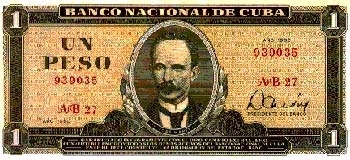
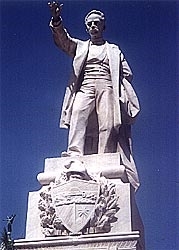
What will never change, regardless of what the future holds for Cuba, is Marti's relevance and importance. Everywhere in Cuba and in the Cuban exile communities in the U.S. there are statues and tributes honoring his life, work, and untimely death. He will always be ingrained in the hearts, minds and souls of the Cuban people as their greatest hero.
Quotations from: MARTI: Thoughts/Pensamientos by Carlos Ripoll
|
|
Written by
Antonio Mendoza
from
Los Angeles
Photos courtesy of FREE CUBA Foundation |
|
FREE CUBA Foundation An excellent resource for Cuban history and culture. Cuba Heritage.com A database of articles, illustrations and photographs chronicling the history of Cuba. CubaNet News A non-partisan and non-profit organization that fosters free press in Cuba. La Pagina de Jose Marti An exhaustive website in Spanish dedicated to the life and works of José Martí. |
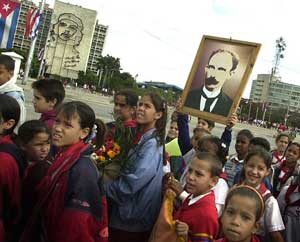
![]() A young Cuban holds a picture of Cuban National Hero Jose Marti during a ceremony in which children put flowers on the hero's monument in Revolutionary Square, Havana, Cuba to mark the 150th anniversary of Marti's birth, Tuesday, Jan. 28, 2003. An image of revolutionary Ernesto "Che" Guevara is seen on building at left. (AP Photo/Cristobal Herrera.) |
RECOMMENDED
READING | |
![]() Jose Marti: Cuban Patriot and Poet (Hispanic Biographies) by David Goodnough |
![]() | ![]() | ||
| Abraham Lincoln was a U.S president who fought for the abolition of slavery while keeping the country united. | Alexander Solzhenitsyn was a Russian novelist and dissident who won the Nobel Prize for Literature. | Angela Davis is a leader, author, and professor who has fought for decades for human rights. | Art Miki founded the National Association for Japanese Canadians to help redress Japanese rights lost during WWII. |
![]() | ![]() | ![]() | ![]() |
| Aung San Suu Kyi has dedicated her life to freeing Burma from a repressive dictatorship and creating democracy without violence. | Bill Bradley once a pro-basketball player now is a politician who advocates reform to make America better for all. | Cesar Chavez was a tireless advocate for migrant farm workers. | Chief Joseph led the Nez Perce tribe in an effort to keep its homeland. |
![]() | ![]() | ![]() | ![]() |
| Clara Shortridge Foltz was the first woman to practice law in California. | Constance Motley became the first African-American woman judge on the largest federal trial bench in the US. | Craig Kielburger believes kids can change the world. | Crazy Horse bravely fought for the freedom of the Sioux Nation. |
![]() | |||
| Daniel Pearl was a Wall Street Journal reporter who reported the news with courage, integrity, and intelligence. | Deborah Sampson dressed as a man so that she could fight in America's Revolutionary War. | Declaration of Human Rights established the basis for human rights beliefs and practices all over the world. | Desmond Tutu worked to end apartheid in South Africa. |
![]() | ![]() | ||
| Dr. Martin Luther King, Jr. "I Have a Dream" was the civil rights speech that moved the world | Dr. Martin Luther King, Jr. Congressman John Lewis talks about how Martin Luther King, Jr. inspired him as a young man during the Civil Rights Movement | Dr. Oscar Elias Biscet is known as the 'Mandela of Cuba' because he bravely defends the rights of Cuban citizens. | Eleanor Roosevelt was a champion for freedom and devoted her life to gaining rights for others |
![]() | ![]() | ||
| Eleanor Roosevelt was a dedicated and strong voice for her husband, FDR, and for the United States. | Elizabeth Cady Stanton was a pioneer in the movement for women's rights. | Ellen Johnson-Sirleaf is a leader who is bringing change and hope to Liberia. | Emmeline Pankhurst fought tirelessly for women's suffrage, and succeeded. |
![]() | ![]() | ![]() | |
| Fadela Amara is recognized throughout France as a champion of women's rights. | Frances Ellen Watkins was a prolific author and poet who devoted her life to speaking out against slavery. | Fred Korematsu bravely protested the Japanese-American internment. | Frederick Douglass courageously spoke out against slavery and became a trusted advisor to Abraham Lincoln. |
![]() | ![]() | ![]() | ![]() |
| George Washington was the first President of the United States. | Harriet Tubman organized the Underground Railroad and helped lead slaves to freedom. | Inez Milholland Boissevain : a brief but spectacular life dedicated to women's suffrage. | Inge Sargent is a Burmese princess devoted to human rights for all. |
![]() | ![]() | ![]() | |
| Iqbal Masih was a brave advocate for child labor laws in Pakistan. | James Reeb risked his own life as a brave civil rights crusader. | Jane Akre & Steve Wilson won the 2001 Goldman Environmental Prize for their courageous journalism. | Janet Jagan was the first female president of Guyana and dedicated her life to building the independence of a nation. |
![]() | ![]() | ||
| Jessie Daniel Ames worked openly and actively on behalf of racial justice. | John Adams worked as hard for peace for the United States as he did for its independence. | John Lewis has worked for civil rights for all for over 40 years. | Jose Manuel Ramos-Horta is Kerry Kennedy's hero because of his human rights work in East Timor. |
![]() | ![]() | ![]() | ![]() |
| Jose Marti is considered the father of Cuba's battle for independence. | Joseph Ki-Zerbo works to help Africans retain control of their country's agriculture. | Joséphine Baker , popular African American dancer in France, fought for civil rights and freedom against the Nazis. | Judy Feld Carr secretly helped thousands of Jews escape from Syria. |
![]() | ![]() | ![]() | |
| Kailash Satyarthi is determined to end child labor practices around the world. | Kofi Annan is an honored freedom and peacemaker hero. | Lyndon B. Johnson was John's great grandfather and the 36th President of the United States. | Malcolm Little known as Malcom X, was a warrior in the fight against racism. |
![]() | ![]() | ||
| Marian Wright Edelman is one of the country's leading advocates for children. | Martin Luther King, Jr. Peaceful freedom fighter and civil rights activist | Mary Harris Jones worked to free men, women, and children from industrial slavery. | Medgar Wiley Evers worked to end racism in America |
![]() | ![]() | ![]() | ![]() |
| Mohammad Hatta was a central figure in Indonesia's fight for independence. | Mohandas K. Gandhi used non-violence to free India from British rule. | Morris Seligman Dees is the co-founder of the Southern Poverty Law Center. | Moses led the Jews from slavery and gave them religious laws. |
![]() | ![]() | ![]() | ![]() |
| Nellie McClung believed in equal rights for all women | Nelson Mandela is a peacemaker and a freedom hero. | Nelson Mandela is Muhammad Ali's hero because he understands what it means to fight against enormous odds | Osceola led the Seminoles in their battle for independence. |
![]() | ![]() | ![]() | ![]() |
| Paul Revere risked his life for the freedom of the American colonies. | Qasim Amin was a forerunner in the fight for women’s liberation in the Islamic world. | Quaid-E-Azam helped to create the nation of Pakistan and obtain significant political rights for Muslims | RAWA promotes women's rights through non-violent action. |
![]() | |||
| Rev. James Reeb worked for equal rights for all | Reverend Peter Nguyen Van Hung works to end human trafficking of Vietnamese women workers and brides. | Robert F. Kennedy was a voice for the powerless and advocate for human rights. | Roger Nash Baldwin A pioneer in the struggle for civil justice. |
![]() | ![]() | ![]() | ![]() |
| Rosa Parks made history when she refused to sit in the back of the bus. | Ruby Bridges bravely led the way to desegregation of schools as a child. | Sir William Wallace was a freedom-fighter for the Scottish people in the early 1300s. | Sojourner Truth born into slavery, worked for the freedom of all. |
![]() | ![]() | ![]() | ![]() |
| Susan B. Anthony led the early Women's Suffrage Movement. | Susie King Taylor was a pioneer in the struggle for African American women's rights. | The Dalai Lama is the religious leader of Tibet and an emblem of Tibet's hopes for freedom. | The Greensboro Four protested segregation with a sit-in at Woolworth's lunch counter. |
![]() | ![]() | ![]() | ![]() |
| The Little Rock Nine bravely fought discrimination to attend an all white high school in Little Rock, Arkansas. | Thomas Jefferson helped the American Colonies achieve independence from Britain. | Thurgood Marshall was the first African-American to serve on the U.S. Supreme Court. | Tiananmen Square discuss freedom and democracy at Tian An Min Square. |
![]() | ![]() | ![]() | |
| Vaclav Havel despite censorship, wrote plays that helped keep the hope of freedom alive.... | Varian Fry helped thousands of refugees escape from France during WWII. | W.E.B. Dubois was a leading 19th century writer and scholar. | William Wallace was a late 13th century freedom fighter for Scotland and Ireland |
![]() | |||
| Winston Churchill was one of the first to recognize and warn others of Hitler's danger to freedom and human rights. |
Last changed on:9/10/2008 9:56:39 AM
|
|