Print-Friendly Version


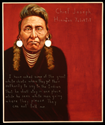
View artist Robert Shetterly's painting of Chief Joseph in the Virtual Gallery.

"The Earth is the mother of all people and all people should have equal rights upon it."
FREEDOM HERO:
CHIEF JOSEPH

by Jennifer Beck


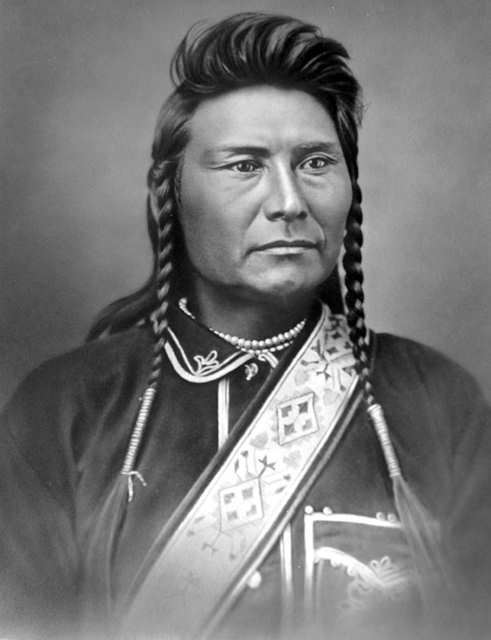
Chief Joseph was the leader of the Wallowa band of the Nez Perce Indian tribe during its desperate, daring war with the United States in 1877. A noted orator, the great chief's eloquent attempts at achieving peace between Native Americans and white settlers would fall on deaf ears in the days of Gold Rush fever and rapid western expansion. Chief Joseph was born in 1840 in the Wallowa Valley located in what's now called northeastern Oregon. He was given the tribal name of Hin-mah-too-yah-lat-kekeht ('Thunder Rolling in the Mountain'), but was baptized 'Joseph,' the name white missionaries had given his father (Old Joseph) upon his baptism and conversion to Christianity in 1838.

The Nez Perce, or 'Pierced Noses,' (named for their habit of wearing shells through their noses) had always maintained good relations with whites since their first meeting with famed explorers Lewis and Clark in 1805. The tribe welcomed the travelers so warmly that Meriwether Lewis would later call them, "among the most amiable men we have seen."

In 1855, in a spirit of peaceful coexistence Old Joseph, along with several other Nez Perce chiefs, signed a treaty with the U.S. government. In it, the Nez Perce agreed to give up a portion of their tribal lands in return for a guarantee whites would not encroach upon the sacred Wallowa Valley.
Wallowa River Valley, Oregon

But when gold was found there in 1860, the deal was broken. White settlers came in droves. In 1863, the U.S. government offered up a new treaty, one which would take away Nez Perce control of the valley and confine the entire tribal nation to a 10,000-acre reservation in Idaho. Although many Nez Perce chiefs signed, Old Chief Joseph flatly refused. He tore up his Bible and returned to traditional tribal ways, utterly disillusioned with the white man.

Upon his death in 1871, Old Chief Joseph's standoff with the U.S. government became Young Chief Joseph's battle. Joseph would forever remember his father's last words: "This country holds your father's body. Never sell the bones of your father and your mother."

From 1871 to 1876, Joseph maintained a tenuous peace between his tribesmen and the ever-expanding white population. But in 1877, when two settlers murdered a young Nez Perce man, things reached a boiling point. The U.S. government intervened before violence could erupt and issued Chief Joseph an ultimatum. He was to leave the Wallowa Valley voluntarily or be forced out by army troops. Believing resistance would cost lives and prove futile, Joseph led his people away from their homeland and toward the reservation in Idaho.

Chief Joseph
But the peaceful trek Joseph had anticipated was not to be. During the journey some young Nez Perce warriors broke away from the band and attacked a settlement, killing several whites. The news spread fast. Troops were dispatched under Cavalry Commander David Perry, and on June 17, his men attacked the tribe in White Bird Canyon. The Nez Perce proved formidable foes and excellent marksmen. In the end, Perry retreated, having lost 34 men. The Nez Perce had lost none.
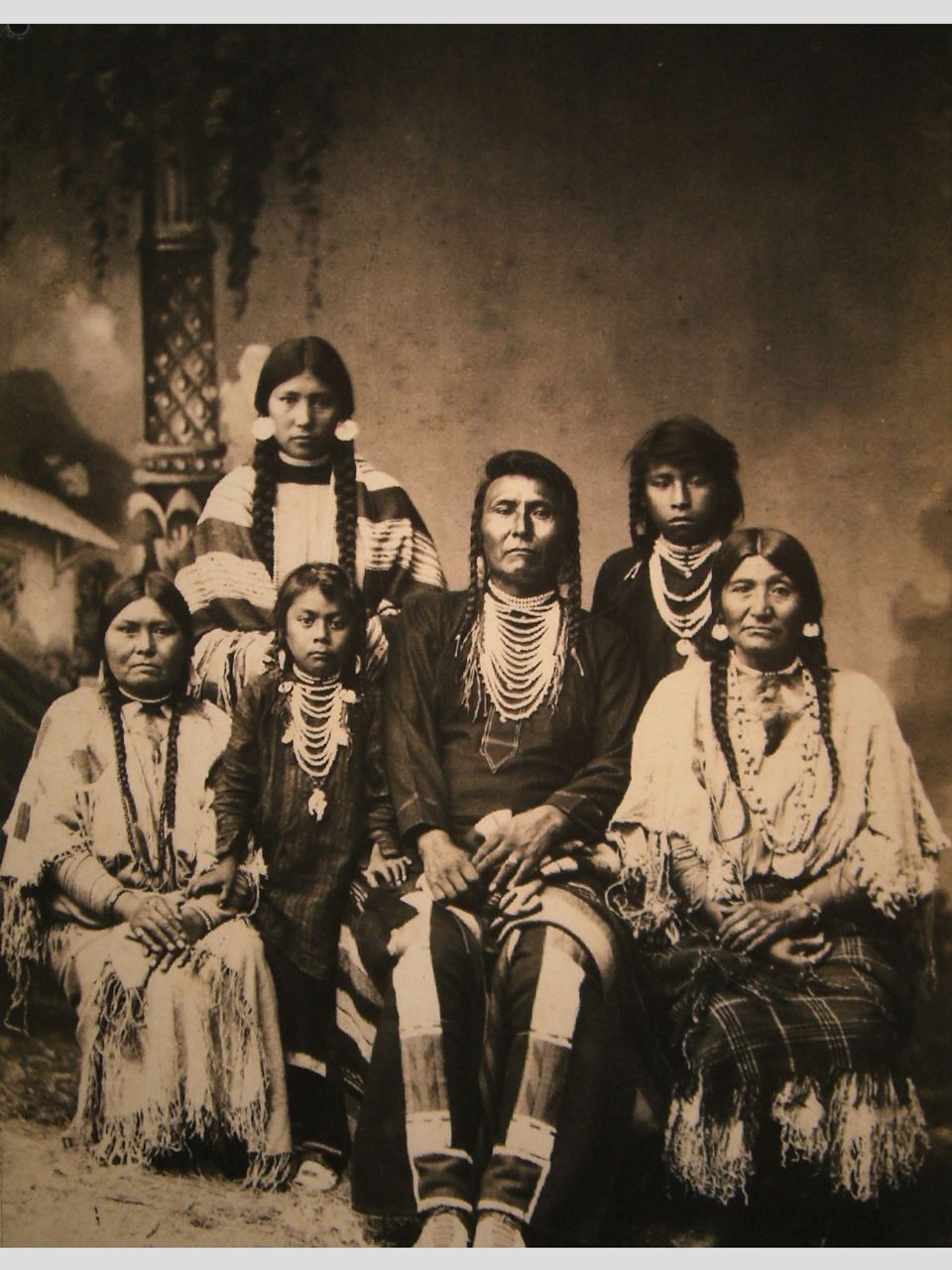

Colville Indian Reservation ca. 1901
Chief Joseph knew that while they had won the battle, they could never win a war against the U.S. government. Of the 700 people in his band, only 200 were warriors. The U.S. Army had thousands, and they would just keep coming. Chief Joseph knew he had to find safety for his people. That night the tribe set out for the Canadian border, nearly 1,500 miles away.

Joseph was right; the U.S. troops did not give up. Over the next three months, the Nez Perce held off U.S. troops in a series of battles and skirmishes that would gain them national press attention for their skill and bravery. On October 5, 1877, Joseph and his band were cornered by U.S. troops just 40 miles from the Canadian border. Three hundred managed to escape, but eighty-seven were killed. Joseph and the rest surrendered and were exiled to the Indian territory of Kansas.

Joseph's grave marker at Wallowa Lake, Oregon
Even in defeat Joseph continued to fight for his people. An eloquent speaker and writer, he wrote letters to government officials as high up as President Rutherford B. Hayes, asking them to allow his people to return to their homeland. Finally, in 1880, the 268 surviving Nez Perce were allowed to return to the northwest, but to the Colville Reservation in Washington, not to the Wallowa Valley.

In 1904, Chief Joseph died on the Colville Reservation, according to his doctor, of a broken heart. But the great chief's spirit lives on through his words and their timeless message. "Treat all men alike," Joseph wrote. "I believe much trouble would be saved if we opened our hearts more."

Written by Jennifer Beck
Photos courtesy of Edward H. Latham; Milton Loryea; Linda Eythchison


RELATED LINKS

Chief Joseph's Most Famous Speech
Read Chief Joseph's 1879 speech at Lincoln Hall in Washington which focuses on equal rights for all people.

Chief Joseph Biography and Quotations
Contains a brief biography of Chief Joseph along with many of his famous quotes.

American Indians of the Pacific Northwest
Find information on the Nez Perce and Chief Joseph as well as other tribes and chiefs of the Pacific Northwest.

PBS 'Perspectives on the West' Series
An on-line series produced by public television including essays on famous people, places, and events of the Old West

EXTRA INFORMATION

Bibliography

"Nez Perce." Encarta Encyclopedia online

"Chief Joseph." Encarta Encyclopedia online

PBS "Perspectives on the West." 2 May. 2001. .

Beal, Merrill D. Chief Joseph and the Nez Perce War. Seattle: University of Washington Press, 1963.

Gridley, M. Kopet. A Documentary Narrative of Chief Joseph's Last Years. Seattle and London: University of Washington Press, 1981.

Josephy, Alvin M., Jr. The Nex Perce Indians and the Opening of the West Boston, New York: Houghton Mifflin Company, 1997.

Joseph, Nez Perce Chief. Chief Joseph's Own Story. Fairfield, Washington: Ye Galleon Press, 1984.


 
RECOMMENDED READING

Chief Joseph and the Nez Perces: A Photographic History

by Bill Moeller, Jan Moeller, Dan Greer (Editor)


More Featured Freedom Heroes

Abraham Lincoln was a U.S president who fought for the abolition of slavery while keeping the country united.Alexander Solzhenitsyn was a Russian novelist and dissident who won the Nobel Prize for Literature.Angela Davis is a
leader, author, and
professor who has fought for decades
for human rights.
Art Miki founded the National Association for Japanese Canadians to help redress Japanese rights lost during WWII.
Aung San Suu Kyi has dedicated her life to freeing Burma from a repressive dictatorship and creating democracy without violence.Bill Bradley once a pro-basketball player now is a politician who advocates reform to make America better for all.Cesar Chavez was a tireless advocate for migrant farm workers.Chief Joseph led the Nez Perce tribe in an effort to keep its homeland.
Clara Shortridge Foltz was the first woman to practice law in California.Constance Motley became the first African-American woman judge on the largest federal trial bench in the US.Craig Kielburger believes kids can change the world.Crazy Horse bravely fought for the freedom of the Sioux Nation.
Daniel Pearl was a Wall Street Journal reporter who reported the news with courage, integrity, and intelligence. Deborah Sampson  dressed as a man so that she could fight in America's Revolutionary War.Declaration of Human Rights  established the basis for human rights beliefs and practices
all over the world.
Desmond Tutu worked to end apartheid in South Africa.
Dr. Martin
Luther King, Jr.
"I Have a Dream"
 was the civil rights speech that moved the world
Dr. Martin Luther King, Jr. 
Congressman John Lewis talks about how Martin Luther King, Jr. inspired him as a young man during the Civil Rights Movement
Dr. Oscar Elias Biscet 
is known as the 'Mandela of Cuba' because he bravely defends the rights of Cuban citizens.
Eleanor Roosevelt was a champion for freedom and devoted her life to gaining rights for others
Eleanor Roosevelt was a dedicated and strong voice for her husband, FDR, and for the United States.Elizabeth Cady Stanton was a pioneer in the movement for women's rights.Ellen Johnson-Sirleaf is a leader who is bringing change and hope to Liberia.Emmeline Pankhurst fought tirelessly for
women's suffrage,
and succeeded.
Fadela Amara is recognized throughout France as a champion of women's rights.Frances Ellen Watkins was a prolific author and poet who devoted her life to speaking out against slavery. Fred Korematsu bravely protested the Japanese-American internment.Frederick Douglass courageously spoke out against slavery and became a trusted advisor to Abraham Lincoln.
George Washington  was the first President of the United States.Harriet Tubman organized the Underground Railroad and helped lead slaves to freedom.Inez Milholland Boissevain : a brief but spectacular life dedicated to women's suffrage.Inge Sargent is a Burmese princess devoted to human rights for all.
Iqbal Masih 
was a brave advocate for child labor laws in Pakistan.
James Reeb risked his own life as a brave civil rights crusader.Jane Akre & Steve Wilson  won the 2001 Goldman Environmental Prize for their courageous journalism.Janet Jagan was the first female president of Guyana and dedicated her life to building the independence of a nation.
Jessie Daniel Ames worked openly and actively on behalf of racial justice.John Adams  worked as hard for peace for the United States as he did for its independence.John Lewis has worked for civil rights for all for over 40 years.Jose Manuel Ramos-Horta is Kerry Kennedy's hero because of his human rights work in East Timor.
Jose Marti is considered the father of Cuba's battle for independence.Joseph Ki-Zerbo 
works to help
Africans retain
control of their
country's agriculture.
Joséphine Baker , popular African American dancer in France, fought for civil rights and freedom against the Nazis.Judy Feld Carr secretly helped thousands of Jews escape from Syria.
Kailash Satyarthi  is determined to end child labor practices around the world. Kofi Annan  is an honored freedom and peacemaker hero.Lyndon B. Johnson was John's great grandfather and the 36th President of the United States.Malcolm Little known as Malcom X, was a warrior in the fight against racism.
Marian Wright Edelman  is one of the country's leading advocates for children. Martin Luther King, Jr. Peaceful freedom fighter and civil rights activistMary Harris Jones  worked to free men, women, and children from industrial slavery.Medgar Wiley Evers 
worked to end
racism in America
Mohammad Hatta was a central figure in Indonesia's fight for independence.Mohandas K. Gandhi used non-violence to free India from British rule.Morris Seligman Dees  is the co-founder of the Southern Poverty Law Center.Moses  led the Jews from slavery and gave them religious laws.
Nellie McClung believed in equal rights for all womenNelson Mandela  is a peacemaker and a freedom hero.Nelson Mandela is Muhammad Ali's hero because he understands what it means to fight against enormous oddsOsceola  led the Seminoles in their battle for independence.
Paul Revere risked his life for the freedom of the American colonies.Qasim Amin
 was a forerunner in the fight for women’s liberation in the Islamic world.
Quaid-E-Azam  helped to create the nation of Pakistan and obtain significant political rights for MuslimsRAWA promotes women's rights through non-violent action.
Rev. James Reeb worked for equal rights for allReverend Peter Nguyen Van Hung works to end human trafficking of Vietnamese women workers and brides.Robert F. Kennedy was a voice for the powerless and advocate for human rights.Roger Nash Baldwin A pioneer in the struggle for civil justice.
Rosa Parks   made history when she refused to sit in the back of the bus.Ruby Bridges 
bravely led the way
to desegregation
of schools as a
child.
Sir William Wallace  was a freedom-fighter for the Scottish people in the early 1300s.Sojourner Truth  born into slavery, worked for the freedom of all.
Susan B. Anthony  led the early Women's Suffrage Movement.Susie King Taylor 
was a pioneer in the struggle for African American women's rights.
The Dalai Lama is the religious leader of Tibet and an emblem of Tibet's hopes for freedom.The Greensboro Four protested segregation with a sit-in at Woolworth's lunch counter.
The Little Rock Nine
 bravely fought discrimination to attend an all white high school in Little Rock, Arkansas.
Thomas Jefferson  helped the American Colonies achieve independence from Britain.Thurgood Marshall 
was the first
African-American
to serve on the
U.S. Supreme Court.
Tiananmen Square 
discuss freedom and democracy at Tian An Min Square.
Vaclav Havel despite censorship, wrote plays that helped keep the hope of freedom alive....Varian Fry helped thousands of refugees escape from France during WWII.W.E.B. Dubois  was a leading 19th century writer and scholar.William Wallace was a late 13th century freedom fighter for Scotland and Ireland
   
Winston Churchill was one of the first to recognize and warn others of Hitler's danger to freedom and human rights.   


Last changed on:6/11/2007 2:57:31 PM