Print-Friendly Version


Jesica P. from Montvale writes:

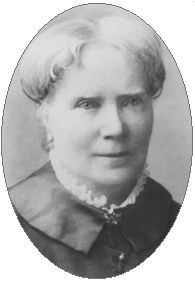
Elizabeth Blackwell was born on Feb. 3, 1821 in Bristol, England. In order to support her family when her father died, Elizabeth, along with her sisters and mother, opened up a small private school. Elizabeth's first job was as a teacher, which she didn't like.

That was when she decided to become a doctor. She applied to many medical schools, including Harvard, Yale and Bowdoin. Sadly, all her applications were turned down, because at that time, only men were doctors. When she was finally accepted, the students and professors were cruel to her because she was the only woman at the school.

For the first time, Elizabeth practiced medicine at a summer program in 1848 at the Philadelphia Hospital in Pennsylvania. The young physicians there were cruel as well and offered her no assistance. Elizabeth graduated from Geneva in 1849.

While she was in Europe, she got a horrible disease called opthalmia, which left her blind in one eye. She then adopted an orphan.

Elizabeth helped do many things, such as establishing a Health Society in 1871. Elizabeth died at her home in Hastings, England, on May 31, 1910.

I do not wish to give [women] a first place, still less a second one--but the most complete freedom to take their true place whatever it may be...

FREEDOM HERO:
ELIZABETH BLACKWELL

by Tahrin and Brooke

Born on Feb. 3, 1821, in Bristol, England, Elizabeth Blackwell was one of nine children. Her mother, Hannah, and father, Samuel, were very generous and considerate people. Her father owned a sugar refinery business. He had always encouraged his children to make their own opportunities. Samuel had every one of his children educated so that in case a chance was handed to them, they could make use of their knowledge. When Elizabeth was seven or eight, Samuel was unable to pay the taxes. The family was then kicked out of their home. They moved to New York City in 1832, where the family was active in the abolitionist movement.

In 1838 the Blackwells moved to Cincinnati, Ohio. A few months later, when Elizabeth was 17, her father passed away. To help support the family, she and her sister established a boarding school for girls. A dying friend named Mary Donaldson suggested that she become a doctor. Blackwell probably thought that would be perfect, because when she was younger she said that she'd be "something hard". All her life she pushed herself and wouldn't stop until she was really satisfied. She was always independent and wished to do things on her own. However, at that time, women were welcomed as seamstresses, nurses, or teachers, but never as doctors. Blackwell soon discovered that the challenging task of becoming a doctor would be a lot harder than she ever imagined.

It was in 1844 that Blackwell convinced herself that she was going to become a medical doctor. The way she began her studies was by reading medical books. Later on, she received private instruction from Samuel H. Dickinson of Charleston (S.C.) Medical College, along with a few other professors and doctors. Because no school would admit her, Blackwell's only choice at that point was private schooling.

Rejections to her applications piled up and up like winter snow. One of the rejections gave her an idea: she should dress up as a man. Even though it sounds dumb, Blackwell decided to give it a try. The school let her study anatomy, but they wouldn't allow "him" to earn a degree. Strong-willed Blackwell tried again, but was once more denied. So many doors were closed simply because she was female. She truly wished to become a doctor with all her heart, and was not about to let that fact stop her from achieving something she desired. Twenty-nine schools turned her down.

Finally, in 1847, she was admitted into a New York college, only to discover that she had been admitted as a joke. At Geneva Medical College (now Hobart and William Smith Colleges) she suffered social ostracism, criticism and ridicule. Other women, walking past her on the street, wouldn't allow any part of themselves to touch her, or they'd talk about her in disgust. Whenever she'd approach the table, everyone would hush and ignore her presence.

Despite constant slights and embarrassments, Blackwell continued her studies and in 1849 graduated at the top of her class. On Nov. 6, 1847, Elizabeth was accepted to Geneva Medical College in Paris. Many schools before that had denied her, but Geneva College accepted her and she was the only woman as a doctor-in-training. She stayed at Geneva for two years and graduated at 26 with special recognition. But Paris doctors proved to be as intolerant as her American colleagues. They wouldn't permit her to practice as a doctor, so she was forced to enter a large maternity hospital, La Maternité, as a student midwife. On Sunday, Nov. 4, 1849, Blackwell was syringing the eye of a baby boy. The patient had purulent ophthalmia, a horrible eye disease. Some of the contaminated water spurted from his eye to Blackwell’s eye. Later, her eye was removed because she had caught the same disease as the baby had. Her eye was replaced by a glass eye. After that she went to London to continue her studies.

After Blackwell returned to New York in 1851, hospitals still wouldn't allow her to work. Male doctors ignored her, many hospitals wouldn't let her into the wards, and she had very few patients. She was barred from practice in most European and American hospitals.

After American hospitals refused to hire her, she opened a clinic in New York City, where she was joined by her sister, Dr. Emily Blackwell, and Dr. Marie E. Zakrzewska. This infirmary was in a small room near Tompkins Square. She received patients three afternoons a week. The majority of the patients were poor immigrants. She taught them the importance of sanitation and gave them medical counsel. She taught them these things and counseled them not because she wanted their money, but because she thought it was necessary. Elizabeth became lonely, so she adopted a thin, red-headed, Irish seven-year old child named Kitty.

Along with other women who became doctors and several other tolerant Quakers, Blackwell started the New York Infirmary for Indigent Woman and Children, staffed entirely by women. The infirmary formally opened on May 12, 1857. The hospital only charged its patients four dollars a week and didn't charge if they could not afford it. Therefore it was always in financial need.

It took lots of work on Blackwell’s part to open the New York Infirmary for Women and Children. Elizabeth, Emily, Dr. Zakrzewska, and many nurses all worked in the infirmary. The infirmary had many hard years. Crowds of family members and/or friends, of patients who died, would accuse them of killing the patients. They said that women weren’t fit for being doctors, and that was the reason their family members and/or friends died. Elizabeth traveled for a few years, but started working at the infirmary again in the beginning of the Civil War.

Eventually, Elizabeth earned the respect of her colleagues and the community. Her leadership in meeting the medical problems presented by the Civil War won her recognition. In 1868, Elizabeth and Emily Blackwell opened a medical college for women which they ran in the hospital. The high-quality institution remained open until 1899, when women were first allowed to enter the Cornell University Medical School.

In 1869, Elizabeth returned to London and maintained a large practice. She was one of the founders of the National Health Society of London and of the London Medical School for Women, where she was Professor of Gynecology from 1875 to 1907. Dr. Blackwell wrote and lectured, too. A series of lectures which she delivered in England in 1859 brought her great recognition in Britain. Her lectures and books dealt mostly with social hygiene and with preventive medicine. Some of the books she wrote are "The Physical Education of Girls" (1852) and "Pioneer Work in Opening the Medical Profession to Woman" (1895).

In one of her favorite works, Elizabeth said, "The idea of winning a doctor's degree gradually assumed the aspect of a great moral struggle, and the moral fight possessed immense attraction for me." She wrote many books and papers on health and education.

She was also in the middle of writing an autobiography, but was unable to complete it. Dr. Blackwell passed away on May 31, 1910, in her home in Hastings, England, at age 89.

Written by Tahrin and Brooke from Montvale, New Jersey


RELATED LINKS

Read another Elizabeth Blackwood tribute page on My Hero written by Rebecca from Fredericksburg

San José State University Virtual Museum Contains biographical information on great people in science and medicine.

Women's History The Library of Congress' women's history site.

The National Women's Hall of Fame

EXTRA INFORMATION


RECOMMENDED READING

Elizabeth Blackwell : Girl Doctor

by Joanne Landers Henry

Elizabeth Blackwell: First Woman Doctor to Modern Times

by Adele Glimm

Elizabeth Blackwell: Physician (American Women of Achievement Series)

by Jordan Brown

Elizabeth Blackwell: The First Woman Doctor (Gateway Biographies)

by Ira Peck


More Featured Freedom Heroes

Abraham Lincoln was a U.S president who fought for the abolition of slavery while keeping the country united.Alexander Solzhenitsyn was a Russian novelist and dissident who won the Nobel Prize for Literature.Angela Davis is a
leader, author, and
professor who has fought for decades
for human rights.
Art Miki founded the National Association for Japanese Canadians to help redress Japanese rights lost during WWII.
Aung San Suu Kyi has dedicated her life to freeing Burma from a repressive dictatorship and creating democracy without violence.Bill Bradley once a pro-basketball player now is a politician who advocates reform to make America better for all.Cesar Chavez was a tireless advocate for migrant farm workers.Chief Joseph led the Nez Perce tribe in an effort to keep its homeland.
Clara Shortridge Foltz was the first woman to practice law in California.Constance Motley became the first African-American woman judge on the largest federal trial bench in the US.Craig Kielburger believes kids can change the world.Crazy Horse bravely fought for the freedom of the Sioux Nation.
Daniel Pearl was a Wall Street Journal reporter who reported the news with courage, integrity, and intelligence. Deborah Sampson  dressed as a man so that she could fight in America's Revolutionary War.Declaration of Human Rights  established the basis for human rights beliefs and practices
all over the world.
Desmond Tutu worked to end apartheid in South Africa.
Dr. Martin
Luther King, Jr.
"I Have a Dream"
 was the civil rights speech that moved the world
Dr. Martin Luther King, Jr. 
Congressman John Lewis talks about how Martin Luther King, Jr. inspired him as a young man during the Civil Rights Movement
Dr. Oscar Elias Biscet 
is known as the 'Mandela of Cuba' because he bravely defends the rights of Cuban citizens.
Eleanor Roosevelt was a champion for freedom and devoted her life to gaining rights for others
Eleanor Roosevelt was a dedicated and strong voice for her husband, FDR, and for the United States.Elizabeth Cady Stanton was a pioneer in the movement for women's rights.Ellen Johnson-Sirleaf is a leader who is bringing change and hope to Liberia.Emmeline Pankhurst fought tirelessly for
women's suffrage,
and succeeded.
Fadela Amara is recognized throughout France as a champion of women's rights.Frances Ellen Watkins was a prolific author and poet who devoted her life to speaking out against slavery. Fred Korematsu bravely protested the Japanese-American internment.Frederick Douglass courageously spoke out against slavery and became a trusted advisor to Abraham Lincoln.
George Washington  was the first President of the United States.Harriet Tubman organized the Underground Railroad and helped lead slaves to freedom.Inez Milholland Boissevain : a brief but spectacular life dedicated to women's suffrage.Inge Sargent is a Burmese princess devoted to human rights for all.
Iqbal Masih 
was a brave advocate for child labor laws in Pakistan.
James Reeb risked his own life as a brave civil rights crusader.Jane Akre & Steve Wilson  won the 2001 Goldman Environmental Prize for their courageous journalism.Janet Jagan was the first female president of Guyana and dedicated her life to building the independence of a nation.
Jessie Daniel Ames worked openly and actively on behalf of racial justice.John Adams  worked as hard for peace for the United States as he did for its independence.John Lewis has worked for civil rights for all for over 40 years.Jose Manuel Ramos-Horta is Kerry Kennedy's hero because of his human rights work in East Timor.
Jose Marti is considered the father of Cuba's battle for independence.Joseph Ki-Zerbo 
works to help
Africans retain
control of their
country's agriculture.
Joséphine Baker , popular African American dancer in France, fought for civil rights and freedom against the Nazis.Judy Feld Carr secretly helped thousands of Jews escape from Syria.
Kailash Satyarthi  is determined to end child labor practices around the world. Kofi Annan  is an honored freedom and peacemaker hero.Lyndon B. Johnson was John's great grandfather and the 36th President of the United States.Malcolm Little known as Malcom X, was a warrior in the fight against racism.
Marian Wright Edelman  is one of the country's leading advocates for children. Martin Luther King, Jr. Peaceful freedom fighter and civil rights activistMary Harris Jones  worked to free men, women, and children from industrial slavery.Medgar Wiley Evers 
worked to end
racism in America
Mohammad Hatta was a central figure in Indonesia's fight for independence.Mohandas K. Gandhi used non-violence to free India from British rule.Morris Seligman Dees  is the co-founder of the Southern Poverty Law Center.Moses  led the Jews from slavery and gave them religious laws.
Nellie McClung believed in equal rights for all womenNelson Mandela  is a peacemaker and a freedom hero.Nelson Mandela is Muhammad Ali's hero because he understands what it means to fight against enormous oddsOsceola  led the Seminoles in their battle for independence.
Paul Revere risked his life for the freedom of the American colonies.Qasim Amin
 was a forerunner in the fight for women’s liberation in the Islamic world.
Quaid-E-Azam  helped to create the nation of Pakistan and obtain significant political rights for MuslimsRAWA promotes women's rights through non-violent action.
Rev. James Reeb worked for equal rights for allReverend Peter Nguyen Van Hung works to end human trafficking of Vietnamese women workers and brides.Robert F. Kennedy was a voice for the powerless and advocate for human rights.Roger Nash Baldwin A pioneer in the struggle for civil justice.
Rosa Parks   made history when she refused to sit in the back of the bus.Ruby Bridges 
bravely led the way
to desegregation
of schools as a
child.
Sir William Wallace  was a freedom-fighter for the Scottish people in the early 1300s.Sojourner Truth  born into slavery, worked for the freedom of all.
Susan B. Anthony  led the early Women's Suffrage Movement.Susie King Taylor 
was a pioneer in the struggle for African American women's rights.
The Dalai Lama is the religious leader of Tibet and an emblem of Tibet's hopes for freedom.The Greensboro Four protested segregation with a sit-in at Woolworth's lunch counter.
The Little Rock Nine
 bravely fought discrimination to attend an all white high school in Little Rock, Arkansas.
Thomas Jefferson  helped the American Colonies achieve independence from Britain.Thurgood Marshall 
was the first
African-American
to serve on the
U.S. Supreme Court.
Tiananmen Square 
discuss freedom and democracy at Tian An Min Square.
Vaclav Havel despite censorship, wrote plays that helped keep the hope of freedom alive....Varian Fry helped thousands of refugees escape from France during WWII.W.E.B. Dubois  was a leading 19th century writer and scholar.William Wallace was a late 13th century freedom fighter for Scotland and Ireland
   
Winston Churchill was one of the first to recognize and warn others of Hitler's danger to freedom and human rights.   


Last changed on:6/28/2004 10:11:27 PM