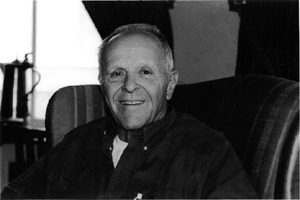
In 1992, Henry Buhl did not consider himself a philanthropist. He had spent 30 years in investment banking, followed by a career in professional photography. However, at the age of 62, this was all about to change.
Buhl was on his way back from lunch one afternoon when a man he recognized as a former street sweeper begged him for $20. Buhl discovered the man had been fired for sleeping on the job and decided to investigate the matter further.
 |
He discovered that the 12 stores up and down the street had been paying this man at the direction of real estate tycoon Tony Goldman. Goldman did not have the time to find someone else for the job so Buhl volunteered to get somebody. He went to the Bowery Residence Committee (BRC), a tax-funded operation providing homeless shelters throughout the city. Buhl says he asked the executive director if he could have one of his guys to sweep the streets. "If he does a good job sweeping, and does not go to the local bar and pass out every afternoon, then we will try to get him a job," Buhl told the director.
The executive director received the offer with enthusiasm and recommended two people. Buhl returned to SoHo and found another block where the stores were willing to pay for a street sweeper. "The executive director threw up his hands and said 'Hallelujah,! You could be my savior,'" Buhl recalls.
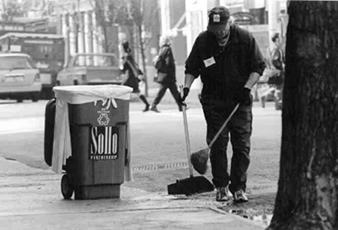 |
Buhl set up the SoHo Partnership in 1992, dedicated "to provide employment readiness training and job placement to New York City recovering homeless individuals through community improvement projects in SoHo." The work and learn program is called Project Comeback. A homeless person enrolled in the program has to do much more than just sweep streets. According to Buhl, they must work 20-24 hours per week on tasks such as tree maintenance, graffiti removal, snow clearance, and street sweeping. In addition, they must attend literacy, computer, and money management classes. They also learn how to write a cover letter and resume and go through between five and fifteen mock interviews in preparation for the job hunt.
"The program pays $6 per hour, of which 85 cents is placed into a Chase Manhattan Bank fee-free savings account," says Buhl. The purpose of this is for the enrollees to have money for a down payment on an apartment after they leave the shelters, Buhl says. Most people leave the shelters about six months after graduation.
In 1999, the SoHo Partnership created Project Stay, an after-care program to assist graduates with different aspects of work, family and social life, and to support their ability to stay employed. According to Buhl, this extensive after-care program is the reason why so many graduates are able to keep their jobs.
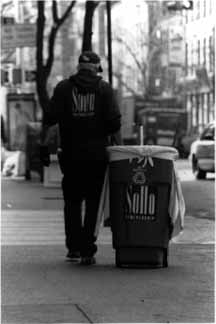 |
Andrew Hager, who has been enrolled in the program for five and one-half months and is looking forward to graduation, likes the classes that go along with the program. Hager is currently working on his cover letter and will soon be seeking a permanent job.
"Not everyone graduates," says Buhl. Nevertheless, roughly 70% find entry-level jobs at the end of the 6-9 month period. "Every other training program will tell you that same statistic," says Buhl, adding that the difference with Project Comeback is that "over 80% of all the people we get jobs for have them one year or longer."
Because the program is privately funded, raising money has become an important task for Buhl. Much of his money comes from the businesses and residents who are members of the SoHo Partnership. Businesses annually pay $400 to $600 for membership, and residents from $60 to $120. Being a business member has several benefits. These include free advertising on the Web site, a discount on advertising in the SoHo guide, and up to five free SoHoTriBeCa Shopping cards. American Express prints this shopping card for the partnership, the partnership sells it for $25, and the cardholders get discounts at 150 stores and restaurants throughout the year. The "guides" are information books about the SoHo and Tribeca communities and sell for $18 and $12 respectively.
Project Comeback and Project Stay have established partnership groups in TriBeCa and Hudson Square in New York City and SoMa (South of Market) in San Francisco. Eight other cities are also interested in Project Comeback, including San Diego, Seattle, Portland, Miami, and Pittsburgh.
Page created on 11/12/2007 8:38:30 AM
Last edited 1/4/2017 10:29:57 PM