Print-Friendly Version


Few will have the greatness to bend history; but each of us can work to change a small portion of events, and in the total of all those acts will be written the history of this generation ... It is from numberless diverse acts of courage and belief that human history is thus shaped. Each time a man stands up for an ideal, or acts to improve the lot of others, or strikes out against injustice, he sends forth a tiny ripple of hope...

Robert F. Kennedy
Day of Affirmation Address, University of Capetown, South Africa, June 6, 1966


FREEDOM HERO:
ROBERT F. KENNEDY

by Richard Kent

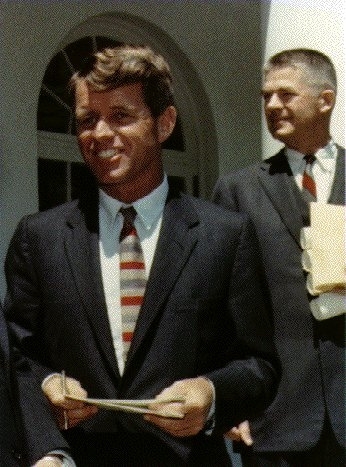
Attorney General of the United States Robert F. Kennedy, Solicitor General Archibald Cox in background, May 7, 1963. White House, Stoughton.
Photo courtesy of John F. Kennedy Library and Museum

It was a chilly fall day in 1959 in New Haven, Connecticut. I lived about three blocks from Mayor Richard C. Lee. He was a rather influential mayor nationally and had just become the first major mayor to endorse the presidential candidacy of John F. Kennedy. I didn’t know much about Kennedy or his family, but I did remember reading about the endorsement in the New Haven Register. I believe the day in question was a Saturday and a few of my friends came over on their bikes and indicated to me that some sort of celebrity was at Mayor Lee’s house.

We all got on our bikes and rode over to the Mayor’s house. There was a man there who appeared to be in his late twenties in a convertible. He was casually dressed and had a “Kennedy for President” bumper sticker on his car. None of us had any idea who he was.

After a few minutes, a crowd of about ten or so people had built up on McKinley Avenue in New Haven and we all wanted to find out who this person was. We were told that his name was Robert F. Kennedy and that he was John F. Kennedy’s brother and someone who would be very influential in his presidential campaign. One of us had a football with us and I remember very distinctly that when he came out of Mayor Lee’s house, Robert Kennedy threw the football around to all of us. He treated us like his peers and seemed like a really cool guy. I made a mental note that I would probably be reading about him in the not-too-distant future.

When I got home I was going through some papers and realized that I had gone to see a movie a year or so earlier called Point of Order at the small and cozy Lincoln Theatre in New Haven. The movie was about the McCarthy Era and one of its component parts was the role that Robert F. Kennedy played during the McCarthy hearings. I then was able to put a face together with a piece of historical perspective.

Robert Francis Kennedy was born on November 20, 1925 in Brookline, Massachusetts, the seventh child of the Rose and Joseph P. Kennedy family. He was the seventh of nine children and later recalled that “when you come from that far down, you have to struggle to survive.”

Kennedy attended Milton Academy and after wartime service in the Navy, received a degree in government from Harvard University and a law degree from the University of Virginia Law School. In 1950, Kennedy married Ethel Skakel of Greenwich, Connecticut and the two of them went on to have eleven children.
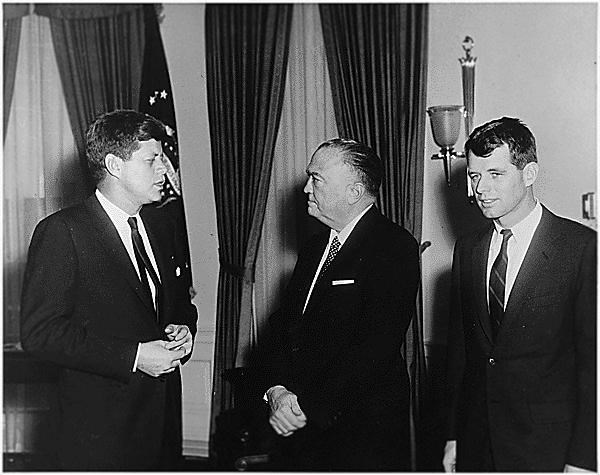
Visit of Attorney General and Director of FBI. President Kennedy, J.Edgar Hoover, Robert F. Kennedy. White House, Oval Office. 2/23/1961
Photo courtesy of John F. Kennedy Library and Museum

In 1952 he made his political debut as manager of John’s successful campaign for U.S. Senate from Massachusetts. The following year he served briefly on the staff of Senator McCarthy, but was disturbed by McCarthy’s controversial tactics and resigned from the staff after only six months. He later worked as chief counsel for the Senate Rackets Committee and investigated corruption in trade unions and, specifically, against Jimmy Hoffa. He and Hoffa were brutal lifetime enemies.

A few months after I met Kennedy, he was named the campaign manager for his brother’s presidential campaign. Kennedy beat Richard Nixon in one of the closest elections in United States history. I remember being in fifth grade at the time and we voted in class. I voted for Kennedy because I had met his brother a year earlier, but I think that Nixon was the winner in our New Haven fifth grade class at Edgewood School.

Kennedy was named by his brother as the Attorney General and waged a successful campaign against organized crime, obtaining convictions against many nationally infamous crime figures. He was also committed to the rights of African Americans to vote and attend school and in 1962 sent U.S. marshals and troops to Oxford, Mississippi to enforce a federal court order admitting the first African American student, James Meredith, to the University of Mississippi. A riot followed, but Kennedy never wavered.

He was not only his brother’s closest advisor and confidant, but played a key role in several critical foreign policy decisions, including helping to salvage the Cuban Missile Crisis.

After President Kennedy’s assassination, Kennedy resigned as Attorney General largely because of a strained relationship with then President Lyndon B. Johnson. He then moved to New York and ran for United States Senate against incumbent Kenneth Keating. Keating labeled Kennedy a carpetbagger during the closely contested campaign, but Kennedy won.

On March 18, 1968, Kennedy announced his candidacy for the Democratic presidential nomination. He took over the lead in that race after winning the California primary on June 5, 1968, but on that evening, at the Ambassador Hotel in Los Angeles, California, was assassinated by Sirhan Sirhan at the tender age of forty-two years. That is where my life, once again, connected with the life of then Senator Kennedy. The next day was my high school graduation from Hamden Hall Country Day School. Our speaker was the President of William Smith College in New York. I idolized Kennedy and had worked for his presidential campaign throughout 1968, having an opportunity to once again meet him in New Haven in March of that year when he came for a campaign visit on Church Street in downtown New Haven. When I woke up on the morning of my high school graduation, I was hugely excited about the graduation, but as soon as I heard about Kennedy’s assassination, our graduation turned awful. I know that the school toyed with the idea of postponing the graduation, but the graduation took place and our graduation speaker had to totally adjust his speech from a speech about education to a speech about Kennedy’s life. It was very moving and has stayed with me to this date. So has the memory of Robert F. Kennedy, one of the greatest Americans of all time.

Written by Richard Kent
Photos courtesy of John F. Kennedy Library and Museum


RELATED LINKS

Robert F. Kennedy Memorial

John F. Kennedy Library and Museum Read selected speeches by Robert F. Kennedy.

Bedford-Stuyvesant Restoration Corporation This model program was established by local activists and crafted into legislation by Senators RFK and Jacob Javits to improve living conditions and employment opportunites in depressed areas of Brooklyn.

Robert F. Kennedy, Jr. Read MY HERO's story about Robert Kennedy's son and his work to protect the environment.

Robert F. Kennedy Children's Action Corps., Inc. was founded by a group of private citizens who desired to perpetuate the social values RFK exemplified during his lifetime. The organization provides services to at-risk youth in Massachusetts.

EXTRA INFORMATION

"
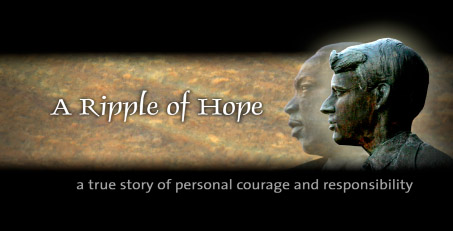
A Ripple of Hope
Produced and Directed by Donald Boggs
Covenant Productions

“Each time a man stands up for an ideal, or acts to improve the lot of others, or strikes out against injustice, he sends forth a tiny ripple of hope, and crossing each other from a million different centers of energy and daring those ripples build a current which can sweep down the mightiest walls of oppression and resistance." Robert Kennedy, June 1966

A generation after his death, the words of Robert Kennedy continue to speak to our political and popular culture. The independent documentary, A Ripple of Hope produced by Covenant Productions captures one poignant day in the life of RFK and explores a little known act of personal courage and responsibility.

On April 4th, 1968 the day Martin Luther King Jr. was assassinated, Robert Kennedy was in the midst of a presidential campaign that was attempting to bridge racial and economic divisions. As word of the assassination spread, riots and fires erupted in cities across the nation. Urged to cancel a rally before a mixed crowd in the inner city of Indianapolis, Robert Kennedy refused. The threat of violence was very real. But the few, simple words he spoke that night are credited with creating a sense of calm that settled over those neighborhoods during chaotic days following Dr. King’s death.

A Ripple of Hope dramatically retells the events of that tragic day 40 years ago thru the eyes of those who were there. With original music by John Colby, the Grammy Award winning composer of the Ken Burns Civil War soundtrack, audiences have been inspired and challenged by a single dream shared by two very different men. Robert Kennedy’s words that night are remarkably relevant today. From the inner city of Indianapolis to a Memphis Hotel, A Ripple of Hope explores the passion for justice, and the personal courage that linked these two extraordinary figures in life as well as death. A Ripple of Hope was produced and directed by award winning filmmaker Donald Boggs.

RIPPLE OF HOPE
Covenant Productions
1100 East Fifth Street
Anderson, IN 46012
765-641-4348 |
gm@covenantproductions.com


RECOMMENDED READING

In His Own Right: The Political Odyssey of Senator Robert F. Kennedy

by Joseph A. Palermo


More Featured Freedom Heroes

Abraham Lincoln was a U.S president who fought for the abolition of slavery while keeping the country united.Alexander Solzhenitsyn was a Russian novelist and dissident who won the Nobel Prize for Literature.Angela Davis is a
leader, author, and
professor who has fought for decades
for human rights.
Art Miki founded the National Association for Japanese Canadians to help redress Japanese rights lost during WWII.
Aung San Suu Kyi has dedicated her life to freeing Burma from a repressive dictatorship and creating democracy without violence.Bill Bradley once a pro-basketball player now is a politician who advocates reform to make America better for all.Cesar Chavez was a tireless advocate for migrant farm workers.Chief Joseph led the Nez Perce tribe in an effort to keep its homeland.
Clara Shortridge Foltz was the first woman to practice law in California.Constance Motley became the first African-American woman judge on the largest federal trial bench in the US.Craig Kielburger believes kids can change the world.Crazy Horse bravely fought for the freedom of the Sioux Nation.
Daniel Pearl was a Wall Street Journal reporter who reported the news with courage, integrity, and intelligence. Deborah Sampson  dressed as a man so that she could fight in America's Revolutionary War.Declaration of Human Rights  established the basis for human rights beliefs and practices
all over the world.
Desmond Tutu worked to end apartheid in South Africa.
Dr. Martin
Luther King, Jr.
"I Have a Dream"
 was the civil rights speech that moved the world
Dr. Martin Luther King, Jr. 
Congressman John Lewis talks about how Martin Luther King, Jr. inspired him as a young man during the Civil Rights Movement
Dr. Oscar Elias Biscet 
is known as the 'Mandela of Cuba' because he bravely defends the rights of Cuban citizens.
Eleanor Roosevelt was a champion for freedom and devoted her life to gaining rights for others
Eleanor Roosevelt was a dedicated and strong voice for her husband, FDR, and for the United States.Elizabeth Cady Stanton was a pioneer in the movement for women's rights.Ellen Johnson-Sirleaf is a leader who is bringing change and hope to Liberia.Emmeline Pankhurst fought tirelessly for
women's suffrage,
and succeeded.
Fadela Amara is recognized throughout France as a champion of women's rights.Frances Ellen Watkins was a prolific author and poet who devoted her life to speaking out against slavery. Fred Korematsu bravely protested the Japanese-American internment.Frederick Douglass courageously spoke out against slavery and became a trusted advisor to Abraham Lincoln.
George Washington  was the first President of the United States.Harriet Tubman organized the Underground Railroad and helped lead slaves to freedom.Inez Milholland Boissevain : a brief but spectacular life dedicated to women's suffrage.Inge Sargent is a Burmese princess devoted to human rights for all.
Iqbal Masih 
was a brave advocate for child labor laws in Pakistan.
James Reeb risked his own life as a brave civil rights crusader.Jane Akre & Steve Wilson  won the 2001 Goldman Environmental Prize for their courageous journalism.Janet Jagan was the first female president of Guyana and dedicated her life to building the independence of a nation.
Jessie Daniel Ames worked openly and actively on behalf of racial justice.John Adams  worked as hard for peace for the United States as he did for its independence.John Lewis has worked for civil rights for all for over 40 years.Jose Manuel Ramos-Horta is Kerry Kennedy's hero because of his human rights work in East Timor.
Jose Marti is considered the father of Cuba's battle for independence.Joseph Ki-Zerbo 
works to help
Africans retain
control of their
country's agriculture.
Joséphine Baker , popular African American dancer in France, fought for civil rights and freedom against the Nazis.Judy Feld Carr secretly helped thousands of Jews escape from Syria.
Kailash Satyarthi  is determined to end child labor practices around the world. Kofi Annan  is an honored freedom and peacemaker hero.Lyndon B. Johnson was John's great grandfather and the 36th President of the United States.Malcolm Little known as Malcom X, was a warrior in the fight against racism.
Marian Wright Edelman  is one of the country's leading advocates for children. Martin Luther King, Jr. Peaceful freedom fighter and civil rights activistMary Harris Jones  worked to free men, women, and children from industrial slavery.Medgar Wiley Evers 
worked to end
racism in America
Mohammad Hatta was a central figure in Indonesia's fight for independence.Mohandas K. Gandhi used non-violence to free India from British rule.Morris Seligman Dees  is the co-founder of the Southern Poverty Law Center.Moses  led the Jews from slavery and gave them religious laws.
Nellie McClung believed in equal rights for all womenNelson Mandela  is a peacemaker and a freedom hero.Nelson Mandela is Muhammad Ali's hero because he understands what it means to fight against enormous oddsOsceola  led the Seminoles in their battle for independence.
Paul Revere risked his life for the freedom of the American colonies.Qasim Amin
 was a forerunner in the fight for women’s liberation in the Islamic world.
Quaid-E-Azam  helped to create the nation of Pakistan and obtain significant political rights for MuslimsRAWA promotes women's rights through non-violent action.
Rev. James Reeb worked for equal rights for allReverend Peter Nguyen Van Hung works to end human trafficking of Vietnamese women workers and brides.Robert F. Kennedy was a voice for the powerless and advocate for human rights.Roger Nash Baldwin A pioneer in the struggle for civil justice.
Rosa Parks   made history when she refused to sit in the back of the bus.Ruby Bridges 
bravely led the way
to desegregation
of schools as a
child.
Sir William Wallace  was a freedom-fighter for the Scottish people in the early 1300s.Sojourner Truth  born into slavery, worked for the freedom of all.
Susan B. Anthony  led the early Women's Suffrage Movement.Susie King Taylor 
was a pioneer in the struggle for African American women's rights.
The Dalai Lama is the religious leader of Tibet and an emblem of Tibet's hopes for freedom.The Greensboro Four protested segregation with a sit-in at Woolworth's lunch counter.
The Little Rock Nine
 bravely fought discrimination to attend an all white high school in Little Rock, Arkansas.
Thomas Jefferson  helped the American Colonies achieve independence from Britain.Thurgood Marshall 
was the first
African-American
to serve on the
U.S. Supreme Court.
Tiananmen Square 
discuss freedom and democracy at Tian An Min Square.
Vaclav Havel despite censorship, wrote plays that helped keep the hope of freedom alive....Varian Fry helped thousands of refugees escape from France during WWII.W.E.B. Dubois  was a leading 19th century writer and scholar.William Wallace was a late 13th century freedom fighter for Scotland and Ireland
   
Winston Churchill was one of the first to recognize and warn others of Hitler's danger to freedom and human rights.   


Last changed on:4/18/2005 1:36:40 PM