 |
| Winston Churchill(http://www.britishempire.co.uk/images3/churchill.jpg) |
INTRODUCTION
"Those who do not think of the future are unworthy of their ancestors." Winston Churchill spoke these words in London on Oct. 24th, 1936, during a tribute to the Royal Marines. This statement, told to those who were prepared to fight and die for their country, foreshadowed the challenges that would face Churchill and all of England during W.W.II. The years before he led Britain to victory in this war were marked by his political isolation and an overall condemnation of his views against Britain's appeasement policy towards Germany. Although condemned, Churchill's views eventually proved well founded, but only when it was too late avoid war. The foresight and leadership that Churchill possessed helped him to become one of the greatest leaders England has seen.
THE PATH TO LEADERSHIP
One of the most important time periods in Winston Churchill's political career was when he held no high-ranking political office and most of his peers found his ideas idiotic. In fact, it was during this time of his unpopularity that he belonged to no political party. An overriding sense of contempt was held for Churchill and his opinions by his political peers. These rivals managed to keep Churchill out of power until the outbreak of W.W.II in 1939.
As Hitler's regime grew to power in Germany, Churchill was one of the few to recognize the danger of this new dictator. No one listened to Churchill's warnings, and many actually liked the new leader of Germany. As the years went by and Hitler began to carry out his destructive plans, Neville Chamberlain and the other leaders in Parliament used appeasement ideology in hope of a lasting peace in Central Europe.
Throughout the 1930s, Churchill's warnings against appeasement had grown more persistent and less effective. As the heads of Parliament veered away from traditional British military preparedness, appeasement policy became the new focus of the leading politicians. Churchill realized it was time that Britain look at its defenses, but Chamberlain, firmly convinced that there was not going to be a war, had no need for armed forces.
The appeasers, led by Chamberlain, seemed totally unaware that Hitler's plans, blueprinted in Mien Kampf, were now emerging in frightening reality. The appeasers sat idle in their ignorant hope that Hitler would eventually stop. What they did not understand was that Hitler's aim was world domination, and that standing idle and watching would not help stop him. Churchill was basically alone in his stand against appeasement.
"One pound was demanded at the pistol's point. When it was given, two pounds were demanded at the pistol's point. Finally, the dictator consented to take one pound, 17 shillings and sixpence, and the rest in promises of good will for the future."
Churchill made this remark while speaking to the House after the Munich Agreement had been signed and Germany was allowed to take the Sudetenland from Czechoslovakia. For Churchill, this was the last straw. He understood that Hitler pushed Chamberlain around in the conference and the land given to Hitler from Czechoslovakia could have easily remained Nazi free with a little allied support.
Hitler's aggressive and unchecked actions led Churchill to say, "There can never be absolute certainty that there will be a fight if one side is determined that it will give way completely.[I] always held the view that the maintenance of peace depends upon the accumulation of deterrents against the aggressor"
Chamberlain's relentless drive for peace in Europe made him weak. Instead of keeping Hitler in line, he basically gave him anything he wanted, even offering colonies in Africa (although Hitler refused to take them) in order to keep "standing" peace in Europe. Instead of creating peace, appeasement encouraged war: if Hitler was never challenged in his aggression, why would he stop aggressing?
It all fell down on Chamberlain's head when Hitler's true side shown through as he had, in Churchill's words, "broken every tie of good faith with the British and French who tried so hard to believe in him." It was now 1939 and Hitler had given the leaders of Czechoslovakia an ultimatum: Either surrender your country or it will be destroyed.
The leaders of Czechoslovakia capitulated and Hitler's power in Central Europe grew much greater with this new landmass. This action marked the end of the appeasement movement in England. It was all flipped around as Churchill became more and more popular and Chamberlain's popularity fell.
Finally in 1940, the prime minister gave in and finally, after six years of warning from Churchill, began war preparations. Churchill was appointed First Lord of the Admiralty. Here he gained tremendous popularity and his words strengthened the nerves of the British people. On May 10, Neville Chamberlain resigned and advised the king to call upon Churchill. Winston Churchill had become the Prime Minister of England.
 |
THE PATH TO VICTORY
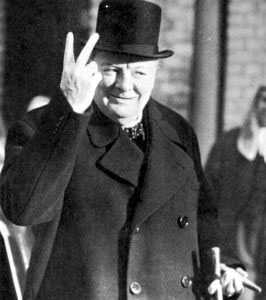
"What is our aim? I can answer in one word: Victory. Victory at all costs, victory in spite of all terrors, victory, however long and hard the road may be. For without victory, there is no survival."
France was the first concern for Churchill because Hitler was already in place in the Rhineland, capable of destroying the country with one order. Churchill tried as hard as he could to keep France in the war, but his brave offer of the Act of Union was denied and France surrendered to Germany without a fight. Britain was now alone and almost unarmed. At this point, almost any leader would have seen defeat, but Churchill would not let this happen. The safety of Britain all depended on a few of her best fighter pilots. Churchill did not plan or direct the Battle of Britain on which the future of mankind depended, but it was he who encouraged and deployed indomitable strength behind the British pilots whose odds of victory were slim. Despite bad odds, the British pilots prevailed and drove the German planes away. The country rallied behind the leadership of Churchill and hoped that he would to lead them to victory.
As the war continued, Hitler's attack on the Soviet Union seemed inevitable and Churchill had to make a choice. Without hesitation, an Anglo-Soviet pact was signed in Moscow. Churchill met FDR and during this meeting, the Atlantic Charter was signed. That same month, the US also signed an agreement with Russia. Overall, 26 nations had signed a declaration committing them to defeat the Axis powers. The Grand Alliance was in being. In December when Japan attacked the United States at Pearl Harbor, Churchill stated that a British declaration of war against Japan was created within the hour. After two years of fighting, the British finally secured a great victory at El Alamein in November 1942.
General Alexander and his brilliant lieutenant, General Montgomery, defeated Nazi General Rommel's entire fighting force. Churchill marked this great turning point as, "not the end. It is not even the beginning of the end. But it is, perhaps, the end of the beginning."
In early 1943, Churchill and Roosevelt met at Casablanca and proclaimed "unconditional surrender" as their aim in victory. They first turned on Italy and by the following September, unconditional surrender was achieved there. Upon returning to London, pneumonia attacked Churchill and if it was not for his determined will to live and see victory, he might not have made it.
The war was moving along and with the Italians out, a strong victory at Stalingrad and another at El Alamein, it was time for the heart of Germany to be hit.
"The hour of our greatest effort and action is approaching," said Churchill as the Allies stepped up and began preparations for D-Day. On June 6, 1944, the first wave of troops landed at Omaha Beach in Normandy. More than 4,000 ships along with several thousand smaller craft crossed the Channel into Normandy. The beach was secured and the allies were able to reach the Rhine within a year.
The final assault on Germany was ready. The Soviet troops on the north and the British and American waiting just outside the Rhine were prepared to sack Germany. On March 25, 1945, General Eisenhower, supreme commander of the allied forces, launched the attack. On May 4, less than two months later, Germany surrendered all of its forces facing the Allied powers. Churchill had succeeded.
The leadership and determination seen in Churchill well before the war started gave strength to the British people and without this courage the war would have been over at the Battle of Britain. Churchill's leadership in creating the Grand Alliance and determination the entire war secured the British and all free people a victory over the evil Nazi empire.
"This is your victory! It is the cause of freedom in every land. In all our long history, we have never seen a greater day than this," Churchill declared exuberantly while making his broadcast announcement of the German surrender on V-E Day.
Page created on 4/27/2009 3:23:14 PM
Last edited 1/6/2017 4:37:22 PM