 |
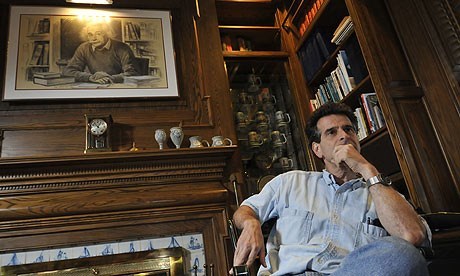
| Dean Kamensits under a drawing of Albert Einstei (www.theguardian.com (Jessica Hill/AP)) |
"When most people think of inventor Dean Kamen, two things come to mind: The Segway, his personal transporter; and the headlines from 2010, which led some people to believe he had died" ("​Welcome to Dean Kamen's Cool World."). However, Kamen is still alive and creating inventions for the good of others. Dean Kamen (pronounced KAY-men) was born on April 5,1951, in Rockville Centre, New York," ("Dean Kamen"). Although Kamen became very successful, he didn't do well in school. He didn't care much about his grades, resulting in him failing many of his classes. Even so, he felt his education was important to his success. "There is a big difference in saying I didn't get a diploma and I didn't get an education," ("Dean Kamen"). Kamen's start in inventing came when he showed innovation, a desire to help others, and a way to solve a global problem with his AutoSyringe. "Combining common parts such as timers and circuit boards with precise elements that he learned to mill out of aluminum himself, Kamen created what he called the AutoSyringe" ("Dean Kamen"). He sold this invention for an estimated $30 million. His career as an inventor/innovator, humanitarian, and global thinker had begun. Kamen qualifies as a hero because a hero must be innovative, help others (be a humanitarian), and do things for the good of the world (be a global thinker). Dean Kamen is not only innovative by creating new inventions which benefit others, especially those in need, but he is also a global thinker because he is trying to solve problems which affect all of humanity, or at least people in many places.
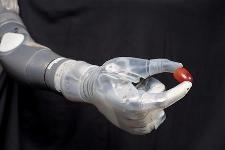 |
| The "Luke" arm holding a grape (http://www.dekaresearch.com/ ()) |
The next quality of a hero is humanitarianism. Kamen's inventions and life demonstrate his caring toward people. When Kamen realizes a problem, such as the lack of clean water in many places, he does what he can to help. Kamen and his company, DEKA, mainly focus on medical problems. "All these advances, he says, were intended to make life better for people with health problems," (Hambleton). Kamen created all of his inventions for people with medical needs; for those who are suffering from a global problem like impure drinking water, or just to make life easier for the rest of humans. While the idea for the Segway originally came from a wheelchair, it's meant to make life easier for humans everywhere. Another of his inventions, the "Luke" arm is to help amputees. When testing the "Luke" arm, he told the tester, "I'll stop when your buddies are envious of your Luke arm because of what it can do, and how it does it. And we'll keep working. And I'm not going to stop working until we do that," (Kamen). This shows that Kamen will keep giving to those in need until they are happy and not disadvantaged by their medical condition. Kamen has invented many things to promote human welfare. Some examples of these inventions include: the iBOT mobility system, the Luke arm, Slingshot, and the AutoSyringe. These inventions either help people with medical problems or help people solve environmental problems where they live. This is why Kamen's caring about others makes him a hero as a humanitarian.
 |
| (http://cartalk360.com/ ()) |
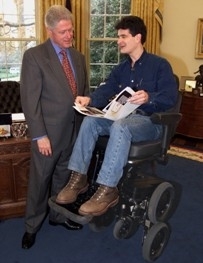
Kamen's inventions and ideas are innovative. When Kamen decides to solve a problem, he and his team try to find a new, different, and better solution to the problem. "It takes a different mind-set to decide we are going to solve the same problem everybody else has been looking at, but we want to take a fundamentally different approach," (Hambleton). For example, the idea of the Segway came from when Kamen's company, DEKA, had been trying to develop a wheelchair capable of lifting a person's head to eye level while in use. Kamen realized that,
"We can get around so well because we're not static, unstable machines with a big, heavy base at the bottom, like a Coke machine. A Coke machine doesn't fall over because it has a 4-foot-by-4-foot base at the bottom. But a human being, who is as tall as a Coke machine, stands on little toes. If you got drunk or if you're not thinking and balancing, looking around without moving, you do fall over. You are dynamically stabilized, not statically stable," (Hambleton).
Solving the wheelchair problem and creating a new mode of personal transport vehicle shows that he is innovative. Without being innovative, solving problems that people have been trying to solve for years would be impossible, and many of today's advancements would have never happened. Now people just don't have a regular wheelchair, but one that can go over many types of terrain and raise and lower its occupants to eye level and back. In addition, that same technology allows normal people a personal transport device. When considering ideas at DEKA, Kamen encourages his employees to defend their ideas, "'I ask that everybody put his or her heart and soul into getting their solution or ideas out on the table. We want as many different ideas put out as we can get. If you don't have enough passion behind your idea to get emotional about it, you probably don't want to be here,'" (Cohen). Encouraging more ideas, rather than only successful ideas shows how Kamen and his employees at DEKA create their innovative solutions because discouraging unsuccessful ideas also discourages many different ideas which could lead to a new and useful invention or a solution to a problem. This demonstrates Kamen's innovativeness, one of the qualities of a hero.
 |
| (usfirst.org) |
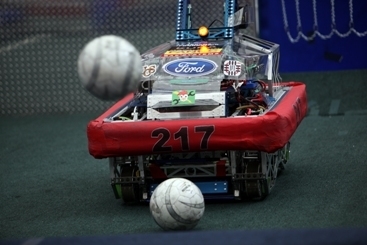
The third qualification for a hero is to be a global thinker. As a global thinker, Kamen has defined some major problems that will affect the world and the future. Kamen works with power sources that have zero carbon footprints. He's created an individual power source because many places don't have enough power, or have power grids that are inadequate. He used that power source to power the Singshot to provide clean drinking water for people in remote areas, or those who want to reduce greenhouse emissions. Many people in the whole world have been trying to solve water and power issues, and Kamen too believes that the world needs solutions, but wants new and creative answers. Kamen sees that many people take technology for granted and are using it without a thought about how difficult it was to develop. However, Kamen recognizes this as a major problem, "Americans thinking that America will continue to lead the world in innovation and quality of life without some quick and serious educational improvements are dangerously delusional," (Kamen). To help fix this, Kamen started FIRST (For Inspiration and Recognition of Science and Technology) to increase the amount of people interested in science.
"Kamen devotes lots of time and money to U.S. FIRST because he thinks it's a great way to change society's values. 'Our culture celebrates one thing: sports heroes,' he said. 'You have teenagers thinking they're going to make millions as NBA stars when that's not realistic for even one percent of them. Becoming a scientist or an engineer is.' Kamen believes that he can put students on the right track by promoting science as a fun and rewarding activity--both personally and financially. If that doesn't occur, he argues, the United States will soon lose its technological edge over other countries. 'In 10 years, unless we dramatically change our priorities and our standards, we will become a second-tier country.... U.S. FIRST is my way of attempting to fix that.'," ("Dean Kamen").
FIRST requires young people to use technology to solve a global problem and build a robot to perform tasks. This builds many skills such as teamwork, creative thinking, familiarity with technology, repurposing products, and programming skills. Much of Kamen's time and money goes to FIRST, to help turn the US around and allow it to continue advancing in technology. Kamen's commitment to FIRST and his inventions for global problems prove that he is a global thinker, and that makes him a hero.
Dean Kamen is a hero who is innovative, a humanitarian who helps people, and a global thinker. He has created many inventions to help people with specific needs and spends much of his time devoted to FIRST to encourage kids to become interested in science and technology and the world around them. He cares about people and the planet. He wants humanity to be sustainable. Kamen inspires people to find careers in science and engineering to help the US keep up and advance in technology so that the world is a better place. The world is already a better place because of Kamen's own innovative inventions and his use of those innovations to help both people and the world. However, Kamen takes it to the next level to try and ensure that others will also rise up to make innovations that help people and the world. Dean Kamen is a hero twice over; once because he is a hero himself, and twice because he makes new heroes for tomorrow.
Works Cited
Cohen, Allan, and Jay Rao. The Iconoclast's Approach to Innovation: An Interview with Dean Kamen. N.p.: Babson College, Aug. 2006. PDF.
"Dean Kamen." Dean Kamen (Biography Today) (2010): 1. Biography Reference Center. Web. 30 Apr. 2015.
Hambleton, Laura. "For the inventive mind, aging may help." Washington Post 17 Mar. 2015. Biography in Context. Web. 1 May 2015.
Kamen, Dean. "Transcript of "The Emotion behind Invention"" Dean Kamen: The Emotion behind Invention. TEDMED, Oct. 2009. Web. 07 May 2015.
"​Welcome to Dean Kamen's Cool World." CBSNews. CBS Interactive, 11 Jan. 2015. Web. 20 May 2015.
Page created on 5/31/2015 12:00:00 AM
Last edited 5/31/2015 12:00:00 AM