Desmond Tutu
by Garrett, Seth, Phoenix, Trystan from Eugene
 Desmond TutuGarrett, Seth, Phoenix, Trystan from Eugene
Desmond Tutu Beliefs/Ideology
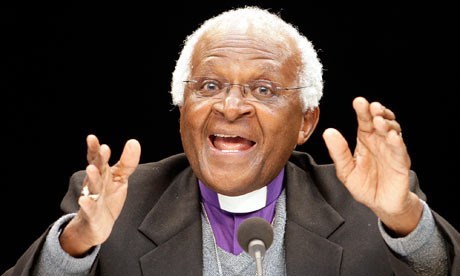
Desmond Tutu made a big impact on the apartheid over years of it. He stood up to racism of the apartheid with faith and conviction. This was the most pivotal time in South Africa's history. He had some certain beliefs that stood out in the apartheid. One of the most substantial ones is his non-violence belief against war. He believed that things did not have to be solved by war and that it could be solved with non-violence. In the apartheid his non-violence act against it both worked and didn't work. At first it didn't stop anything and at times made it worse. But towards the end of his time spent trying to help it started to work. Tutu's beliefs were very strong and very controversial for some people. He had a message of hope and optimism in the community. As Desmond Tutu states in the text and this is a direct quote of his belief, "is an intimate portrait that gets at the heart of a man dedicated to the defense of human rights and fighting all forms of oppression through advocating non-violence, peaceful reconciliation, and social justice for all".
The History of Apartheid In South Africa
The Apartheid took place in South Africa during the years of 1946 and 1998, these brutal days, were also a lot like the Holocaust in many different, but same ways. Apartheid was the law for many black South Africans. These laws were as the following: curfew for the slaves; who had to be in their homes at ten o'clock at night; slaves were to have passbooks at all time and in order; and mostly the worse thing is if you had black colored in your family, or even if you looked like it, you would be considered as a black South African.
Millions of these South Africans were forced to live in very poor shacks, referred to as "homelands." The homelands were like independent houses that had no electricity, heat, warmth, bathrooms, etc. When they had to use the restroom, they would go in buckets outside, and people known as "Shit-men" had to clean all the waste on the land. If you were to break any rules you would have penalties, and these penalties were whippings, imprisonment, and fines.
During these brutal years there were many protests, non-violent and violent. These protests led the police to harsh acts of trying to stop these protesters. They would shoot into the crowd hoping to scare the individuals away. They would also gas or smoke the crowd and go in with there with riot shields and truncheons, beating them down. Desmond Tutu was in prison for trying to stop apartheid for ever happening.Fight Against Apartheid
Desmond Tutu was completely against apartheid. Since the 1970's he fought strongly against apartheid. He fought in every non violent way possible in order to abolish it. At every chance he had, Desmond would speak out against apartheid in his sermons, his public visits and articles that he published. In 1975 he even wrote a letter to the prime minister to turn and focus his attention on
the dangerous and unfair situation in South Africa, but the letter was immediately disregarded and forgotten, which continued the black oppression. Desmond later realized that the white government would be no help in his fight against apartheid so he decided to make it a national awareness and promote fellow blacks to fight against the unfair oppression of his people's rights.Soon after realizing what he had to do, Desmond Tutu acquired the help of other people like church bishops. In 1984 Desmond was awarded the Nobel Peace prize giving him more notoriety and more followers. The Peace Prize also attracted a lot of global view towards South Africa, helping Tutu even more in his fight. Tutu had no intentions of promoting a violent uprise against the white minority, it was not only a desire but a belief as a holy man of God. Through his constant effort with boycotts, protests and strikes, Tutu was able to contribute a large amount towards the take down of apartheid.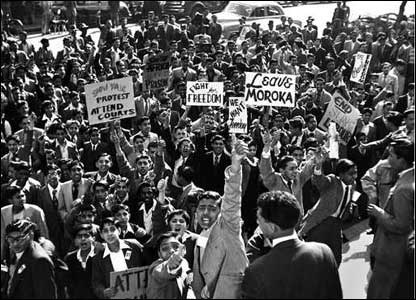 Desmond TutuGarrett, Seth, Phoenix, Trystan from Eugene
 Biography On Desmond Tutu
Desmond Mpilo Tutu was born on October 7, 1931 in Klerksdrop South Africa.
Desmond Tutu's Father was a grade school principal and his mother was a cook and cleaning lady at a school for blind kids. As a child, Desmond Tutu knew that he was treated worse than white kids because of the color of his skin.
Desmond Tutu had a bad childhood because he grew up in a racist society. He managed to make the best of it. Desmond Tutu was very bright and curious. He had a passion for reading, especially for comics strips. Desmond also loved to read Shakespeare and his plays.
Desmond Tutu graduated at the age of 19 in 1950. Although he was accepted into medical school, his family did not have the money to send him there. There was another way he was able to go to college and that was by a scholarship to study education.
Desmond Tutu went to Pretoria Banta Normal College and graduated with his teacher's certificate. After Desmond graduated college, he went back to high school to teach English and History, he wanted the kids to have the same education as he had in high school. In 1976 Desmond Tutu had been appointed Bishop of Lesotho. Desmond had sent a letter to the prime minister of South Africa.
The letter said that racial inequality could have dire consequence. The only thing is his letter was ignored. Desmond Tutu used his deviated position. That way he could put an end to the apartheid.
In 1984 Desmond Tutu won the Nobel Peace Prize not only as a jester of support to him; but also for all of the individuals and groups in South Africa.
"Interview with Desmond Tutu." 2008. 2/15/12
Wissen, Agora. "Desmond Tutu's fight against apartheid." Meaning. Web. 15 Feb. 2012.
Page created on 6/25/2012 1:57:26 PM
Last edited 7/26/2026 4:03:21 AM
The beliefs, viewpoints and opinions expressed in this hero submission on the website are those of the author and do not necessarily reflect the beliefs, viewpoints and opinions of The MY HERO Project and its staff.