 |
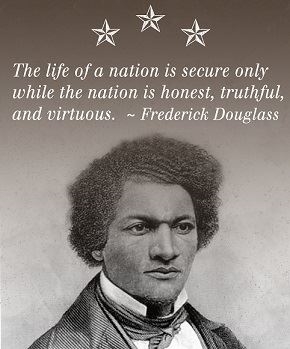
| One of Douglass's famous quotes. (https://www.emaze.com/@ALWQZCIC/Frederick-Douglass ()) |
"Where justice is denied, where poverty is enforced, where ignorance prevails, and where any one class is made to feel that society is an organized conspiracy to oppress, rob and degrade them, neither persons nor property will be safe." Despite Frederick Douglass being a slave over a decade in his life, will, perseverance, and the desire to never give up, he escaped and soon became one of the most outspoken leaders in the anti-slavery movement. Frederick Douglass was born with the name Frederick Douglass Washington Bailey. His mother was Harriet Bailey, and was an important figure to him while she was alive, she died when he was eight. Frederick was born in his grandmother's home which was located in Talbot County. He was born in February of 1818 but never knew when his exact birth date was. Frederick escaped slavery after two unsuccessful attempts with the help of Anna Murray who he later married and had five children with. After escaping Douglass made a major impact on slavery not with his fists, but with his words as he wrote in newspapers and spoke in meetings to make his message heard. To be a hero, you need to work hard to help those in need and never give up. You also need the determination to make your voice heard so you can be the voice of the people who can't speak up for themselves. Frederick Douglass is a hero because of his hard work and determination not to give up and to help people see the reason why slavery is wrong and needs to be stopped, as well as helping enforce equality and women's rights.
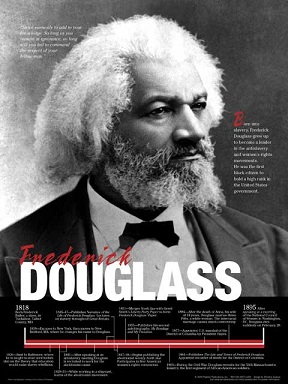 |
| Timeline of Douglass's life (https://www.techdirections.com/fpdouglass.html ()) |
Frederick Douglass was a hard worker because he faced challenges in his life most people could not even dream of, yet he prevailed and faced those challenges head on and also helped others in need. "So riveting was his presentation that the officers of the Massachusetts Anti-Slavery Society asked him to become an agent. Douglass accepted and embarked on a lecture tour of the North for the next four years..."("Frederick Douglass."). As Frederick Douglass started speaking at meetings of groups that were against slavery and that supported women's rights, he gained both positive and negative notoriety. When he gave his opinions at these meetings he gained the audience's full attention. The leaders showed interest in him because they could see his potential and that he was a valuable asset in the campaign and they could not let him go. He went out on tours and did lectures on the dangers of slavery inside the plantation. "At the urging of Garrison, Douglass wrote and published his first autobiography, Narrative of the Life of Frederick Douglass, an American Slave, in 1845."("Frederick Douglass. Biography"). Frederick not only shared the experiences of others and what they went through. But took it a step further by giving people an insight on his experience as a slave. When Douglass published his book it had a ripple effect. People read and noticed the cruelty and danger slavery held and more and more people were starting to rally against it. Frederick Douglass's hard work made a crucial difference in the anti-slavery movement and without him, it would have taken longer than it did to put an end to it.
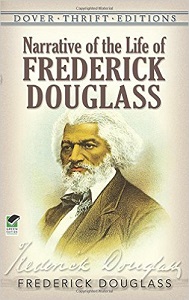 |
| The cover of Douglass's narrative (https://www.amazon.com/Narrative-Life-Frederick-Do ()) |
Frederick Douglass's determination in his efforts to make his voice heard about the problems black people and women all over were facing, yet he didn't result to violence but instead used his words and knowledge to help him."Douglass escaped to the North, gained his freedom, and joined the abolitionist movement. Douglass became an eloquent spokesperson and acclaimed writer in the fight to abolish slavery in the United States" ("Frederick Douglass."). Frederick Douglass never really escaped slavery in a sense. It will always be apart of him whether he was on the receiving end of it or he was fighting to have it abolished. He wasted no time after escaping slavery, he immediately started going to meeting after meeting trying to be as much of a help as he could be. Douglass took a lot of risks in his life which could have resulted with him being dead but that didn't deter him. "he taught other slaves on the plantation to read the New Testament at a weekly church service. Interest was so great that in any week, more than 40 slaves would attend lesson" ("Frederick Douglass." Biography.com). Douglass was first taught to read by the wife of one of his slave owners while he was at their plantation. It was illegal to teach a slave to read so when the husband found out he stopped the teachings immediately. Douglass was relentless in his endeavors as he sought out anyone he could find on the plantation to help him read. He took what he knew and shared his knowledge with other slaves so that they could share his newfound gift with him. Because of Douglass's determination to succeed, he played a major role in the abolition in slavery and without him our world wouldn't be what it is today.
Douglass's will to exceed outweighed any challenge he had to face in his life. People tried to break his spirit and tear him down. Some people got close, but Douglass prevailed and came back ten times stronger because of it. "Covey's constant abuse did nearly break the 16-year-old Douglass psychologically. Eventually, however, Douglass fought back, in a scene rendered powerfully in his first autobiography. After losing a physical confrontation with Douglass, Covey never beat him again" ("Frederick Douglass." Biography.com). Douglass was an inspiration because he never let other people get it the way of his dreams and goals and always got the job done. Douglass's hard work and determination to give other people a better future is what makes Frederick Douglass a hero.
Works Cited
"Frederick Douglass." Biography.com, A&E Networks Television, 1 Feb. 2016,
www.biography.com/people/frederick-douglass-9278324.
"Frederick Douglass." Notable Black American Men, Book II, edited by Jessie Carney Smith,
Gale, 1998. Biography in Context,
link.galegroup.com/apps/doc/K1622000126/BIC1?u=powa9245&xid=3380c462. Accessed 17 Jan. 2017.
Page created on 2/6/2017 12:00:00 AM
Last edited 2/6/2017 12:00:00 AM