STORIES
Freedom

Franklin D. Roosevelt

by Ali from San Diego

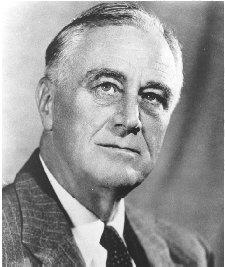
 (Franklin Roosevelt Library)
(Franklin Roosevelt Library)

"Show me a hero, and I'll write you a tragedy!" -F. Scott Fitzgerald

A tragedy indeed. They say behind every hero are their mistakes. And behind that? Their misfortunes. That's how a hero is made, not with money or power, but with loss and sadness. For a man who lost much, Franklin Roosevelt is the perfect example of how a hero can be forged from their own despair. Many know him as a president, or a politician, but what really mattered was what he was for future generations and how he still influences their lives today. Exploring Roosevelt's past you'd find how easy of a life he had. A popular "ladies man", Roosevelt graduated Harvard with a "Gentleman's C". Roosevelt was the prodigy for an excellent life. His friends were wealthy and his family was very renowned and prestigious. Roosevelt had a wonderful town where he was widely known and loved. Everyone related him with enormous potential. But at the ripe old age of 39, tragedy struck. Roosevelt was diagnosed with polio, and as his mental and physical health deteriorated, so did his ability to walk. Life was miserable and filled with constant pains and discomforts. But refusing to scrape by with his shattered life, Roosevelt took to the life of politics and patriotism. But more on that in a second.

Society has a history of turning celebrities into first class heroes. But simply donating to a breast cancer fund doesn't make you a hero does it? There is a list of characteristics that describe what it means to be an Icon of Greatness. Roosevelt is known as a hero, simply because he falls into that category of certain traits. Roosevelt was memorialized for being brave, selfless, and determined, all among other traits. All three were important for a president who commanded in a time of hardship. Defining the traits bestowed upon Roosevelt, you can get an idea on what type of person he really was. To be brave meant to fight for your beliefs despite the opposition of others, to be selfless is to put those in need in front of you no matter the size of the matter, and finally, to be determined is to set your mind to a goal and fight for it, tooth and nail. Roosevelt is not only recognized as one of the greatest and most loved presidents in U.S history, but also the founder for many extravagant treatment centers for his fellow polio victims. Plagued with polio at a mere 39, he managed to lead a nation out of one of the most severe depressions in American history, and still inspire the future generations for decades. Roosevelt is truly an American hero.
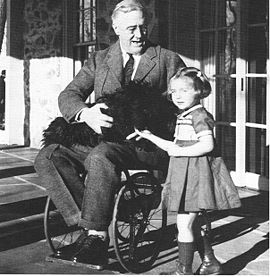
Roosevelt in his wheelchair at Hyde Park. (wikipedia.org)

Memorialized as one of the bravest and most charismatic presidents, Franklin Roosevelt led the country through thick and thin. His bravery, which was uncommon for politicians, was shown during one of his early elections. "Roosevelt was asked to run as a Democrat for the state senate seat from Duchess County, New York. Although Roosevelt had grown up in Duchess County, the seat had long been held by Republicans. Despite the odds against him, Franklin D. Roosevelt won the senate seat in 1910 and then again in 1912."(Roosevelt Memorial Librarian) Against a seat which was long held by Republicans, Roosevelt had very low expectations of him. Despite the fates favoring the other side, Roosevelt ran against a powerful and diligent opponent. '"Roosevelt was asked to run as a Democrat for the state senate seat from Duchess County, New York. Although Roosevelt had grown up in Duchess County, the seat had long been held by Republicans"'. Through his entire campaign career, Roosevelt had stuck close to his home state, which inspired him to fight for the seat. Refusing to give up, he showed bravery and resolve to his goals and ideals. In the end he won the seat in the senate and successfully took his baby step into politics. Skipping forward in time to the WWII era, in which Roosevelt was president, another example of bravery was shown. "When Hitler attacked Poland in September 1939, Roosevelt stated that, although the nation was neutral, he did not expect America to remain inactive in the face of Nazi aggression. Accordingly, he tried to make American aid available to Britain, France, and China and to obtain an amendment of the Neutrality Acts which rendered such assistance difficult. He also took measures to build up the armed forces in the face of isolationist opposition" (Roosevelt museum and library researcher) 


"Roosevelt stated that, although the nation was neutral, he did not expect America to remain inactive in the face of Nazi aggression,"' Roosevelt predicted that the war overseas would somehow draw the United States, which was a peaceful country at the time, into a long and bloody war. When speaking about the war, he had a fearless manner even though he understood that he could be threatened by pro-Nazi or pro-separatist civilians. His whole political career could have ended with the American people on edge to say peaceful. "Accordingly, he tried to make American aid available to Britain, France, and China and to obtain an amendment of the Neutrality Acts which rendered such assistance difficult. He also took measures to build up the armed forces in the face of isolationist opposition".  When he couldn't find the American peoples interest in joining the war, Roosevelt supplied materials to the warring countries. Roosevelt helped those in need the most even when he was in danger of doing so. Death threats came constantly from Germany and the Axis powers. Not many people would have helped in the war when the consequences were that you could have been thrown out of power or assassinated. Roosevelt had shown many times, both throughout his political career and life, his bravery. His urge to go against the injustice overseas was uncommon as the First Great War was still fresh on the worlds mind. But Roosevelt did what was the best thing to do at the time. Although his choices are still questioned today, no one can deny that Roosevelt will always be remembered for his bravery as a president.

Throughout his whole political career, or as most people recall it as after his marriage, Roosevelt has been very altruistic in nature. His selflessness appeared first in his presidential campaign in his early political career with revolutionary change.

"Roosevelt spent his first two terms as president taking steps to ease the U.S. out of the Great Depression. The first three months of his presidency were a whirlwind of activity, which has become known as "the first hundred days." The "New Deal" that FDR offered to the American people began immediately after he took office. Within his first week, Roosevelt had declared a banking holiday in order to strengthen the banks and reestablish confidence in the banking system. FDR also quickly created the alphabet agencies (such as the AAA, CCC, FERA, TVA, and TWA) to help offer relief."(Martin) 

Instead of sitting by while the government fell to ruins, which seemed to be the only choice for many, Franklin worked ferociously and aggressively so the economy and country could get back on its feet. As I quote, it was "-a whirlwind of activity" within the first three months of his election. Roosevelt quickly created agencies that are still in effect today, such as the CCC, AAA, and the FERA. He was in constant discomfort due to his diseases, polio, yet he still managed to be productive by making new deals and fixing the banking systems. For people who aren't economists, giving power to the banks was a risky move due to the depression the country was already in. Perhaps a better example is when Roosevelt joined the Allies in the Second Great War, and how he proved to change the way nations reacted to humanitarian and international problems. "He moved to create a "grand alliance" against the Axis powers through "The Declaration of the United Nations," January 1, 1942, in which all nations fighting the Axis agreed not to make a separate peace and pledged them to a peacekeeping organization (now the United Nations) upon victory." (Library and museum researcher) To promote world peace, he went as far as to overthrow the current peace keeping organization, the League of Nations, and create a more effective one. Established as the United Nations, its goal was to maintain world peace and to prevent further wars. Roosevelt suspected that there would be future conflicts, as he made this pact for all countries and nations to agree on, to preserve their futures. The U.S had lost no real land in the war, due to the fighting over seas, yet nations like Russia and Poland were being divided. The agreement was made so the affected countries would get a fair claim in what was theirs and what was not. Issues could be taken up accordingly and fairly. Roosevelt was gifted as a very giving man, as he was selfless and generous to all. These examples are just some of the many deeds Roosevelt has accomplished over his life time. But the last trait still remains to be justified.

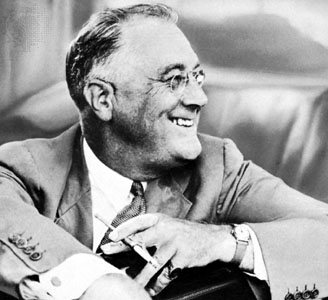
 (Courtesy of the Roosevelt Museum)
(Courtesy of the Roosevelt Museum)

One of the leading role models for determination, for he was next to his wife, President Franklin Roosevelt had captured the world's attention for decades even after his death. To tell you about Roosevelt's determination would be pointless without saying what he's been through.  While vacationing at Campobello Island, New Brunswick in the summer of 1921, Roosevelt contracted poliomyelitis (infantile paralysis).  "Despite courageous efforts to overcome his crippling illness, his chances of walking ever again looked dire. In time, he established a foundation at Warm Springs, Georgia to help other polio victims, and inspired, as well as directed, the March of Dimes program that eventually funded an effective vaccine for the disease."  Contracting poliomyelitis, or commonly known as polio, was a huge problem in Franklin's life.  It bothered him constantly and he had sharp pains every day.  Just running for office was an extraordinary feet, and it shows his indomitable strength in his being. When sick, Roosevelt used his best friend, and his very dear wife, to build up the courage to fight the disease, and enter politics again. As time progressed so did his ability to walk.  He soon learned to move on metal braces, which may have slowed his speed down, but not his indomitable spirit. 


Bringing attention back to Roosevelt's election when he was elected president at the wrong time; his limitless courage and faith in himself braced him for the hard days to come.  "In July, 1932, Roosevelt was chosen by the Democratic party as its presidential candidate to run against the Republican incumbent, Herbert C. Hoover. In November, Roosevelt was overwhelmingly elected President. He came to the White House at the height of crisis-the economic structure of the country was tottering, and fear and despair hung over the nation. Roosevelt's inaugural address held words of hope and vigor to reassure the troubled country-"Let me assert my firm belief that the only thing we have to fear is fear itself"" (Literary reference center)  He was elected into one of the most dangerous times in American history.  Any wrong political move would "break the ice" and America would fall into the gloomy and obscure vast pit of anarchy.   Even in the depths of darkness, with the murky curtain still over the nation, Roosevelt delivered his hopeful inaugural speech in 1933 that echoed through every street corner in the world.  "The only thing we need fear is fear itself" an expression used commonly used today coined by, yours truly, Franklin Roosevelt.  The quote illustrates how determined Franklin was to help his country out of the dark depths and uncertainess of the Great Depression.  Franklin Roosevelt, known as one of the "Big Three" (In the WWII era there were 3 superpowers), captured the attention of the world for decades, and inspired future generations with his will power and dedication.  

Roosevelt was not only  immortalized as one of the greatest presidents, but also as a person who inspired many generations ahead of him.   In his lifetime, Roosevelt displayed determination in the face of adversity and peril.  He displayed bravery and selflessness when combating forces of evil, local and global.  He overcame polio and helped find a cure for future victims.  He supplied materials to countries in need during WWII, even when threats from the Axis powers got more and more real.

Roosevelt inspires me in multiple ways. It's rare when you find an actual hero in modern society.  Perhaps it's the media's fault, but that's beside the point.  Roosevelt inspires me for the very point that he is human.  Unlike other heroes where they overcome difficulties singlehandedly and by themselves, Roosevelt relied on his strengths.  He relied on his wife and advisors.  Every problem that was hurled in his direction was cushioned by his close friends and family.  He inspires me because he was not perfect, or highly talented, or always right.  He influences me because he made mistakes and he admitted to them.  But what made the difference was instead of lying down and waiting for his past to fade, he got up on his feet and learned off them.  It's true that heroes can lift swords and fight dragons; but it's also true that heroes can live in any way shape or form, living and breathing that certain list of characteristics as their own moral code.   Roosevelt truly lifts my hopes in humanities' potential to be a great, truthful, and an unselfish race.  Franklin Roosevelt, a true American hero. 


  Work Cited Page

Beschloss, Michael, and Hugh Sidey. "Franklin D. Roosevelt." The White House. N.p., 2009. Web. 08 Dec. 2012.

"Franklin Delano Roosevelt." Contemporary Heroes and Heroines. Vol. 2. Gale, 1992. Gale Biography In Context. Web. 5 Dec. 2012.

"Franklin D. Roosevelt Presidential Library and Museum." - Roosevelt Facts and Figures: 101 Questions. Franklin D. Roosevelt Library and Museum,. Web. 10 Dec. 2012.

Rosenberg, Jennifer. Franklin D. Roosevelt (Page 2). About.com 20th Century History. IAC/ InterActiveCorp, n.d. Web. 11 Dec. 2012

Schnell, J. Christopher. "Franklin D. Roosevelt." Dictionary Of World Biography: The 20Th Century (2000): 1-4. Literary Reference Center. Web. 25 Dec. 2012.

http://www.fdrlibrary.marist.edu/facts.html


Page created on 1/10/2013 12:00:00 AM

Last edited 1/10/2013 12:00:00 AM

The beliefs, viewpoints and opinions expressed in this hero submission on the website are those of the author and do not necessarily reflect the beliefs, viewpoints and opinions of The MY HERO Project and its staff.