-they must be felt with the heart.
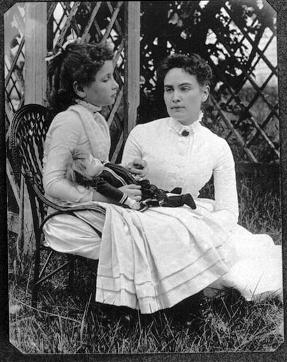 |
| Helen Keller with Anne Sullivan (http://en.wikipedia.org/wiki/File:Helen_Keller_wit ()) |
"When one door to happiness closes, another opens; but often we look so long at the closed door that we do not see the one which has been opened for us"(Helen Keller). At 18 months old, Helen Keller contracted a near deadly sickness and the doors to sight and sound closed on her. However, she did not let one closed door stop her from achieving happiness. Knowing she differed from others, Keller faced many frustrations in her early years. Despite the hopelessness she felt, a new door opened for her when she met her teacher and lifelong friend Anne Sullivan. Sullivan creatively and patiently taught Keller the many joys of the world that did not require sight and sound. She taught Keller to communicate by teaching her fingerspelling in which Sullivan used her finger to trace a word on Keller's hand. At first Keller was defiant, but she began to realize everything had a name and she became determined to learn to communicate. At the age of ten, Keller enrolled in the Horace Mann School for the Deaf where she struggled for years to learn how to speak. She later advanced to Radcliff College where she graduated with honors. After overcoming her own disabilities, Keller dedicated the rest of her life to making reforms in the lives a wide variety of disadvantaged people. "Keller won many awards and citations for her humanitarian work. Credited with prompting the organization of state commissions for the blind, she helped put a stop to placing deaf and blind individuals in mental asylums. As a pioneer in educating the public in the prevention of blindness of the newborn, she wrote newspaper and magazine articles about the relationship between venereal disease, a sexually transmitted disease, and blindness in newborn infants. She traveled to Europe, Asia, North and South America, and Africa lecturing about the need to improve the lives of disabled people" ("Helen Keller." U*X*L Biographies). Her extraordinary achievements inspire all to believe in limitless possibilities and her generosity and compassion toward the less fortunate shows how a physically challenged woman still has something to offer the world. Through her unfaltering determination and optimism, Helen Keller proved that anything is possible and her benevolence exemplifies how a disadvantaged woman can still have the desire and ability to change the world.
Helen Keller's steadfast determination allowed her to overcome even the most tedious tasks and tremendous challenges throughout her life. Among these, the greatest challenge she ever faced was learning to live with her disabilities. "Despite her loss of sight and hearing, Keller learned to do many small tasks such as folding the laundry and fetching objects for her mother. In fact, she devised an effective though limited system of signs to make her wishes known" ("Helen Keller." Contemporary Heroes and Heroines). Starting at a young age, Keller refused to let her disabilities control her life. Her determination to communicate allowed her to work around her handicaps and find new ways to do ordinary tasks. At the age of ten, Keller opened the challenging yet rewarding door to success: "In 1890, Keller began speech classes at the Horace Mann School for the Deaf in Boston. She would toil for 25 years to learn to speak so that others could understand her" ("Helen Adams Keller."). Although the door to speech seemed unreachable, Helen Keller did not relent in trying to open it even after years of failure. Her sheer determination inspires the belief that aspirations will lead to success. With her unrelenting determination, Helen Keller opened the seemingly closed door to communication, and by doing so she inspired countless others to follow in her footsteps.
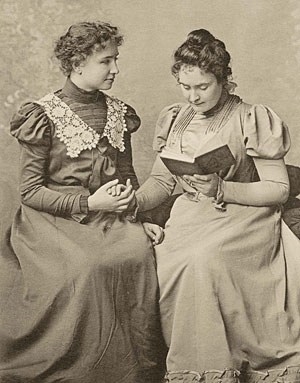 |
| Keller fingerspelling with Sullivan ((http://historyofredding.com/epl/twain-keller-exhib)) |
Helen Keller's benevolence exemplifies how one with so little can possess the capability and willpower to do great things. After learning to speak and write, Keller worked relentlessly for the betterment of others struggling against disabilities. "After conquering her own limitations, Keller's next battle was the public's indifference to the welfare of the disabled. She devoted the rest of her life to promoting social reforms aimed at bettering the education and treatment of the blind, the deaf, the mute- in effect, many physically challenged people" ("Helen Keller." U*X*L Biographies). Keller refused to watch others suffer while she had the power to make a difference. She used her astonishing achievements and experiences to open countless doors for disabled people. Another unique aspect about Keller is that she not only wanted to help handicapped people, she fought for many causes: "From an early age, she championed the rights of underdog and used her skills as a writer to speak truth to power. A pacifist, she protested U.S. involvement in World War I. A committed socialist, she took up the cause of workers' rights. She was also a tireless advocate for women's suffrage and an early member of the American Civil Liberties Union" ("Helen Keller EAD."). She worked diligently and selflessly for the well-being of others rather than herself. Moreover, her persistent efforts improved the lives of innumerable people. Helen Keller's compassion toward disadvantaged people sparked reforms in a wide variety of causes and opened countless doors for the less fortunate.
Without her extensive optimism, Helen Keller would not have had the ability to keep trying in spite of the frustrations and challenges she faced. Even though she could not see or hear, Keller confidently believed she would communicate someday. "I knew that 'w-a-t-e-r' meant that wonderful, cool something that was flowing over my hand. That living world awakened my soul, gave it light, hope, joy, set it free! There were barriers still, it is true, but barriers that could in time be swept away" (Keller, Helen). Knowing the challenges she faced, Keller optimistically believed she would communicate someday. This doubtless hope inspires disabled people everywhere to learn to communicate. She truly opens up when she explains her thoughts on her disabilities: "Everything has its wonders, even darkness and silence, and I learn, whatever state I may be in, therein to be content" (Macy, John Albert). In this touching quote, Keller describes how happiness can be found in any situation for those willing to look. This optimism portrays the basis of what makes Helen Keller a true hero. Though her unparalleled optimism, Keller not only learned to communicate without sight or hearing; she also learned to be happy with what she had instead of what she lacked and her legacy continues to inspire the same in others.
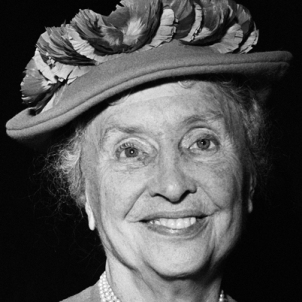 |
| Helen Keller ( http://www.biography.com/people/helen-keller-9361 ()) |
Helen
Keller's determination, benevolence, and optimism allowed her to accomplish
extraordinary things that she would have otherwise been unable to do. In her
exceptional lifetime, Keller learned to communicate several different ways and
she put all her effort into improving conditions for less fortunate people. Her
story inspires the best in countless people and her legacy has no equal. In
every aspect of her life, Keller applied her positivite attitude, goodwill and fortitude
which resulted in a successful life regardless of the extreme challenges she
faced. Her unmatched optimism inspires me to be happy no matter what
circumstances I face while her story makes me realize how much I take for
granted every day and how much I have to be grateful for. The determination she
possess has no equal and it shows me that I can accomplish anything I put my
mind to. Her unparalleled spirit shows how everyone has something to offer the
world. Above all, Keller's life serves as a true example of how much one person
can accomplish. Keller lived an inspiring lifetime in which she never took what
she had for granted and she never focused on what she did not have. Although
the door to sight and hearing closed on her, the door to success and happiness
remained open and Keller did not hesitate to pass through it. Works Cited "Helen Adams Keller." 2012. The Biography Channel website. 10 Dec 2012, 07:43 <http://www.biography.com/people/helen-keller-9361967>. "Helen Keller." Contemporary Heroes and Heroines. Vol. 1. Gale, 1990. Gale Biography In Context. Web. 5 Dec. 2012. "Helen Keller." U*X*L Biographies. Detroit: U*X*L, 2003. Gale Student Resources In Context. Web. 9 Dec. 2012. "Helen Keller EAD." - American Foundation for the Blind. American Foundation for the Blind, 2012. Web. 10 Dec. 2012.
Page created on 1/11/2013 12:00:00 AM
Last edited 1/11/2013 12:00:00 AM