 |
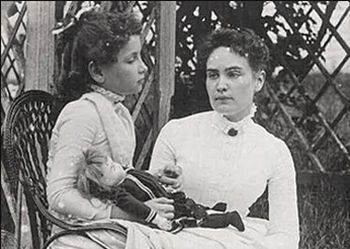
| Anne Sullivan teaching Keller about a D-O-L-L. (ipentimento.com) |
After finding out the use of a key, a young, rebellious girl slammed the pantry door and locked her mother in. Although she couldn't see or hear, the child sat on the porch steps and laughed while feeling the vibrations from the floorboards of her mother yelling and pounding against the door for three hours (Keller). No one would have expected much of Helen Keller; some even thought that the deaf-blind child should be sent to an asylum to spare her family of misery and burden. But more than just changing their minds about herself, Keller, with her amazing accomplishments, became such an inspirational figure in modern history. Keller was born in Tuscumbia, a small town in northern Alabama on June 27, 1880. She had a normal infant life until she was nineteen months old, when an unknown illness left her unable to see or hear. After her deadly illness subsided, Keller became uncontrollable; she ate food with her fingers and constantly threw tantrums. This type of behavior lasted until early March in 1887. That was when Keller's future mentor, Anne Sullivan, arrived. Sullivan was determined to tutor Keller with the right amount of love and discipline. She slowly spelled out words on Keller's palm and gradually taught her that everything had a name. This spawned Keller's desire to learn about various subjects. To satisfy that craving, she attended the Perkins Institution for the Blind with her tutor. Sullivan's teachings allowed Keller to graduate from Radcliffe College and start writing. Later in life, Keller joined several organizations that promoted a better life for disabled people. She was not daunted by her lack of vision and hearing. Instead of focusing on her own disability, Keller was insistent that people less fortunate than herself be helped first. Keller's perseverance was crucial in supporting others in need and changing the way disabled people were viewed.
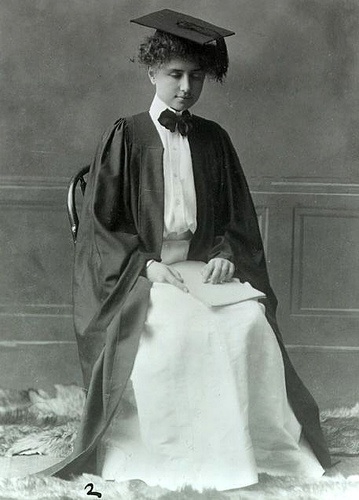 |
| Keller's graduation photo in 1904. (hartransom.org) |
Keller's early life was filled with many unfortunate events, but she was victorious over each challenge. After her mentor Anne Sullivan had arrived at her home in 1887, Keller "...in a few months learned 300 words. By mid-July she wrote her first letter to her mother, and by the end of 1887… she was known internationally as 'one of the most remarkable children in existence'" (Lash). Deaf people had trouble speaking correctly, and blind people faced difficulties in reading or writing; many activities would be nearly impossible to accomplish for a blind and deaf person. Anxious to speak, Keller started working on that skill despite the obvious obstacles ahead of her. Unlike most deaf-blind children of her time, Keller was determined to recover her communication skills to live a fuller life. Although in the end she wasn't able to speak as clearly as a normal person could, her perseverance and persistence were evident in her hard fought ability to communicate. She even published the famous memoir, The Story of My Life. Keller had her share of doubters, but her "...improbable success (she took the same entrance exams as all others and graduated in 1904 with honors in German and English) answered most of the critics" (Reiman). Many graduates of Radcliffe College also took some of Keller's classes. But while others quickly learned the class material in a spoken lecture, Keller had to have someone rapidly "write" the words on her palm. She incessantly persevered despite the countless obstacles she encountered. Passing German and English with honors was but one example of how Keller pushed her limits to achieve the same results as other students.
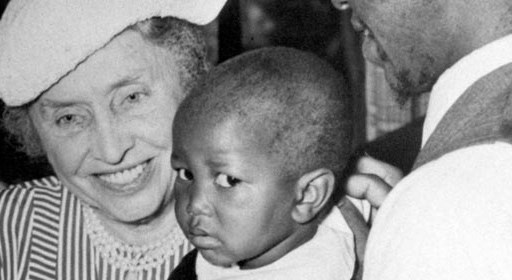 |
| Keller encouraging a blind child and his father. (bonlook.com) |
Since a young age, Keller felt empathy toward others who suffered like she did. She dedicated her life to helping them. "Keller began her lifelong career of philanthropic fundraising, collecting contributions for the education of a destitute blind and deaf boy when she was eleven, giving a tea to benefit the kindergarten for the blind when she was twelve, and campaigning for money to start a public library in Tuscumbia when she was thirteen... She wrote. She lectured. She exerted her considerable influence over public institutions and powerful people. She raised funds for serving the disabled." (Williams). Keller did a lot to allow deaf and blind people to live a better life. As unfortunate as she was with her disability, Keller felt tremendous compassion for other people like herself, or even worse off than her. She reached out to them and worked hard to improve their conditions. Keller wanted to show that regardless of age and disability, anyone could make a difference as long as they have the desire to. Devoting most of her time to the betterment of the disabled, she joined charity organizations and traveled extensively to raise money for her cause. After Keller had heard "...about four-year-old Tommy Stringer, triply afflicted like herself, she persuaded Anagnos [who was a director at the Perkins Institution] to take him in, then raised a fund for him" (Lash). Keller spent most of her time and effort on helping enable the disabled, like Stringer, to live in better conditions. She raised money because she could feel the disabled's pain. The things that Keller did in helping the handicapped demonstrated her personal commitment to helping the disadvantaged, particularly the blind and the deaf.
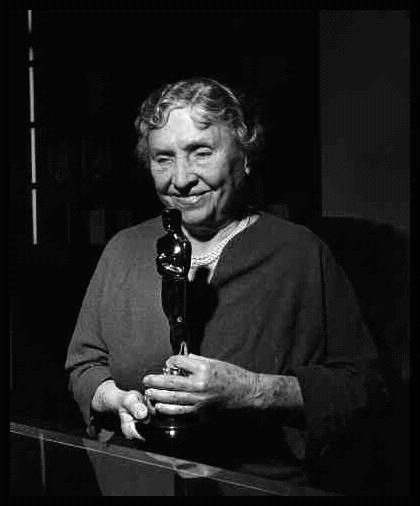 |
| Her Oscar for the documentary of her life. (dipity.com) |
Not only did Keller's charity work directly help people in need, but her achievements also allowed for society to view the disabled in a new light. Keller was born into a "...world that had extremely limiting ideas about what was possible for a deaf and blind woman to accomplish… Each lecture she gave, each article she wrote defied stereotypes and served to change the attitudes and expectations of her society" (Williams). Prior to Keller's accomplishments, American society regarded disabled people as inferior; not many believed that they could be educated in any meaningful way. Keller changed their attitudes through her own example and advocacy. Keller received countless awards including an Oscar for the documentary about her life, the Presidential Medal of Freedom, and the Alumnae Achievement Award from Radcliffe College. When people realized that the deaf-blind could be educated and successful, the disabled were given many more opportunities to flourish. Toward the later part of Keller's life, the disabled were no longer considered limited compared to healthy, "normal" people. Since Keller's passing, "...most Americans had come to agree that the severely handicapped, while entitled to special public and private considerations, were not in any other respects necessarily limited in their capacities. Such a notion would have been unthinkable in 1880" (Reiman). Disabled people were treated with newfound respect. Keller indeed played a critical role in how blind or deaf people, or any handicapped people are perceived today.
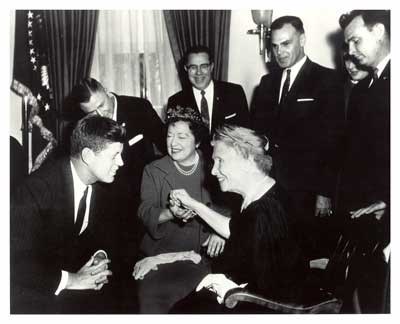 |
| President Kennedy respects Keller as a hero. (perkins.pvt.k12.ma.us) |
Keller once said that, "We can do anything we want to if we stick to it long enough... When we do the best that we can, we never know what miracle is wrought in our life or in the life of another." Keller's life-long mission, to help the disadvantaged was so selfless and inspiring. As a society, we can learn to help others to live better lives. It is important that we respect all people regardless of any disabilities they might have. Thousands of lives, mine included, have been touched by Keller's success. She is my hero because she constantly pressed on without complaining amidst adversities. Keller achieved much when she had so little. Without sight or hearing, Keller learned the entire alphabet and spelling techniques in a few months; without many people advocating for her, Keller became the first deaf-blind person to graduate from college with a Bachelor of Arts degree. If someone like Keller could accomplish those astonishing feats, what can healthy people do when they try their best? What can I achieve if I have Keller's strength, belief, and persistence? As a freshman student taking demanding honors classes, I sometimes question my ability to complete tasks. But Keller's accomplishments have taught me that as long as I keep at it, I can succeed in my goals. Keller's most prominent traits including her perseverance, compassion, and impact left on the world, made her a true hero.
Works Cited
Keller, Helen. The Story of My Life. New York, NY: Bantam, 2005. Print.
Lash, Joseph P. "KELLER, Helen." Notable American Women, The Modern Period: A Biographical Dictionary (Vol.4) (1980): 389. Biography Reference Center. Web. 14 Dec. 2011.
Reiman, Richard A. "Helen Keller." American National Biography (2010): 1. Biography Reference Center. Web. 13 Dec. 2011.
Williams, Donna Glee. "Helen Keller." Great Lives From History: The Twentieth Century (2008): 1. Biography Reference Center.Page created on 1/14/2012 12:00:00 AM
Last edited 1/14/2012 12:00:00 AM