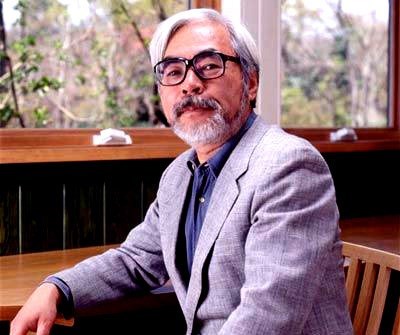
 Hayao MiyazakiLeamarie from San Diego Art can express many different meanings. A picture can't fill someone with happiness, sadness, or fear without the power from its artist. Langston Hughes once said, "An artist must be free to choose what he does, certainly, but he must also never be afraid to do what he might choose." ("Langston Hughes"), and animator Hayao Miyazaki became more than a free artist. Born in Tokyo, Japan on January 5, 1941 the young Miyazaki grew an influence in his father's aeronautical career and began his drawing interest during the harsh environment of World War II. When his family was forced to evacuate from their home to get away from the war zone he would often spend time drawing like any other child's hobby. However, his sketches of battleships, jet planes, and tanks never ended after childhood, but also became something more. As a young adult, Miyazaki entered Gakushuin University and began studying political science and economics to develop a recovery plan in aiding Japan from the outcome of the war, along with researching children's literature later impacting his animating career. After co-founding Studio Ghibli, a Japanese animation and film studio, he turned this into an advantage to amplify his animating skills. He used everything he studied from Gakushuin University and implied it into his movies to channel messages towards children as well as adults. These animated movies gained much fame and popularity, but intended something far greater than entertainment: a lesson vividly learned. Miyazaki's creativity and open mind is evident behind each of his colorful masterpieces that touch and inspire many people throughout the world.
Movies such as Spirited Away, Howl's Moving Castle, and Nausicca of the Valley of the Wind all have a different setting and idea emphasizing Miyazaki's style of creativity. Instead of trying to please a crowd by applying a general idea for a story with colorful pictures, he blends certain aspects of Asian folklore to European environments, along with contemporary to post-apocalyptic worlds, increasing its variety. "Miyazaki does not simply replicate the cutesy cartoon antics of critters as in the golden age of cartooning. Instead, he ponders timeless themes from Asian folklore and mythology, delves into the psyche of his characters, and occasionally inserts blood-spattered samurai action scenes and realistic depictions of everyday life in medieval Japan." (Authors and Artists for Young Adults). Aside from choosing to "imitate" a repetitive style, Miyazaki shaped art into his own hands by creating a different path of originality. He was able to stray away from the golden age of cartooning by coinciding plot and complex environments. The style of storytelling Miyazaki conveys through pictures is also his method of communicating to people and the world. "Miyazaki told Lawson that his primary task was to "tell truths in an emotional, involving way." However, he also noted, "It is not my job to make people think differently about animated movies. My work is in making us aware of subconscious worlds. It is always there. I'm just drawing it." (Authors and Artists for Young Adults). Miyazaki's goal isn't necessarily giving his viewers a different outlook on animated movies as a form of entertainment, but a way in promoting various themes helping people get involved and aware of what goes on throughout the world. This also reflects on how he implies messages, themes, and morals which give a distinct outlook on his movies. Miyazaki's success wasn't gained primarily for the fame; he wanted his own way of expressing a story with morals to pick up. His timeless movies continue touching the emotions of regular everyday people.
Most of the themes that build the foundation of these movies originate from a functioning, well-worked open-mind. An example would be the idea and plot of Howl's Moving Castle. "Mr. MIYAZAKI: (Through Translator) The movie really is a meditation on what if I had been bolder in 1944. If you opposed the war you would instantly be killed. But on the other hand, would I have joined the military and gone to kill for my country? No, so the question was: What is the alternative? And therefore, you have Howl running, running, running. It's a movie about running away from the reality of participating in a war." (Weekend All Things Considered (NPR)). In the time of his youth, Miyazaki believed that the use of violence to defend his country wasn't something he wanted be a part of. Howl's constant flee doesn't resemble cowardly distance from a fight, but symbolizes that war isn't always a solution to a problem. The aspect of Howl's flee depicts how Miyazaki promotes pacifism. Among many themes Miyazaki reuses, he promotes feminism.".Miyazaki has said, "[W]e've reached a time when the male-oriented way of thinking is reaching a limit. The girl or woman has more flexibility. This is why a female point of view fits the current times." (25) Nevertheless, Miyazaki's heroines stretch the conventional idea of femininity to the point, perhaps, of redefining it altogether, proving the 'flexibility' of the feminine and leaving us with something new--neither stereotypically masculine nor feminine, but human in the most hopeful sense." (Journal of Religion and Popular Culture). Feminism is included as one of Miyazaki's reoccurring themes, in which, is heavily expressed through the choice of gender of his many leading character roles (ex. Spirited Away, Kiki's Delivery Service, Nausicaa of the Valley of the Wind, etc.). When it comes to female characters, they appear strong and independent when they do things on their own unlike other plots where males possess those kinds of leading roles, while most females lack those elements. Not only did Miyazaki promote feminism through more involvement of female characters, he also constructed their personalities to the point of shaping a realistic human rather than a defined, flat stereotype. As famous and well-known Miyazaki's movies are today, he incorporates various themes, impacting people's minds and hearts.
"In our work, the question is how much you absorb from others. So for me, creativity is really like a relay race. As children we are handed a baton. Rather than passing it onto the next generation as is, first we need to digest it and make it our own." ('Hayao Miyazaki'). As Miyazaki said, he was able to turn simple drawing into a big idea. By doing this, he used art as a conduit to display a handful of meanings and interpretations. Children usually want to watch movies with these elements incorporated into the film: something colorful and bright, humor, and of course a happy ending. Miyazaki, however, took up a challenge for his work to appeal to any audience: children, adolescent, and adults. Many of his movies are unique and unrivaled in comparison to other animated movies: "Miyazaki is not just unusual for the content of his films, but also for the way he goes about making them. According to Time's Lee, Miyazaki often begins "constructing a film without a full script," letting the drawings lead the story." (Newsmakers). Combining his thinking and power of creativity inspires people all over: it's not how something is made but what's made from it. Hayao Miyazaki is an inspirational figure to me, not only because of his art or open-mindedness, but how he's able to connect those two and produce a symbolizing story. Using an open-mind and heart, it's not the simple colors or fascinating plot any other animator could casually provide; it's the message behind the plot and how the colors speak. Through Miyazaki's work, his heroism truly portrays that pictures can paint a deep meaning, a better understanding, and one-thousand words.
 Hayao MiyazakiLeamarie from San DiegoWorks Cited: Weekend All Things
Page created on 4/20/2012 12:00:00 AM
Last edited 7/26/2026 4:20:10 AM