José Francisco de San Martín Matorras, known as José de San Martín, was born on February 25th, 1778 in a small village called Yapeyú, located in the Argentinian province of Corrientes. Gregoria Matorras and Juan de San Martín were his parents, both Spanish, and he had four siblings.
In 1784 the whole family moved to Spain where he did his first steps as a military man. At the age of 6, he entered the Seminario de Nobles de Madrid where he started studying. After graduating, he joined the Regimiento de Muricia and some time later, he and his regiment were sent to a military campaign in Africa where they suffered from little sleep and hunger. Back in Europe, he joined the Ejército de Aragon where he fought against the French Forces. For more than a year, San Martín and his regiment were part of a naval squadron which was at war with the English. Despite a respiratory disease that would affect him the rest of his life, he went on fighting. For over two decades San Martín fought against the Moors, French, English and Portuguese.
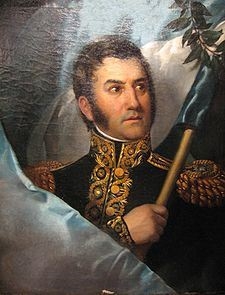 |
| José de San Martín (google image) |
Gradually he realized that he could not continue fighting against France, so he decided to continue their struggle in America. He undertook travel to Buenos Aires where he was named as the Commander of the Squadron of Granaderos a Caballo. That year he got married with an Argentinian woman, Remedios de Escalada, with whom would have a daughter called Merceditas. After a lot of battles in different South American countries, he achieved independence in Argentina, Chile and Peru from Spain. Later, he settled in Brussels. At the age of 72, he died in Boulogne-sur-Mer. His remains were repatriated in 1880 and now rests in a mausoleum built in the Cathedral of Buenos Aires. Many monuments in his honor were built in different cities of Argentina and some in the world.
In my opinion, he was, is and will continue being an icon in the history of South America because he was essential for the independence of a lot of countries in the continent. Not for nothing he is considered the most important liberator of South America.
Page created on 7/20/2009 12:00:00 AM
Last edited 7/20/2009 12:00:00 AM