 |
| A young girl with poliomyelitis. (http://www.healthgiants.com/wp-content/uploads/2009/12/polio.jpg) |
This photograph illustrates the pain thousands of children endured during the early 20th century. Multitudes of young children, like this little girl, were suffering from the incurable disease poliomyelitis, more commonly known as polio, a disease that cripples those affected. If the polio virus reaches the spinal chord, the results are deadly. Polio continued to infect children until 1954, when Jonas Salk’s creation of a vaccine effectively immunized the population. It was not only this act, saving nearly every child in America from the threat of polio, that qualified Jonas Salk to be considered a “hero”, but also his willingness to go through years of public ridicule, mocking, and skepticism to pursue what he knew was right. Through his heroic actions, Salk gave the country a sense of hope, at a time when it felt hopeless. He devoted his life to protecting others, and, in the process, became an inspiration to many.
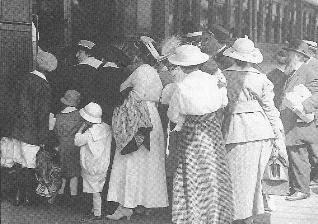 |
| People evacuating New York City in summer 1916. (http://www.umw.edu/hisa/resources/Student%20Projects/McCreedy/students.umw.edu/_lmccr9sd/poliovaccine/treatment.html) |
In October 1915, Jonas Salk was born in East Harlem, New York, to immigrant parents. The following summer, a tremendous outbreak of the disease polio spread like wildfire throughout the country. Infecting more and more children, this outbreak continued to rage throughout the summer. Public health officials ordered that sick children were to be taken away from their families to be quarantined, isolated, and sanitized. By the end of the summer of 1916, twenty-seven thousand babies in the United States had contracted the disease. Those who lived endured its crippling effects for the rest of their lives. Mothers across the country were sent into panic. Summer after summer, the disease returned, sometimes with a vengeance. Decades later, around the time of World Word II, Salk began medical trials to create a vaccine that would immunize the American troops from the flu. His vaccine for the flu was a success, effectively protecting the troops, making Jonas Salk very well known in the medical research community. As a result of Salk’s success with the flu vaccine, he was soon offered a job conducting polio research in a lab at the University of Pittsburg School of Medicine. It was in this lab that Salk introduced his killed-virus technique for creating a vaccine for polio. This technique was received with much controversy, as the live-virus technique was the accepted standard in the medical world. In 1953, Salk’s new type of vaccine began to undergo the largest clinical trial ever. The next year, in 1954, his vaccine was approved as safe for public use. Within five years, Salk’s vaccine virtually eliminated polio in the United States. Because of Jonas Salk, the United States would never endure another polio summer.
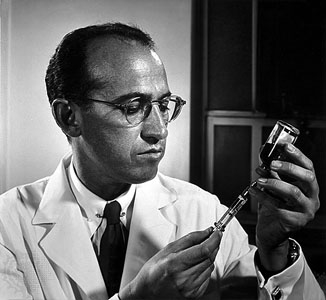 |
| Salk with his vaccine. (http://2.bp.blogspot.com/_93yxiAXcKgg/SBOenfI_fOI/AAAAAAAAAMc/PE1TCKogAQM/s400/Jonas+Salk.jpg) |
Jonas Salk is considered a hero mainly due to his devotion toward creating a vaccine for polio that ultimately saved thousands of children from contracting the crippling disease. Dwight Murray, the head of the American Medical Association at the time, called Salk’s vaccine “one of the greatest events in the history of mankind” (Vogt). Jonas Salk created a vaccine that ended the fear of parents and children worldwide. Immunization of the nation’s children virtually eliminated any new cases of polio arising in the United States within five years. In fact, what Salk did was so heroic even the president, Dwight D. Eisenhower, was honoring him. Eisenhower arranged to give Salk a special citation soon after the approval of his vaccine. Tearfully, Eisenhower stated, “I have no words to thank you. I am very, very, happy” (Vogt). This declaration from the president led Jonas Salk into instant media heroism and stardom.
For almost a decade, Jonas Salk endured skepticism, mocking, and criticism from the scientific community, as well as the public, for his use of the killed-virus technique. Sacrificing himself and his image, Salk did what he knew was right; a heroic feat. Salk went through many years of this criticism as, “fear, skepticism, opposition from medical colleagues who favored a live-virus vaccine, improper production of vaccine by some pharmaceutical companies, and a glaring Hollywood-like promotion for the vaccine caused much scientific criticism of Salk” (Jennifer L. Stong). Falling prey to this negative publicity, the public was skeptical of Salk’s type of vaccine. Even with Jonas Salk’s successful medical background, “Many people scoffed at the idea because it went against all of the current theories of viral research. The general scientific consensus at the time was that the body could only provide immunity to a virus that was still living. Salk brought up the idea of making a dead virus vaccine at a conference in New York, where he was laughed at” (Vogt). However, Salk knew he was correct, and devoted years toward creating a vaccine that would eventually save the population from polio.
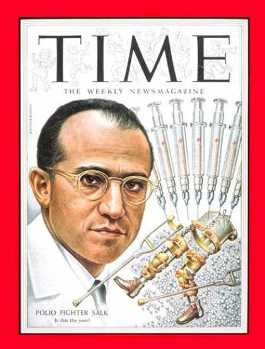 |
| Salk on the cover of Time Magazine in 1954. (http://www.coverbrowser.com/image/time/1622-1.jpg) |
Jonas Salk spent his whole life finding cures for many diseases, and, along the way, gave people a sense of hope. In doing so, Salk became an inspiration to many. “To this day, Salk remains known as the man who defeated polio” ("Salk, Jonas (1914-1995)" DISCovering Biography.) Eliminating the threat of polio was a momentous feat, and it didn’t come without complications for Salk. He went through much public skepticism and criticism to create a vaccine that ultimately saved thousands of lives; something very inspiring. After Jonas Salk’s vaccine gained success, he founded the Salk Institute for Biological Studies. The institute “attracted some of the best scientists in the world, all drawn by Salk’s promise of full-time, uninterrupted biological research.” ("Salk, Jonas (1914-1995)." Scientists: Their Lives and Works). Here, in this institute, Salk devoted the rest of his life to finding cures for numerous diseases. Jonas Salk could have lived a normal life, but he sacrificed much and devoted his all toward medical research. Salk helped millions; becoming an inspiration and a medical hero.
Page created on 5/21/2010 12:00:00 AM
Last edited 5/21/2010 12:00:00 AM