 |
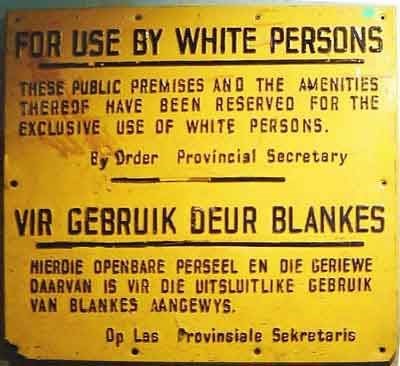
| Example of Apartheid signs (http://www.southafrica.to/history/Apartheid/apartheid.jpg) |
Introduction to Apartheid: In the seventeenth century, Dutch farmers and sailors settled in South Africa. Many of these settlers were religious extremists, and thought that the land was given to them by God, often conflicting and disregarding the African natives. This was the beginning of the discrimination that would eventually lead to the racist regime known as Apartheid. Fast forward to the 20th century, and the descendants of the Dutch, known as Afrikaners, have gained control of the country from the British. There was an uneasy power struggle between political parties until the 40s when the Afrikaner National Party took a majority. To keep control of economic and social order, and to make sure a future power struggle didn’t occur, the party created a plan of institutionalized segregation This was Apartheid. Apartheid was a plan designed to segregate races, Blacks, Coloureds, and Whites, so that Whites were in control of the economy/government, and Blacks and Coloureds were at the bottom serving as cheap labour. Laws were passed such as the Pass laws which revoked Black and Coloured rights and kept the more government control over them. By the 1950’s and 60’s there where several prominent leader protesting the Apartheid laws, among them being Joe Slovo...
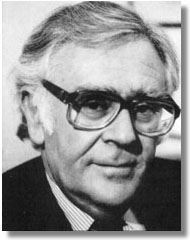 |
| Joe Slovo himself. (http://www.sacp.org.za/people/slovo/joe.jpg) |
Biography (Kevin):
May 23, 1926-January 6, 1995. Yossel Mashel Slovo (Joe Slovo) was born and raised in Obelai, Lithuania in northern Europe. Slovo’s family immigrated to South Africa in 1935 when the anti-Semitism in Europe began. When 1941 hit Slovo got kicked out of school and joined the allies to fight against fascists in WWII. After the war in 1946 – 1950 Slovo studied law at the University of South Africa. In 1956 Slovo, Nelson Mandela, Walter Sisulu, Oliver Tambo and 152 others were arrested for high treason and charges under the Suppression of Communism Act. Slovo got detained for two months. Slovo completed a master’s degree in law at the London School of Economics in 1966 and in 1985 Slovo became the first white member of the National Executive Committee of the ANC. When Slovo died in Johannesburg on 6 January he died from a long battle with bone marrow cancer. On January 15th, Mandela spoke of Slovo by saying that he "leaves the South African working class - black and white - a challenge, particularly now that the walls of racial division are finally collapsing: the time for unity has come! (Mandela)”
Fight against Apartheid(Bre Sams):
Joe Slovo fought against apartheid in various ways. He became a legendary white communist, and got close to Nelson Mandela to fight the struggle against apartheid. The Communist party leader fought against apartheid for decades with bombs, strikes, and negotiating skills. He was a national chair man of the South African Communist Party and the first white member of the executive of Mandela’s African National Congress, the one time outlawed party that won power in April.
Slovo led the ANC’s guerrilla wing(Umkhonto we Sizwe) after the movement decided whites would never surrender their power without a fight. "When the ANC committed itself to peaceful negotiations 30 years later, Slovo devised the crucial comprise under which the ANC and the National Party, which imposed apartheid, shared power."
In 1956, Slovo, Mandela and 154 others were charged with treason for their support of the Freedom Charter, which Joe helped create. The charter called for a non-racial democracy and proclaimed, “South Africa belongs to who all live in it, black and white.” All were acquitted five years later. When the government banned the ANC and communist party in 1960, Slovo and Mandela embarked on a sabotage campaign. Following Mandela’s arrest, Slovo then fled into exile in 1963. In 1990, he returned to South Africa and proposed a series of “talks about talks” and in 1992 proposed negotiations to end apartheid. After the elections of 1994 he became Minister of Housing until his death in 1995 from cancer. His funeral was attended by Nelson Mandela and other important officials.
Source: "The History of Apartheid in South Africa." The History of Apartheid in Sotuh Africa. Stanford University, Feb.-Mar. 2010. Web. 22 Feb. 2011. http://www-cs-students.stanford.edu/~cale/cs201/apartheid.hist.html.
Slovo, Yossel M. "Joe Slovo Biography." moreorless : heroes & killers of the 20th century. www.moreorless.au.com · 2000-2011 , 31 Jan. 2001. Web. 18 Feb. 2011. http://www.moreorless.au.com/heroes/slovo.html.
Page created on 3/8/2011 5:29:21 PM
Last edited 3/8/2011 5:29:21 PM