 |
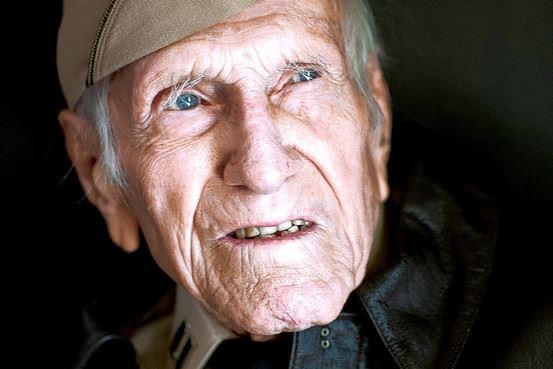
| Louis Zamperini (https://dailymedal.wordpress.com/2014/07/03/war-he ()) |
The sunrise was beautiful, yet it meant that he was going to be tortured for the next couple of hours. Nights at the camp were cold and whimpers of despair rung with the wind. Thousands of men cried out and lost all hope, but he still had an ember glowing from within. "Hope is being able to see that there is light despite all of the darkness" ("Desmond Tutu"). Similar to this quote, Louis Zamperini, a true war hero, sought after hope and forgiveness in the midst of his trials. He was determined to keep whatever "light" he had left inside of his heart. Zamperini started out as a young Olympic runner, determined to get better each day. He later was a World War II bombardier soaring above the clear waters of the Pacific and fighting for America. Louis' days of flying came to a halt when his plane spiraled towards the sea. He survived the devastating crash, but spent nearly forty- seven days aimlessly floating on a life raft. When hope of rescue came to sight, it turned out to be the enemy. Louis and his companions were captured and labeled as prisoners of war. Day after day, he felt the torture of his captors both physically and mentally (Berkow). Although Louis experienced trials that were too hard to forget, he forgave those who abused him during capture. Zamperini kept his hopes up for a better tomorrow and looked at the world in a positive light. Louis Zamperini's valiant acts of persevering when hope vanished, and forgiving his ruthless captors of abuse, prove he is both a hero and an example.
Amidst each and every trial that was thrown at him, Zamperini pressed onward with faith that there would soon be light at the end of the tunnel. He was courageous during his "storm" displaying traits of pressing onward and never giving up. He needed every drop of courage that could be mustered from within as a prisoner of war. Life slowly wilted away as "Zamperini was bedeviled by one Japanese soldier in particular. Mutsuhiro Watanabe was called the Bird by other prisoners. He was determined to break Zamperini by beating him and degrading him in any way possible"("Louis Zamperini"). Louis' mind was altered by something as simple as cruel words. He stood tall while words of hate were spat at his face. The one side of his already degraded character that hadn't vanished, was his optimism. The ability to see the good in a tribulation, is a trait many seek after. Ever since Zamperini was a young child, "... he was confident that he was clever, resourceful and bold enough to escape any predicament... When history carried him into war, this resilient optimism would define him" ("Life of faith and forgiveness"). Louis is a confident, courageous man with hope shining through his eyes. Positivity fastened to his heart and held on in the darkest times. This ability provided mental strength and courage when the world was trying to bring him down. Louis kept a firm foundation on what he believed would get him through the war; he said, " '...you have to have confidence in yourself and believe that no matter what you're faced with, you can deal with it - that you just can't give up.' " (Berkow). Life threatening trials were constantly thrown across his shoulders testing his faith and outlooks on the world. Louis persevered through abuse, starvation, and war by believing his life would be better than the one he had at the time. Zamperini's decision to follow the narrow path of optimism gained him courage to get past his darkest nights. This act of bravery widened his view and eventually enabled him to do something much more beautiful; forgive.
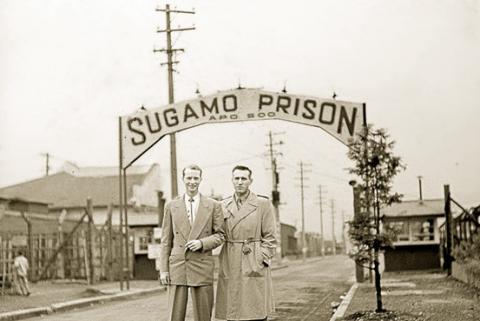 |
| Louis stands in front of his past prison camp. (https://www.awesomestories.com/asset/view/FORGIVEN ()) |
Louis' choice to make a change in the way he thought of those who tormented him revealed his true desire to forgive and to stop dwelling on the past. Having gone through war, starvation, and deadly adventures, the time at the camp was one of the hardest for him. " 'I could take the beatings and the physical punishment,' Mr. Zamperini said, 'but it was the attempt to destroy your dignity, to make you a nonentity that was the hardest thing to bear' " (Berkow). These stone-hearted soldiers knocked him to the ground, and they got up each day to spend their time crushing hearts of the once strong American soldiers. The Japanese soldiers beat and punished Louis Zamperini for their amusement. He shattered while they slowly tore apart his character and forced worthlessness upon his broken soul. The countless decisions his captors made, lead to an even harder healing process of forgiving those men. The prison camp was discovered later on and the remaining American soldiers were finally released. Louis and thousands of men believed the mental torture of war would end; the agony returned once more. He went through countless recollections of his trauma as a prisoner. Zamperini said, "...nightmares came every night...I honestly wanted to go back to Japan and secretly find and kill him before I'd be satisfied...I felt this perfect calm...I'd forgiven all my prison guards." (Meroney). After the constant urge of revenge, a sense of renewal came upon him. The hate many have towards cruel people can grow larger and injure a person from within. Louis had a strong character, but it was weakening from his old memories of a poisonous man. The understandable loathing he had for his captor and abuser disintegrated. Zamperini found a way to see into the man's soul and forgive him. Forgiveness takes time, and for Louis it took many months. He still had scars and bruises on his mind from the unspeakable past. Although he struggled to forgive, the moment he could open up and allow love to seep in helped him understand its meaning. "He felt something that he had never before felt for his captors...something shifted sweetly inside him. It was forgiveness, beautiful and effortless and complete. For Louis Zamperini, the war was over" ("Life of faith and forgiveness"). Louis took the time to think of the hate within that was slowly poisoning his heart. After recognizing his survival at war was rare, he realized that there was more amazing things to think of than hate. Small, yet simple miraculous things occurred on his journey. These little miracles were hardly remembered when hope appeared. Louis teaches that instead of dwelling on the past of another man's poor choice, we should forgive and be grateful that we lived through it.
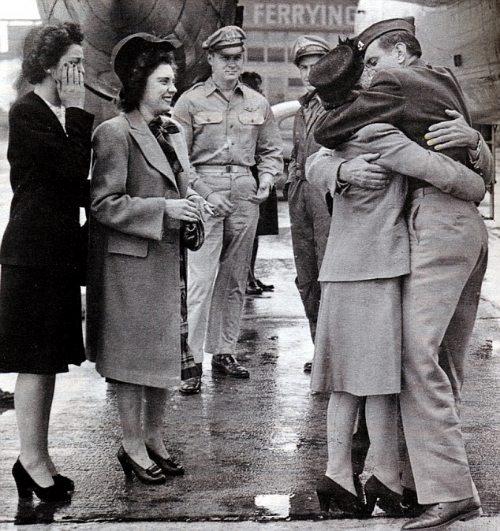 |
| Zamperini embraces his family after years of war. (http://operationmeatball.squarespace.com/new-girlb ()) |
Zamperini's courage to seek the positive while at war, and the new found desire in forgiving those who abused him, made Louis an inspirational man. He was brave in dire situations that almost led to his death. Optimism encouraged his soul to perk up and to push onward to the end. He was trying to gain positivity while being constantly abused as a prisoner of war. Zamperini recovered from his past and let go of burdens by forgiving his captors. Louis said, "...forgiveness has to be complete. If you hate somebody, it's like a boomerang that misses its target and comes back and hits you in the head. The one who hates is the one who hurts"(Meroney). He had personal experience with this statement. He learned valuable lessons and continued to live up to them by setting an example for those nearby. Although many would hope for a flawless and perfect hero, a true hero is one who learned from their personal mistakes and taught others how to live a better life. Louis Zamperini is not only a hero, but a man who grew strong upon his wisdom. He inspires others because he was courageous when a trial confronted him, and forgiving of those who contributed to his tribulations. His flawed character inspired thousands. This example of being able to renew a heart with forgiveness and give life a better view through optimism, brought many to look up to him. Louis was imperfect, yet he learned how to forgive and love those who may not love him back. His dark days were brightened by the unbreakable rays of hope. Once again, Zamperini walked outside, feeling the air whisper sharp words into his ears. He closed his eyes and opened them once more, yet a little slower. Along the horizon, colors ribboned out across the pale sky. The sun was rising, and beautiful, warm colors lit up the mens' faces. A smile silently crept up the the corners of Louis' cheeks. There is hope.
Works Cited Berkow, Ira. "Louis Zamperini, Olympian and 'Unbroken' World War II Survivor, Dies at 97." New York Times, 4 July 2014, p. B16(L). Biography in Context, link.galegroup.com/apps/doc/A373631918/BIC1?u=powa9245&xid=425c79ca. Accessed 18 Jan. 2017. "Desmond Tutu." BrainyQuote.com. Xplore Inc, 2017. 25 January 2017. https://www.brainyquote.com/quotes/quotes/d/desmondtut454129.html "Life of faith and forgiveness." Washington Times [Washington, DC], 25 Feb. 2011, p. B06. Biography in Context, link.galegroup.com/apps/doc/A249974714/BIC1?u=powa9245&xid=dcdb98d4. Accessed 19 Jan. 2017. "Louis Zamperini." Gale Biography in Context, Gale, 2014. Biography in Context, link.galegroup.com/apps/doc/K1650009447/BIC1?u=powa9245&xid=bbbfa43e. Accessed 12 Jan. 2017. Meroney, John. "'World War II Isn't Over': Talking to Unbroken Veteran Louis Zamperini." The Atlantic, Atlantic Media Company, 11 Nov. 2014, www.theatlantic.com/politics/archive/2014/11/world-war-ii-isnt-over-talking-to-unbroke n-veteran-louis-zamperini/382616/.
Page created on 2/7/2017 12:00:00 AM
Last edited 2/7/2017 12:00:00 AM