 |
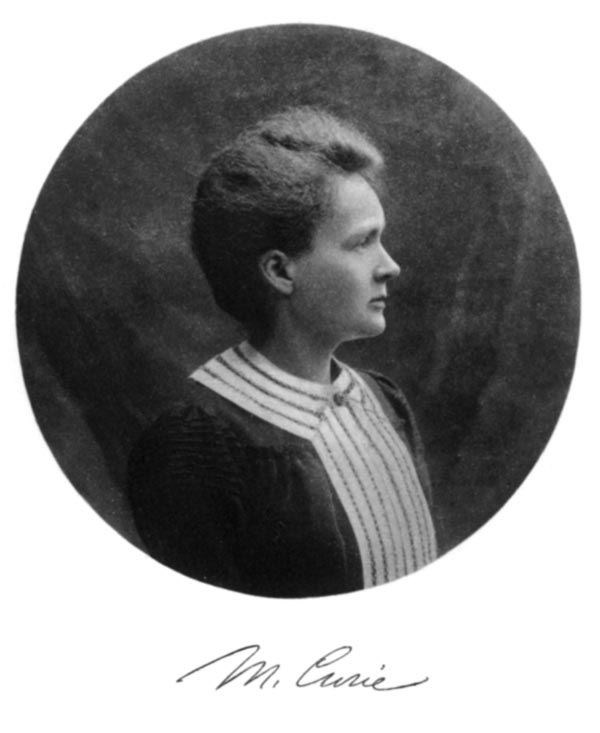
| A portrait of Mme. Curie with her signature. (http://upload.wikimedia.org/wikipedia/commons/e/e8/Marie-noble-portrait-600.jpg) |
According to the Center for Disease Control and Prevention and the National Cancer Institute, 9.8 million cancer survivors live in the United States today (National Cancer Institute). The number of lives saved from cancer has greatly increased since years past and continues to grow, thanks to developments in treatment and advances towards a cure. However, where did it all start? How did treatment originate, who made the first breakthrough? To answer this question, we must turn to the hard work and sacrifices made by the Polish scientist Marie Curie. A pioneer in the field of radioactivity and a two time Nobel Peace Prize winner, Marie Curie is synonymous to a hero for all that she endured for education and research, sacrifices for society, and selfless behavior.
Born Marie Skłodowska on November 7, 1867 in Warsaw, Poland, she expressed great interest in school and studies at a very early age. After completing her secondary education, she continued her studies at the Floating School of Warsaw, an underground association of eager scholars. At the time, her sister Bronya studied medicine in Paris, and made arrangements for Marie to join her. While studying physics at the Sorbonne in Paris, she met Pierre Curie. Their first meeting was “movingly recorded in the future Madame Curie’s recollections”(Jaki), for she was so amazed by how much they had in common, and by his deep, thorough understanding of the sciences. They married soon after she graduated, marking the beginning of “a most extraordinary partnership in scientific work”(Jaki). Their marriage produced two daughters, the discovery of radiation and two new elements, two Nobel Peace Prizes, and much more.
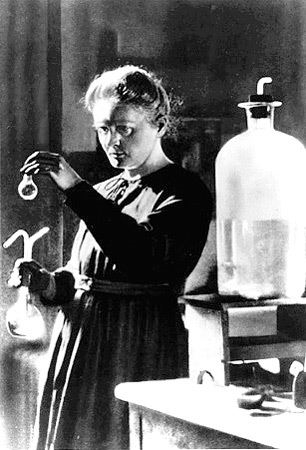 |
| Marie Curie with flask. (http://reich-chemistry.wikispaces.com/file/view/Marie_curie_pic.jpg/98628437/Marie_curie_pic.jpg) |
Marie Curie was a devout scholar, a characteristic evident since childhood, and her love for learning and discovery helped her overcome formidable obstacles and persevere until the end. Life in France was very expensive, and the money her family sent her couldn’t adequately cover her living fees. “Too proud to ask for additional assistance, she subsisted on a diet of buttered bread and tea, which she augmented sometimes with fruit or an egg. Because she often went without heat, she would study at a nearby library until it closed. Not surprisingly, on this regimen she became anemic and on at least one occasion fainted during class”(Curie). At the cost of her own health, she did not ask for any additional assistance, and continued her studies faithfully. Though she was in no way obligated or expected to go to college, she stayed in Paris. As a result, she “took her degree in physics in 1893, graduating first among her classmates, and ranked second for the degree in mathematics the following year”(Weiss). To do something beyond what is demanded of her shows a great sense of integrity and responsibility. She decided that a thorough and complete college education was the best choice that she could make for herself, and her motivation to fulfill her wish helped her overcome her difficulties. Later in her life, her husband was tragically killed by a carriage, leaving her to care for their daughters and their research. “Shock broke her down totally to begin with. But even now she could draw on the toughness and perseverance that were fundamental aspects of her character. When she was offered a pension, she refused it: I am 38 and able to support myself, was her answer”( Fröman). The easiest thing for her to do would have been to mourn her beloved husband’s death, forgetting about everything else. However, she chose to rise above her despair and take a huge leap forward, carrying on with work that would become her lasting legacy to the world. Through these instances in her life, Mme. Curie has proved herself to be a persistent and resolute woman, merely backbones to her heroic character.
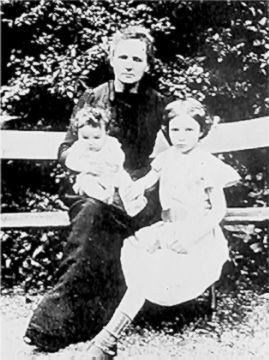 |
| Marie Curie with daughters Irene and Eve. (http://www.munich-photonics.de/uploads/pics/Marie_Curie_mit_Irene_und_Eve.jpg) |
The “body” of her heroism comes from her sacrifices for the advancement of her scientific research, sacrifices of time, money, and ultimately her life. Soon after her marriage to Pierre, they embarked on a long journey of groundbreaking studies, one that would only come to a close with their lives. Their work was physically intensive and exhausting, and by no means easy, they sought a lab to extract the uranium ore from the tons of pitchblende they received. “After long search, the Curies had to settle for a shed occupying part of a courtyard in the School of Physics and Chemistry”(Jaki). Rather than waste any time searching for a more suitable laboratory, they continued with all of their work at that site, despite its shoddy, far from idealistic status. She gave up the comforts of a laboratory like other accomplished scientists and settled for the first one she encountered, starting to work as soon as she could. Not even those terrible conditions could hold them back, however, as the discoveries of two new elements there exemplify. Towards the end of her life, all of the hard work that had burdened her body finally caught up to her. “She died on July 4, 1934, of leukemia, probably caused by years of exposure to radiation”(Crawford). In the end, the very thing that she cared for the most killed her – her research. Although she and her husband had formerly speculated at the more precarious side of radiation, she continued her research despite the dangers, and ended up losing her life in the process. Knowing the dangers before proceeding to potentially harm her proves her martyrdom, as she willingly gave up her life to further the development of her research. Naturally these sacrifices were difficult, but as they yielded benefits for the greater good, Madame Curie nobly gave up what she had for those that her sacrifices would influence.
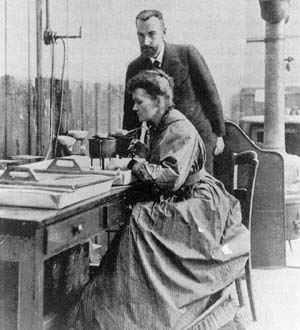 |
| Marie and Pierre Curie. (http://www.bonzasheila.com/stories/images/mariepierrecurie2.jpg) |
Despite her life drawn short by a terrible disease, Marie Curie still accumulated a long list of achievements, and made just as many selfless contributions to society. At the Sorbonne, “she had received the Alexandrovitch Scholarship, which enabled her to continue her education free of monetary worries. Many years later, Curie became the first recipient ever to pay back the prize. She reasoned that with that money, yet another student might be given the same opportunities she had”(Curie). It was well known that she lived in poverty for most of her life, but in a remarkable act of gallantry, she managed to find the money to repay her scholarship. She could have used her money for so many other things, but she chose to help another student get an education like hers. In addition, she also played a major role in World War II. Using her knowledge of radiation, equipped X-ray machines to automobiles, producing what were known as “Little Curies”. With these, many lives were saved on and off the battlefield. “By the end of the war Curie was past her fiftieth year with much of her physical energy already spent, together with her savings, which she had patriotically invested in war bonds. But her dedication seemed to be inexhaustible” (Jaki). Although Poland was her homeland, she sought to help out the war effort from France in any way possible. Never did she review in a negative light the money she invested into the war, and looked only for the positive effect that it had. These honest acts of kindness truly express how considerate a person Marie Curie was.
When a stone is thrown in a pond, the impact creates ripples that continually spread outwards. Like a stone, Madame Curie’s actions continue to touch us today. She has saved lives and made world altering breakthroughs in the world of science. Her perseverance, sacrifices, and self-sacrificing behaviors have proved her a deserving hero. A teacher by her actions, we learn that we must never give up, to look towards the future when making our choices, and to willingly give up what little we have no matter how little is left. She may have lived in another time, but her legacy outlives her, proving that hard work does indeed pay off.
Page created on 5/20/2010 12:00:00 AM
Last edited 5/20/2010 12:00:00 AM
Crawford-Brown, Douglas John. "Curie, Marie Skłodowska." [Online] Available World Book Advanced. 2010..
No, Author. "Curie, Marie (1867-1934)." [Online] Available http://find.galegroup.com/srcx/infomark.do?&contentSet=GSRC&type=retrieve&tabID=T001&prodId=SRC-1&do. 2003.
Fröman, Nanny. "Marie and Pierre Curie and the Discovery of Polonium and Radium." [Online] Available http://nobelprize.org/nobel_prizes/physics/articles/curie/. 01 12 1996.
Jaki, Stanley L.. "Curie, Marie Sklodowska (1867-1934)." [Online] Available http://find.galegroup.com/srcx/infomark.do?&contentSet=GBRC&type=retrieve&tabID=T001&prodId=SRC-1&do. 1998.
No, Author. "Number of Cancer Survivors Growing According to New Report." [Online] Available http://breastcancer.about.com/b/2010/03/03/marie-curie.htm. 03 March 2010.