 |
| finance.yahoo.com () |
An extraordinary man once said, "You must not lose faith in humanity. Humanity is an ocean; if a few drops of the ocean are dirty, the ocean does not become dirty." This was said by Mohandas K. Gandhi and truly expresses his bold and humble character. On October 2, 1869 in Porbandar, India, Gandhi was born. Mahatma means great soul which is how he lived and stayed true to his entire life. Gandhi began and joined several important movements. One of the things Gandhi did was travel to London to become a barrister on September 8, 1888 after his father told him to. Gandhi also moved to South Africa in 1993 and stayed for three years for a lawsuit to help unite India with other nationalities. On July 31,1907 he went to Britain to start a nonviolence group with joined cultures. Gandhi gathered a group of his race to contribute to World War I by being nurses to the wounded soldiers. Gandhi did this so that the British could start to trust and form a relationship with India. The biggest movement that he started was the Great March between Charleston and Volksrust. The Great March was for gaining the rights of Indians. Gandhi created humanitarian pursuits and leadership as he helped gain other cultures trust and respect for Indians through adventurous movements. He also showed whole hearted forgiveness when he was shoved off a subway because of his ethnicity and didn't fight back, but prayed for a good relation and peace with others. Mohandas Gandhi is more than an ordinary man, he was an influential hero because of his humanitarian pursuits, his inspiring forgiveness, and for his astounding leadership to others.
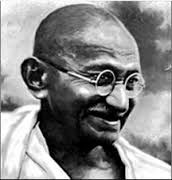 |
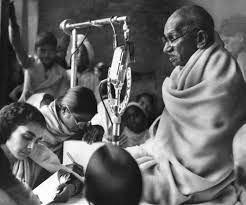
| This is a picture of Mohanda K. Gandhi when older. (dwardmac.pitzer.edu ()) |
The book The Importance Of Mohandas Gandhi, by Mary and Mike Furbee, informs readers about a religious leader who desired humane pursuits named Gandhi. In July of 1914 Gandhi went home from South Africa after he helped the British during World War I. Gandhi decided that he wanted to go back to South Africa a few years later, "In 1919, Gandhi launched an organized campaign of passive resistance in response to Parliament's passage of the Rowlatt Acts, which gave colonial authorities emergency powers to suppress subversive activities" (Mohandas Gandhi). His humanitarian pursuits are because he created an organization to stop nonviolence with the British to keep peace with India. The fact Gandhi cared enough about resolving feud between two groups shows how he wanted to encourage India's welfare. To go along with the non violence in Britain, South Africa had issues simultaneously, "Gandhi spent twenty one years in South Africa, and it is here his political views and leadership skills were developed" (Mahatma Gandhi). Gandhi himself was dedicated to his religion along with his country. He traveled to South Africa for twenty one years to spread nonviolence and understanding for his culture. Mahatma Gandhi was a man who always put his country and religion before anything and was dedicated to making his country a more peaceful place.
Mohandas Gandhi touched and affected people's lives because of overcoming his life difficulties. In 1931 Gandhi decided to stop his resistance movement so he could further help British Congress. "Arrested upon his return by a newly aggressive colonial government, Gandhi began a series of hunger strikes in protest of the treatment of India's so-called "untouchables" (the poorer classes), whom he renamed Harijans, or "children of God" (Mohandas Gandhi). Instead of fighting back or trying to disagree with his punishment for protesting his rights for India, Gandhi decided to keep pushing to try to get others to accept India. Despite his roadblocks such as going to prison, he chose to overlook the hatred and disagreement while pushing what he knew was best for everyone. "Gandhi's peace-loving philosophy developed over the course of several years as a reaction to the widespread violence, racial and religious intolerance, and social divisions and injustices he witnessed in South Africa during the 1800's" (Mahatma Gandhi). Throughout all the violence and lack of acceptance going on between different cultures, Gandhi had forgiven the British by finding peace within their cultures so that he could help contribute to Britain. He contributed to many lives through is overcoming and optimistic personality. Gandhi's strength and beliefs contributed to his astounding leadership by having achieved nonviolence and peace with India.
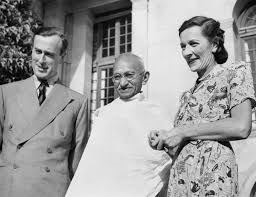 |
| Gandhi with the couple of last British Viceroy. (en.wikipedia.org ()) |
By 1920 Gandhi became a well known Indian leader in India's lives, "Gandhi stressed the importance of economic independence for India. He particularly advocated the manufacture of Khaddar, or homespun cloth, in order to replace imported textiles from Britain" (Mohandas Gandhi). Gandhi liked to lead and instructed many influential and inspiring movements for India. He made sure he did everything he could with regard to make his home, India, a comfortable and peaceful country associated with other religions. Gandhi eventually followed through with his non violence campaign. His strive for independence upon India started touching speeches from other well know role models. "Just as he summoned Indians to seek their destiny, he influenced champions of equality in my own country, including a young preacher named Martin Luther King. After making his pilgrimage to India a half-century ago, Dr. King called Gandhi's philosophy of nonviolent resistance "the only logical and moral approach' in the struggle for justice and progress" (The Spirit Of Partnership Between Our Nations). When Gandhi started the nonviolence campaign and Martin Luther King explains his appreciation of Mohandas's influential and courageous personality because of the accomplishments Gandhi created. "Inspired by the salt march, young supporters of Gandhi take seawater in vessels to create their own salt. All along India's coasts, people carried out similar demonstrations to protest the salt laws." His leadership moved hundreds of people to contribute to peace within India and Britain. Gandhi looked for ways to best contribute to the welfare of others and his country.
Gandhi was an outstanding non violence activist changing the Indian culture because of his social perception and legal changes. He looked for the best in everyone, walked and joined organizations to enrich India with unity, and forgave to proceed in what is most important which is a good relationship with other countries. A global humanitarian icon, Gandhi, is said to have been a unique character in South African and Indian global history. Mahatma (which means 'great soul' in Sanskrit) lived up to his name gracefully though his lifetime. Even through the difficulties along Gandhi's journey to success, he made one of the most remarkable changes for a country, peace. This shows all of Gandhi's best interests and his wonderful intentions for others. These aspects inspire me because someone who is benevolent like himself, makes me want to be and do good for others as well. I want to make change for the best of my community and help others in need just like Gandhi did. A hero isn't measured by simple acts of kindness or wanting to be known, a hero is someone born to make a change and whole heartedly seeking social or humanitarian change for the best of everyone.Page created on 2/15/2016 12:00:00 AM
Last edited 2/15/2016 12:00:00 AM