 |
| (http://pictures-sunny-raj.blogspot.com/2010/09/mahatma-gandhi.html) |
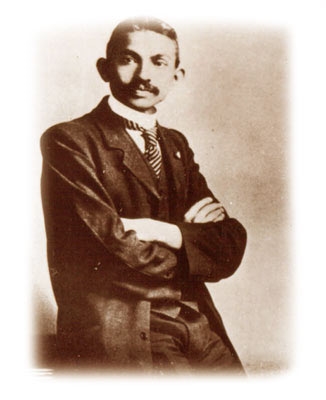
“Loyalty and devotion lead to bravery. Bravery leads to the spirit of self-sacrifice. The spirit of self-sacrifice creates trust in the power of love.” Said Morihei Ueshiba. These traits have a direct correlation with Mohandas Gandhi, as they are the traits that describe him best. No one would have guessed that the normal boy from a middle ranking family would grow up to be one of the greatest influential leaders of all time. After completing law school Gandhi was hired to work in South Africa. During his work in South Africa he observed hate, violence and racism, which changed his views on life. He no longer sat on the sideline and watched what was happening, he decided to make an impact. “In 1906 Gandhi formed the satyagraha movement of passive resistance. This became the centerpiece of his activities until death.” (“Mohandas”) Under this platform in 1919, “Gandhi lunched his first nation wide civil disobedience campaign.” (“Mohandas”) Gandhi was the face that gave others a sense of freedom and hope. However he was not just an icon of the movement. Gandhi was the heart and soul. Later on in his life, this strong determination and devotion lead him to give up everything in his life to see India free from British rule. Gandhi is a hero not only because of his bravery to lead against challenging odds, but also because he was willing to sacrifice his own life for the greater good. Gandhi has inspired people around the world by showing them that they can make a difference through courage, perseverance, and hard work.
 |
| Gandhi leading march (http://www.kamat.com/mmgandhi/gandhi.htm) |
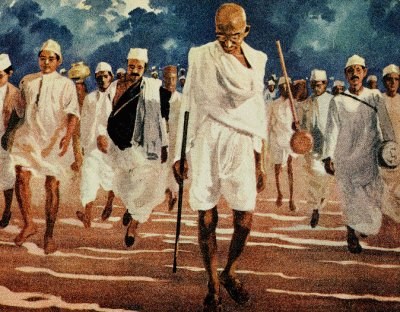
Bravery can be defined in many ways and Gandhi represented it with passive resistance. In 1906, “Gandhi reacted by organizing a movement for "passive resistance" to the law, a movement that became known as Satyagraha, the Force which is born of Truth and Love." Satyagraha, or passive resistance, became the centerpiece of his activities until his death.”(“Mohandas”) After he moved from South Africa, Gandhi had the courage to stand up to the British government, and its army without weapons. Gandhi strongly believed that he should use passive resistance to free India. In 1919 “Gandhi launched the first nation-wide civil disobedience campaign. Scattered violence, however, marred the strike and prompted a swift and brutal response from local British officials…Nonetheless, he also hesitated to fully exercise his influence lest violence break out again.”(“Mohandas”). Gandhi was courageous enough to create his first campaign knowing that it would have consequences, but he also did not want violence to be a part of his campaign. Gandhi knew his actions influenced people but he did not want his campaigns turning into massacres. Gandhi led one of the greatest marches in history, “The 'Salt March' of 1930 was designed to flout the government's heavily taxed monopoly on the manufacture of salt by marching to the coast to take salt directly from the sea. Gandhi reached the sea in April, scooping up the first piece of natural salt himself, and calling on all Indians to emulate his actions in defiance of the government.” ("Mohandas”) Gandhi gallantly led one of his most famous marches knowing that there would be a punishment. Gandhi’s courageousness leads him to send a clear message to the British government that India no longer wanted them ruling their country. Gandhi courage outshined all around him showing that he had the nerve to stand against British rule to one day create a peaceful, free India.
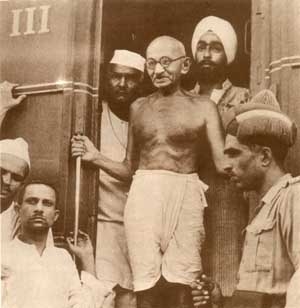 |
Gandhi is a hero because he is willing to sacrifice his own life for the good of others. Gandhi often got his point across to the British government by putting his life on the line... “Along with thousands of others, Gandhi himself was arrested in 1922 and sentenced to six years in prison for seditious conspiracy.”("Overview of”) Gandhi showed that he was willing to go to jail if it served the final goal. Gandhi never gave up no matter how harsh the punishment was, “When rising communal violence threatened to make the newly free subcontinent ungovernable, Gandhi spoke out passionately for religious tolerance and began a "fast unto death" to protest the bloodshed.”(Martin) Gandhi stood up for peace so much so that he decided that the welfare of the country was greater then his own. No matter what people said or did he still strived to end violence. Even during his early days in South Africa, he showed the same character of self-sacrifice. He was imprisoned many times in South Africa, which played an important role in putting the pressure on the South African government to deal with the Indians.” (Mohandas) Later in India, Gandhi would spend time in prison again, but he ultimately achieved what he wanted, awareness that India wanted freedom. Gandhi was nicknamed the mahatma meaning great not only because it sounded like his name, but also because of his way of thinking and his Ideas. Gandhi lived up to his nickname by sacrificing himself to create a better world for those who lived around him.
Gandhi not only courageously organized marches to help free India, but also unselfishly led India to freedom. Gandhi remains an inspiration to this day because of his values and what he did for India. In the words of Ueshiba, Gandhi’s bravery led to his self-sacrifice. Without these qualities Gandhi would have never been able to lead a whole country to freedom. Gandhi has many characteristics that influence his actions, “Above all, Gandhi's personal example of self-abnegation, his courage and perseverance, and his tolerance and humanity remain a source of inspiration to millions worldwide.”(Overview of) What makes Gandhi an inspiration are his values. Without them he would have been able to remain strong thru all the difficult periods. Gandhi led India to freedom, “Nationalist, moral and spiritual leader in India's struggle for independence from Great Britain. He advocated passive resistance, civil disobedience, and boycotts to force the pace of social and political reform.” (Martin) Gandhi lives in the hearts of many as one of the greatest non-violence leaders of all time. His courage and mind set made him truly a mahatma.
 |
| (http://www.zazzle.com/mahatma_gandhi_quote_poster-228260596063571701) |
Page created on 5/26/2011 12:00:00 AM
Last edited 5/26/2011 12:00:00 AM
Martin, Brian. ""The Thin Line That Ended Partition." ." none. 2003.
Baughman, Judith. ""Mohandas Gandhi." ." none. 1998.
author, no. ""Overview of Mohandas Karamchand Gandhi." ." none. 2003.
GANDHI RESEARCH, FOUDATION. "WELCOME TO MAHATMA GANDHI ONE SPOT COMPLETE INFORMATION WEBSITE." [Online] Available