Mohandas Karamchand Gandhi
by Victoria from San Diego
"We must be the change we wish to see in the world"(Gandhi). In this quote, Gandhi shows his true dedication to want to see a change for the better in this world. He lived up to this phrase, truly doing what he wanted to see changed in the world proving the drive that he had towards making peace, which creates a hero in Gandhi. Born Mohandas Karamchand Gandhi on October 2, 1869, later known as Mahatma Gandhi(Mahatma meaning 'great soul'). Gandhi was an amazing spiritual leader who used his influence for both social and political reform. In London, he studied law before he went to South Africa in 1893. For 20 years, he worked to oppose discriminatory legislation for the Indians of South America. In Gandhi's life he accomplished many things including being a successful lawyer in South Africa, leading a 200 mile salt march so the people of India didn't not have to purchase from the British but could collect their own salt, protesting the war between the Muslims and the Hindus by going on a 21 day fast, and his lifelong fight for his India's Independence which came true on August 15, 1947. Gandhi was then assassinated on January 30, 1948. Any hero must possess forms of strength, a reformed mindset, and some intellectuality. Strength in its forms include, showing a mass of followers what is virtuous, being strong enough to fight against what you believe in, and having the strength to go against popular belief. Any type of driven mindset is required of a hero, and without this quality, they don't really stand for anything and cannot be seen as an extraordinary person who stands up for what they believe in. If a hero does not create their own mindset of values, then the mind may become corrupt. Whether the hero's Intellectual levels are minimal or exceed all others, they must have intellectual thoughts which can be elaborated upon. Gandhi holds true to his own forms of the three. He has the ability to be a soldier of peace, hold true to his spiritual mindset, and to have the complete mind an intellectual man, all comprising Gandhi to be a hero.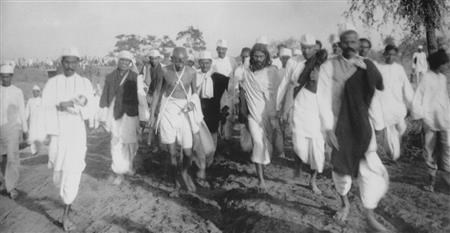
|
| Gandhi in his Salt March of 1930 (http://www.history.com/topics/mahatma-gandhi/pictu (history.com)) |
The reason Gandhi is a hero is not only because he was a soldier, but because he was a soldier of peace. Gandhi wanted his followers to be soldiers like him, of peace. To be a soldier of peace is not one to participate in war fighting but to participate through nonviolent forms: "In its positive form, nonviolence means the largest love, the greatest charity. If I am a follower of nonviolence, I must love my enemy. I must apply the same rules to the wrong-doer who is my enemy or a stranger to me, as I would to my wrong-doing father or son. This active nonviolence necessarily includes truth and fearlessness. The practice of nonviolence calls forth the greatest courage"(Gandhi). It is hard to completely follow the path of nonviolence but in the end it leads to the greatest accomplishments of knowing what has been done is right. Gandhi shows by example that you truly must keeps your friends close and your enemy closer but goes more into why it is such an important means of peace. He was a strong leader who was a soldier of his own and was able to lead people: " 'I have not the shadow of a doubt that any man or woman can achieve what I have, if he or she would make the same effort, and cultivate the same hope and faith.' Gandhi, who always claimed he had no more than ordinary capacities, is proof that these spiritual laws do work, and that by obeying them we can transform our character and consciousness. Gandhi belongs to our own century and faced many of the problems we ourselves are facing today, and even though physically dead, he still continues to give new direction to our civilization"(Easwaran). Gandhi was very good at leading by example. He knew how to because he was not an ordinary soldier, he used spirituality to help him through any struggles. He was able to explain to others how they should do things in a correct way rather than just ordering others to carry out his will. Gandhi was never a fighter of actions, but a fighter of words which encouraged others with his wisdom and knowledge of how to work past obstacles through means of non violence.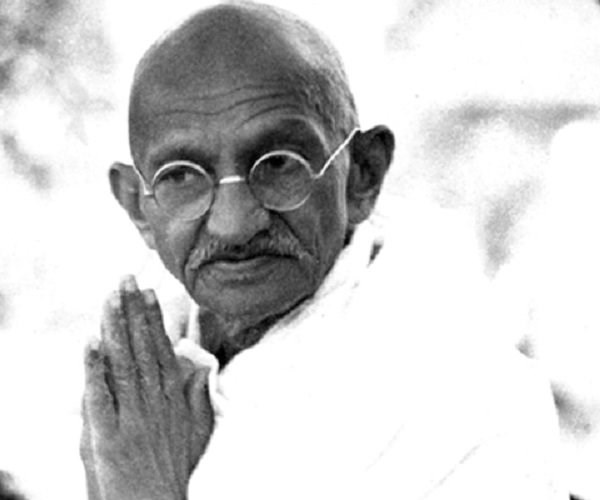
|
| (http://www.miscw.com/famous-inspiring-mahatma-gand ()) |
While having a spiritual mindset, one can be inclined to overcome great hardships. For Gandhi, this stood true as having a spiritual mindset taught him how to get through suffering and pain but also to see the joy in everything. A mantram is a phrase that can be used to quiet the mind, calm the body, or improve concentration: "Rama, Gandhi's mantram, is a formula for abiding joy. Gandhi used to walk for miles every day repeating it to himself until the rhythm of the mantram and his footsteps began to stabilize the rhythm of his breathing, which is closely connected with the rhythm of the mind. When fear or anger threatened him, clinging to Rama used the power of these emotions to drive this formula for joy deep into Gandhi's mind. "Gandhi said: 'The mantram becomes one's staff of life and carries one through every ordeal' "(Easaran). By adapting such a spiritual mindset, Gandhi was able to overcome a lot of impurities his mind would come across. Whenever something made him feel harsh emotions, which could've lead to a negative impact on others and himself, he was able to use the mantram to ease his mind. By sticking to his mantram, he was able to keep a 'cool head' when faced with trouble. Even with being able to find the joy in everything, Gandhi also taught us that you must learn how to live with pain: "Gandhi teaches us to accept suffering, even to court suffering, if we want personal transformation, political revolution, and a vision of God. 'Nonviolence ... means the putting of one's whole soul against the will of the tyrant.'... When asked to sum up the meaning of life in three words or less, Gandhi responded cheerfully, 'That's easy: Renounce and enjoy.' Today it is not popular to talk about self-denial or voluntary suffering, but Gandhi talked about it all the time. The key to his daring achievements lies in his own ongoing suffering, including his poverty, celibacy, arrests, imprisonments, attacks, and assassination"(Conway). To get the personal things in life, Gandhi states, that you have to endure suffering and not push self-denial to the side. Gandhi's will for renunciation is a spiritual move which he believes is part of the meaning of life. He is able to move through suffering and self-denial easily with his spiritual mindset. Gandhi can be considered a hero for his spiritual mindset because he was able to use it to teach others his ways. Anyone who had lost their way could look to Gandhi and use him as an example in their endeavors.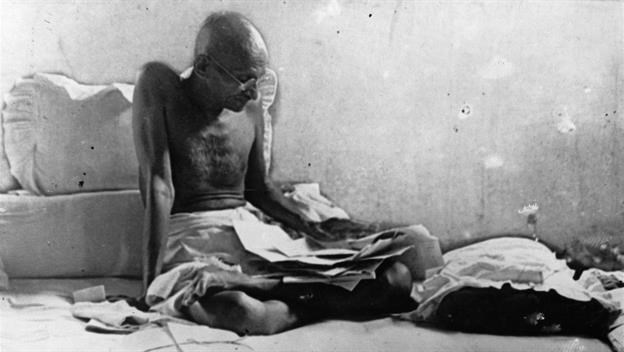
|
| (http://www.history.com/this-day-in-history/gandhi- ()) |
To be wise is to be intellectual and to be intellectual is to be able to think at a higher degree than others. Gandhi has the intellect of a hero because he takes ideas and analyzes them to a better understanding: "Men often become what they believe themselves to be. If I believe I cannot do something, it makes me incapable of doing it. But when I believe I can, then I acquire the ability to do it even if I didn't have it in the beginning"(Gandhi). A wise individual has the will to analyze their problems even if the results reveal their flaws, it helps them to become a better person. By Gandhi having the ability to recognize that if he is negative with himself it will lead to not getting anything done, he then decides that by believing he can he can accomplish much more. Gandhi was a lawyer at a firm in London before he went on to social reform but as a lawyer he was able to come up with the conclusion: "His limited successes as a lawyer also proved revealing. "I had learnt the true practice of law," Gandhi concluded after his first case, "I realized that the true function of a lawyer was to unite parties riven asunder""(Historic World Leaders). After little time in law, Gandhi was able to find the reality of what a lawyer should be. They are people who should bring two parties, who have been driven against each other, to an agreement and together in some type of unity. Whereas typical people only see lawyers to be people who work in name of the law and leave aside the concerns of the parties to just make one side win to get their money. Gandhi felt that people should bring people together in equality, and not help to drive them apart with hate. A great hero must be able to think at a higher level than other people because, in most cases, they are the one setting the bar. Gandhi was able to think differently and with more critical thoughts than those who worked with or followed him. Gandhi is a hero because he is able to be a soldier of peace, use his spiritual mindset wisely, and spread positivity through his intellectuality. He was able to go about his fights with nonviolent methods, he used his spiritual mindset to show others how to work through suffering and pain while keeping your mind positive, and most importantly he spread truth and positivity with his wise words. Gandhi inspires me along with many others by two main reasons. The wise words he constantly would say through his life and his nonviolent ways of getting the end results he wanted. Most would say they look to Gandhi for wisdom for everything. He had many different inspirational quotes such as ones about love, happiness, spirituality, peace, war, and life. Huge inspirational events were his fasts because he would starve himself to show his philosophy of nonviolence. He would risk his life to fight for freedom he believed was needed in the world. Mahatma Gandhi was a true hero because he knew how to lead others in peace, he was able to apply his spiritual mindset to all in his life to lead to his success, and he inspired millions of people with his intellectuality.
Works Consulted
Brussak, Federic A. "10 Reasons Why Gandhi Is My Hero." Spirituality and Practice, n.d. Web. 10 May 2016. .
Conway, Timothy. "Mahatma Gandhi." Enlightened Spirituality. N.p., 200. Web. 15 May 2016.
Easwaran, Eknath. Gandhi, the Man. The Story of His Transformation ed. Petaluma, CA: Nilgiri, 1978. Print.
Easwaran, Eknath. The Bhagavad Gita for Daily Living. The End of Sorrow ed. Vol. 1. Petaluma, CA: Nilgiri, 1975. Print.
Gandhi. Mohandas Gandhi: Essential Writings. Ed. John Dear. Maryknoll, NY: Orbis, 2002. Print.
Green, Roedy. "Quotations of Mahatma Gandhi." Canadian Mind Products, n.d. Web. 02 May 2016. .
"Mohandas Gandhi." Historic World Leaders. Ed. Anne Commire. Detroit: Gale, 1994. Biography in Context. Web. 3 May 2016.
Mohandas, Gandhi K. An Autobiography: The Story of My Experiments with Truth. Boston: Beacon, 1993. Print.
Page created on 7/10/2016 12:00:00 AM
Last edited 7/10/2016 12:00:00 AM
The beliefs, viewpoints and opinions expressed in this hero submission on the website are those of the author and do not necessarily reflect the beliefs, viewpoints and opinions of The MY HERO Project and its staff.
Bibliography
Brussak, Federic. "10 Reasons Why Gandhi Is My Hero." [Online] Available http://www.spiritualityandpractice.com/practices/features/view/24687/10-reasons-why-gandhi-is-my-her.