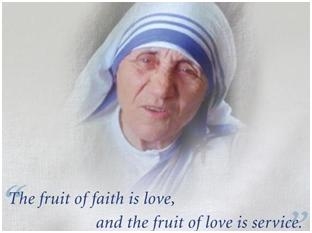
 Mother Teresaacelebrationofwomen.org -"I think a hero is any person really intent on making this a better place for all people" (Maya Angelou). A hero is someone who helps without expecting anything in return. A hero is someone who possesses traits that make him or her a role model for others. A hero is Mother Teresa. Born Gonxha (Agnes) Bojaxhiu in Skopje, Macedonia Mother Teresa ultimately moved to India. She lived from August 26, 1910 to September 5, 1997. However, "She felt that August 27, 1910, the day of her baptism, was her true birthday" (Jaiman, Arti, and Chitra Padmanabhan). She lived a fulfilling childhood, but soon discovered that she wanted to serve others not as lucky as she had been. She did this as a Roman Catholic nun. She took on the name Mother Teresa and with it, the titles: Nun, Humanitarian, and Missionary. Mother Teresa said, "'They are using me to be the hand, to be the bridge'" (Documentary about Mother Teresa). She succeeded in helping a variety of people while acting as God's extended hand from heaven. She acted as a "bridge" to make the rich and the poor, the powerful and the lowly, consubstantial into one community. Mother Teresa chose to live her life outside of the convent to affect others in a more personal and direct way. A hero must possess determination because doing good every once in a while is not enough. It does not prove passion; passion is not a light switch. A hero must strive to achieve his or her ongoing and powerful message. A hero must possess kindness, because if he or she feeds the hungry, for example, the person must have an open and caring heart. A hero must also possess humility. A hero defined as a person with insensitive arrogance about what he or she achieved is not a hero at all; the person must believe that their achievements were part of his or her duty, his or her purpose. Mother Teresa is inspirational because she connected the gap separating different people in the world; she cared for the poor and lonely, she spread her love with determination, and she was humble.
Mother Teresa showed determination when she helped others. She grew up with a goal in her life that she yearned to achieve: "As Agnes grew up, it was clear that she was drawn to helping the poor. Her mother, deeply religious and devoted to helping others, often took Agnes with her when she distributed food and clothing to the poor and needy. These experiences, combined with her religious education, led her to decide, at the age of 12, that she would become a nun and work with the poor" ("Mother Teresa"). Even from the young age of 12, Mother Teresa already determined her passion-- she loved spreading God's word. Knowing her life's purpose at such a young age gave her the determination she needed to make a difference. Mother Teresa revealed how dedicated she was when she chose to continue feeding the hungry and sheltering the lonely, even when her mother was not influencing her. It proves how much it fed her soul and gave her the satisfaction she desired. As she matured, Mother Teresa set new goals to elaborate on her life's purpose: "'I realized that I had the call to take care of the sick and the dying, the hungry, the naked, the homeless - to be God's Love in action to the poorest of the poor. That was the beginning of the Missionaries of Charity.' She didn't hesitate, she didn't question" (Jaiman, Arti, and Chitra Padmanabhan). When Mother Teresa acknowledged her "calling", she decided to do something about it. Instead of sitting there waiting for a change, she constantly worked to make the difference and did not avoid the ones who needed the attention most. Mother Teresa "didn't hesitate, she didn't question", which demonstrates her good morals because it takes an incredible amount of courage to immediately choose what you want to dedicate the rest of your life to. Mother Teresa's calling became a beacon of light for people in the depths of darkness and despair. Heroes use their influence to help others, as Mother Teresa did. She had the confidence to pursue her purpose and she remained dedicated to serving people in need of a little light.
Mother Teresa's efforts to care for the poor and lonely showed her caring nature. The events surrounding Mother Teresa inspired her, according to a fellow nun, Sister Agnes: "In 1952, Mother Teresa became interested in the care and comfort of the dying after she found a woman lying in a Calcutta street who had been nearly devoured by rats. 'We tried to get someone to take her to a hospital,' said Sister Agnes, a long-time associate of Mother Teresa, 'but before we could, she died. Mother said there should be a place where people can die with dignity and know that they are wanted'" (Parello). The human tragedy that Mother Teresa witnessed inspired her to help the hopeless. She found satisfaction in letting the lonely know that someone cared: Mother Teresa spoke to the poor about how they were important and how they had the potential to be powerful. Mother Teresa spread the need to help others through her actions. The kindness of her heart was the flame that ignited her light. It spread warmth like a wildfire to millions. Mother Teresa did not believe anyone deserved to be lonely and shameful in his or her time of death; he or she should be happy and comforted. Mother Teresa's answer to why she was doing what she did would be her "...simple message [that]'the poor must know that we love them'" (Documentary about Mother Teresa). "Simple" means "straightforward", "uncomplicated", and "effortless". This explains how Mother Teresa viewed her work and how easy it was to care for another person in need. She wanted to let people know that they were not useless. Love is something that one cannot live without. That is why she took care of the poor. She felt that they needed her to feel important. She took care of the people that no one wanted to look at or to think about because they seemed different. Mother Teresa understood that people are all people and every person deserves the same treatment. She carried her values throughout life and showed kindness to be a better person. She realized that people need others to depend on to survive.
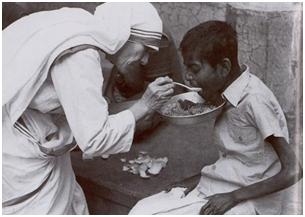 Mother Teresafragbows.blogspot.com -Mother Teresa showed true humility when she remained humble throughout her fame. Mother Teresa reflected upon what her decisions were to be in order to pursue her passion and she stated: "'I was to give up all,' she later wrote in her 1995 book A Simple Path, 'and follow Jesus into the slums.' The nuns of the order wore a white sari with blue trim, a habit designed by Mother Teresa. In 1979, Mother Teresa received the Nobel Peace Prize because 'poverty and distress also constitute a threat to peace.' At her request, the banquet following the ceremony was canceled, and the $7,000 budgeted for the luncheon was given to the poor" (Parello). The "habit designed by Mother Teresa" of wearing a white sari proves that she wanted to connect to her audience, poor people, in a more effective way. She wanted them to trust her, so she decided to take a step in their shoes. Even though Mother Teresa well deserved the rewards, she chose to give up the "$7,000 budgeted for the luncheon" for the poor. She was humble and gave up her riches. In the book Mother Teresa: Saint of the Poor, Mother Teresa spoke about what she believed her actions to help the poor were about: "'The poor do not need our compassion or our pity; they need our help. What they give us is more than what we give to them'" (Morgan 35). The only explanation for this is that Mother Teresa believed that one could not stand around and pity other people while doing nothing to aid them. She believed that the impact that she had on the poor had been minuscule compared to their effect on her. Seeing the beauty and joy on their faces when they received something that a large amount of people around the world took for granted gave Mother Teresa happiness. Spending time with them brightened her eyes. The poor gave her a life-long purpose as much as she gave them hope. Mother Teresa knew that to reach out to her audience, she needed to connect to them and act as an equal. She gave up earthly luxuries and set the example for those who needed the help. Mother Teresa also claimed that everything she did and was awarded was for the people, not for bragging purposes or for her own reputation. She saw beauty in everyone and rated her achievements on smiles.
Page created on 1/14/2012 12:00:00 AM
Last edited 7/26/2026 3:52:12 AM