 |
| Manny |
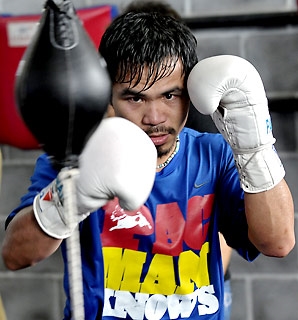
After a bout in the ring with Manny Pacquiao, every fighter has the same bloodied look to their face and says the same daunting words later: “He was just too fast.” Quick, cunning, and decisive, there has never been a fighter like Manny Pacquiao. Born in December 1978 to a family living in very destitute conditions in the Philippines, the young Pacquiao quickly and amazingly rose from humble street peddler to world-renowned boxer. As he continues to dominate in the ring and lead his country in Congress, Pacquiao remains one of the foremost humanitarians in the region. Manny Pacquiao, the national hero of the Philippines, inspires his country and the world with his honor, perseverance, and determination to elude the grasp of poverty and top the sport of boxing.
Against all odds, Manny Pacquiao fought off overwhelming poverty as a child and young man with his determination and honor. He was born in the rural city of Kibawe in the south of the Philippines, and his family moved to General Santos City when he was a young child. As early as nine years old, Pacquiao sold anything he could in the streets. In his autobiography, he writes, “My new career as a grocer kept me and my family from the one thing I dreaded most--begging. I would never beg for food or money.” (Pacquiao 40). This shows how noble Pacquiao is, even at such a young age. Most of us cannot even fathom the level of poverty he was at, and to keep his values and honesty is something extraordinary. When at rock bottom, the easiest thing to do is give in. Pacquiao never gave in. Even as a young man, around sixteen years old, living on his own in the streets of Manila, the capital of the Philippines, Pacquiao never gave in. He writes, “Sometimes I felt the temptation to beg…the [restaurant] managers would come out to hand me food, but I would never accept it without working for it.” (Pacquiao 54). Even though Pacquiao very easily could have taken the generous charity and been gone, he chose to do the honorable thing and work for his pay. These examples show how determined Pacquiao is, even at the simple act of providing for himself. This quality of being honorable is admirable, and sets an example for others in impoverished lands.
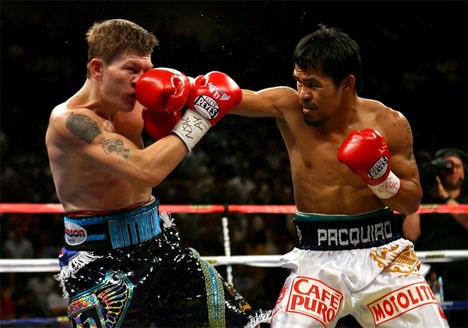 |
| Pacquiao v. Ricky Hatton (May 2009) (http://www.talkloud.info/images/manny-pacquiao-ricky-hatton.jpg) |
Manny Pacquiao has quickly become one of the best boxers in the world through his hard work, perseverance, and determination. He talks of when he was a child, and how cockfights in the slums of General Santos had given him his basis for training. He says, “The main thing that struck me was that these proud birds never quit…they would never just lay down to indicate that they had enough. It was never enough” (Pacquiao 44). These are lessons that Pacquiao learned as a child and incorporated into his boxing style. In his professional record of nearly 60 fights, Pacquiao has lost only three, and only by knock-out or decision (Pacquiao 214-215). He, like the gamecocks from his youth, has never given up. Even when outmatched, like in his 2009 fight against the Puerto Rican boxing star Miguel Cotto, Pacquiao still rises to the occasion and dominates. “[Miguel] Cotto hurt me with some of his powerful shots, and he even busted my eardrum in the third or fourth round. I kept fighting anyway” (Pacquiao 134). Pacquiao went on to win the match with a technical knock-out (TKO) in the twelfth round. Boxing is by nature a very tough sport. Most are often bloodied as the fight progresses past the sixth or seventh round. To fight in a huge arena, hundreds looking on, and millions more on television across the globe, is something courageous itself. But fighting while injured takes an enormous amount of perseverance. Once again, Pacquiao could have taken the easy way out and conceded. But he knew he could win, even battered and bruised, and he was able to persevere. Perseverance is a valuable quality, in sports and in other endeavors. As Pacquiao made a bid for the Philippine Congress in 2009, he recalls, “Campaigning wasn’t easy. It occurred to me that suddenly I wasn’t the known champion, but the underdog again. In fact, it reminded me of the feelings I had in 2008 before my fight with Oscar De La Hoya. But with that feeling of having to prove something came the great will to see a victory” (Pacquiao 178). Politics in the Philippines are not like politics in America. In the Philippines, where corruption abounds, people are bribed and often killed over votes in a system of “democracy” controlled by powerful political families. Pacquiao, feeling the same nervousness as he had when fighting De La Hoya, who had offered to be Pacquiao’s promoter in years past, sought to break the cycle of unjust politics in his country. He powered through the tedious election process, and went on later that year to become the congressman for the Sarangani province. The example set by Pacquiao’s hard work and determination is now visible to everyone, especially to the destitute children of the Philippines.
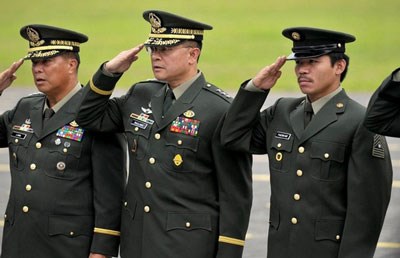 |
| Pacquiao (right) as an officer in the Philippine A (http://firequinito.com/uploads/boxing/manny-pacquiao-army2.jpg) |
Manny Pacquiao, in the spotlight of his country and the world, inspires honor, hard work, and determination in others. His real-life examples of how keeping these qualities pays off have inspired millions worldwide. “Many people say when I fight, the entire country [the Philippines] stops and watches--literally” (Pacquiao 163). Pacquiao not only does good, but he also inspires good, something that I don’t believe many heroes today do. In my letter-essay for his autobiography, I wrote, “On fight night, the streets of Manila are silent, crime rates plummet, and television usage soars as the entire country watches in awe as their hero takes home another victory.” This kind of power can be a great risk if the person entrusted with it isn’t careful or doesn’t display good intentions. But Manny Pacquiao, the fighting pride of the Philippines, holds this influence to a great standard, and uses it to purvey the messages of good and fairness to the listening people of the world. By his hand, the whole world has been made aware of the terrible poverty of his destitute homeland and Pacquiao inspires hope in those who have given up and charity in those in a position to help. He has personally donated millions of Philippine pesos to causes funding better education, health care, and public services, backing these donations up with his power in Congress. In a world of terrible poverty, political corruption, and the near extinction of hope, Manny Pacquiao stands for the good that is all but lost. These lessons of humility teach others around the world to be thankful, humble, and philanthropic, and to stay determined in your fight, whatever that may be. Manny Pacquiao, boxer, congressman, actor, musician, military officer, and humanitarian, is determined to save the world, no matter what that means.
Page created on 5/26/2011 12:00:00 AM
Last edited 5/26/2011 12:00:00 AM