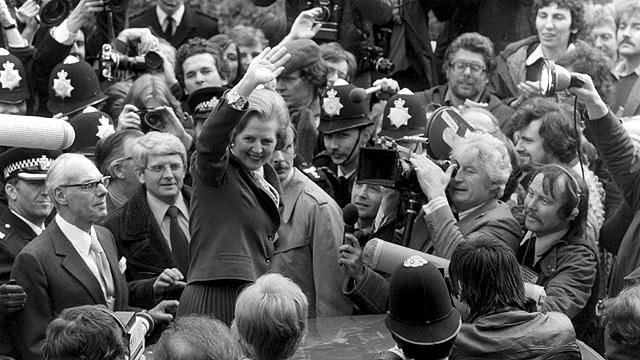
 Margaret Thatcherstatic.bbc.co.uk/history/img/ic/640/images/resources/people/margaret_thatcher.jpg - "Continuous effort - not strength or intelligence - is the key to unlocking our potential." (Winston Churchill). This brief quote from Churchill told us of a great perception that numerous successful leaders followed; including his eventual successor, Ms. Margaret Thatcher. 'Doing' was what Thatcher loved, and she did more of it than anyone since Winston Churchill. Being a unique individual that sought to change Great Britain for the better, Mrs. Thatcher was known for her resolute behavior and independent nature. Born in 1925 in Grantham, England, Thatcher knew at a young age that one should be resolute with their decisions, and later, influenced by her father's teachings, she used that knowledge to battle through the field of politics, knowing that only she could control her future and what she could achieve. She eventually became the one and only female prime minister of Great Britain, and, with winning three consecutive terms, she also served as the longest sustained prime minister of her country in the 20th century. To many doubtful people, she showed them that she desired change, and she had the ability to create the changes she sought. As the first female leader of Britain, she faced critique and judgment, yet she proved to the world that her gender did not hinder her ability to lead her country into a prosperous future. She strode straight into the mess that her country was entangled in and reached in, showing her country that there was still a way out of the disorder they were in. Being the foremost and only female prime minister of Great Britain, Margaret Thatcher worked wholeheartedly to efficaciously pull Great Britain out of its economic crisis. Her diligent work ethics, tenacious beliefs, and her particularly strong mindset aided her in following her strong ideals.
Having accepted and prioritized her country's needs, Thatcher worked diligently to provide the best abilities that she had for the country. Yet, even though she had taken the role of Prime Minister, Thatcher meticulously fulfilled her positions as not only the leader of the country but also an attentive housewife. Many people, through continuous observations after she began her term, noted her extraordinary work ethics: "Aides and colleagues described Thatcher as a workaholic, who only accepted a portion of her $84,000 yearly salary. During her prime ministership, she got by on three to four hours of sleep a night and still insisted on fixing breakfast and dinners (shepherd's pie or coronation chicken) for Denis Thatcher and herself. She had been known to interrupt a late-afternoon briefing to run out to buy bacon for the next morning's breakfast" (Margaret Thatcher). Thatcher did not omit the care needed for her family, yet also worked assiduously to provide her country the best that she could contribute; both she could not bear to neglect, and both she stayed attentive to. The thought of abandoning either position never occurred to her, and she conformed to each role resiliently. Profoundly immersed in her duties, she spared no time for personal pleasures; only time for others and her country. That was a certified trait that many had observed from their time spent with her. Even the individuals that disliked and disagreed with her ideas respected her for the amount of devotion that she poured into her work: "Thatcher's critics were in awe of her strong will and daunting stamina. Able to get by on four hours of sleep a night, she stayed up until early morning poring over her papers. She was a bold, innovative leader who wanted nothing less than to change 'the soul' of the British people. A woman of principle, she once said, 'I am not a consensus politician. I'm a conviction politician. The reason I am in politics is because I believe in certain things and try to put them into practice'" (Axelrod-Contrada). Whether they were alongside or opposed to her, her efforts were tremendously respected by all. Thatcher only strived for her position so she could change her country for the better; she was not in it for the mere authority that came along with it, but for the capability of change that she could create with her prerogative and the gained respect. The sole reason that Britain had trudged through its monetary crisis was because Thatcher was there behind it, pushing and pulling with all that she was capable of to help her country regain its previous glory.
Tenacious in what she believed in, Thatcher stood by her ideals, becoming a figure deemed worthy of respect. Everything that she did as prime minister was for the better of the country and that her country could be great again. When she first took her role, she had not been satisfied with how the government was operating, so thus she initiated alteration: "Once the center of a vast and wealthy empire, Britain had fallen on hard times after World War II. German bombs had destroyed much of London, and the cost of the war effort had left the British economy in ruins. To put Britain back on its feet, the government took over various industries and social services. Thatcher deplored this "welfare state" and vowed to replace it with the enterprising values of her youth: hard work, competition, and self-reliance" (Axelrod-Contrada). Influenced by the effects of war, Britain had been left in pieces, and unfitting means had been attempted to revive the economic state of the country. Thatcher sacrificed her time to discover a more suitable way to pull Britain out of the financial swamps that it had been plunged into for she had disagreed with previous operational methods. She believed in change; but most importantly, she believed that she can create change. Thatcher knew that the situation was dire for Great Britain as she took her role as a leader of her nation, and sought to form a better country for generations to come. As she had spoken during her Remarks on Becoming Prime Minister: "I know full well the responsibilities that await me as I enter the door of No. 10 and I'll strive unceasingly to try to fulfill the trust and confidence that the British people have placed in me and the things in which I believe... and to all the British people - howsoever they voted- may I say this. Now that the Election is over, may we get together and strive to serve and strengthen the country of which we're so proud to be a part" (Thatcher). Even having cognition that some may like her, she paid no concern to that fact; she had, instead, asked the people of Great Britain to stand in unity in order to do what's better for their country. Likes and dislikes set aside, she believed that they should all strive towards one common goal; to journey towards the revival of their country, returning it to its prior splendor. Her country's situation was not faring well when she had accepted her term, yet it did not diminish her belief in her people and country, and she trusted that they were able to create a better future for themselves. Head thrust forward, she had marched on and pursued her cause to place the 'Great' back into Great Britain.
Situating the need of the country in front of her own, Thatcher's particularly strong mindset constantly reminded her to do what she expected herself to do; not what others believed that she should do. She was confident in what she did, and followed her ideas resolutely. With a steadfast attitude, the pejorative words of others did not affect her in deciding what her further actions may be: "Some critics accused Margaret Thatcher of being cold and uncaring. Never one to be slowed by criticism, she tossed off objections to her leadership style as typical male chauvinism. 'When a woman is strong, she is strident,' Thatcher declared. 'If a man is strong, gosh, he's a good guy' (Axelrod-Contrada). Thatcher's personality allowed for others' harsh remarks to not offend her; she did not let others' critique hinder her, and stood strong as she did what she believed in. Being a female had nothing to do with what she was capable of or what she accomplished. What drover her intentions and decisions was being a human being that pursued change, and it proved what she was capable of doing. Her indomitable ethics aided her in standing strong through the test of subjective opinions, and she was firm about the idea that one should know what they are to do. Having stridden forward to meet the challenges that being a prime minister provided, she dealt with it with clear precision: "In the literature on Margaret Thatcher's rule, no word appears with greater frequency than "revolution." Her leadership dealt with change, not with mere stewardship. Many viewed that change as "radical." Her message of "radical conservatism" bore her name: "Thatcherism." No other British prime minister has had the suffix "ism" attached to his name. Oxford historian, John Roberts, described her as "Above all a disturbing, much-needed questioner and mould-breaker" (Thompson 3). The idea of 'Thatcherism' was to promote low inflation, privatization, the small state and free markets through tight control of the money supply, and constraints on the labor movement (Hugo, Young). Introducing a completely new notion to her people, she had made herself loud and clear; she was not one to sit and do nothing as her country wasted away. Thatcher was different; she was unique, and because of such exclusive ideals her ideas changed Great Britain. She did not sit well with simply overlooking her country; she desired to make it a better place for her citizens, and endeavored to do so. She did not accomplish things just because others wanted her to do so; she made up her mind about what she believed in, and influenced others to follow her ideas.
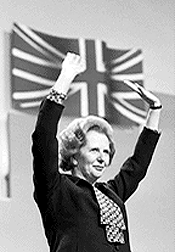 Margaret Thatcherwww.margaretthatcher.org/images/essPhoto-unionjack.gif - Thatcher once said, "One only gets to the top rung of the ladder by steadily climbing up one at a time, and suddenly all sorts of powers, all sorts of abilities which you thought never belonged to you- suddenly become within your own possibility and you think, 'Well, I'll have a go, too.'" Her well respected determination, unhesitant executive skills, firm beliefs and unwavering ideas caused her to successfully lift Britain back onto its feet; and in doing so, she changed the course of British history. She stood out through the vast pool of politicians and performed what she believed was for the better of the economy, country, and her fellow citizens. When faced with spite, her resolution did not waver; she believed in herself and strode through judgmental opinions, proving her capabilities to others while seeking for a way to make her country flourish again. She had once declared, "Defeat? I do not recognize the meaning of the word." Portraying her perseverance and belief in herself; that was the reason why her steps did not falter; no matter what obstacles blocked her way, she would surmount them with her strength of character and her belief in never giving up. She also did not feel the need to compare herself to another, for she believed that she had been offering the world what she could provide. I believe that a leader takes people where they want to go, taking all opinions and advice into consideration, but a dutiful leader guides people where they do not necessarily want to go, but ought to be. As a figure that I look up to, that was who Thatcher was; a person that worked with not the goal to please others, but to commit her efforts to do what she could do for a better society.
 Margaret Thatchergallery.socionix.com/d/19520-1/thatcher02.jpg -
Page created on 4/23/2012 12:00:00 AM
Last edited 8/5/2026 9:59:46 PM
Works Cited
Axelrod-Contrada, Joan. "3: Margaret Thatcher Britain's Iron Lady."
Women Who Led Nations (1999): 50.
Biography Reference Center. Web. 27 Mar. 2012.
Margaret Thatcher, Newmakers, Detroit: Gale, 1989.
Gale Biography In Context. Web. 21 Mar. 2012.
Thatcher, Margaret, "Remarks on becoming Prime Minister" (St Francis's prayer), Outside No.10 Downing Street, 1979 May 4 Fri.
Thompson, Juliet S, and Wayne C. Thompson. Margaret Thatcher: Prime Minister Indomitable. Boulder [Colo.: Westview Press, 1994. Print.