 |
| (http://www.jsc.nasa.gov/Bios/htmlbios/armstrong-na.html) |
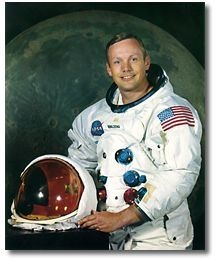
Forty-one years ago, man made an astounding step in technology, science, and history. On July 24th, the impossible was achieved successfully and it was a moment of awe for the whole world. Imprinted footsteps not only on the moon, but also in time, were taken and forever lay on the lunar surface. The first man to take this step was Neil Armstrong. He was born on August 5th, 1930 in Wapakoneta, Ohio and started taking interest in airplanes when he was only 6 years old. He even saved up and spent all his money for piloting lessons. After graduating from high school, he attended Purdue University to study aeronautical engineering on a Navy scholarship. Later on, he was called to fly a combat aircraft in the Korean War. (“Armstrong, Neil Alden (1930-“). Other than being shot down once, he was an ideal pilot and was awarded three air medals. Before becoming a NASA astronaut in 1962, he was a research test pilot. He had his humble beginnings but he later devoted his energy, time, and life solely to being a pilot. Neil Armstrong is still greatly admired for his devotion to aero science, his responsibility for representing a great accomplishment in world history, and his courage to become the first man on the moon.
Neil Armstrong became the man he is known as through his devotion to doing what he loves. It took persistence and true interest to pursue a dream of becoming an astronaut. "He started learning to fly at age 14 and got his wings 2 years later, paying the $9.00 an hour fee for his flying lessons by doing odd jobs."("Neil Armstrong."). Neil was extremely devoted to his practice of air science and becoming a hard-working astronaut to make adventurous missions into space. He studied vigorously and prepared tirelessly. He also sacrificed his time and money to being able to do something that alleviated further study of research in the new concept of space travel. "Occupation: Astronaut Presidential Medal of Freedom; Harmon International Aviation Trophy; Royal Geographic Society's Hubbard Gold Medal; Became a fellow of the Society of Experimental Test Pilots, the American Astronautical Society, and the American Institute of Aeronautics and Astronautics; Space Medal of Honor, 1978."("Neil Alden Armstrong"). Neil began and continued his life working with astronautical studies. The variety of the mass awards he has won shows his dedication in the participation of the events. His life's accomplishments are a result of his hard work and persistence.
 |
| (http://thedrawncutlass.blogspot.com/2009_07_01_archive.html) |
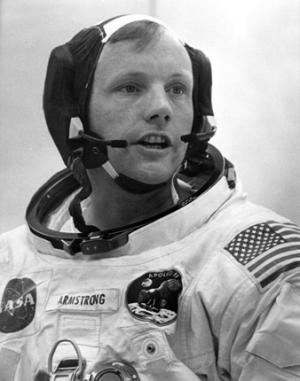
Armstrong was chosen for the critical space mission to the moon because he obtained a great amount of responsibility. Armstrong is a very reliable man and was ideal for the tedious and death defying job of being an astronaut during that time. "Suddenly a boulder field loomed in front of him. He quickly switched to manual control and guided the Eagle over it to a smooth landing with only 10 seconds of fuel left."("Neil Alden Armstrong"). Even with life risking circumstances, Armstrong managed to land the spaceship on the moon safely with ease and precision. He also had the capacity to carefully and quickly maneuver around foreign obstacles. Neil took the responsibility of filling a role as an astronaut even when he didn't display much desire for being one. "Armstrong was selected as one of the first three pilots of NASA for the X-15 rocket plane, and he made seven flights in this prototype spacecraft. Once he set a record altitude of 207,500 feet and a speed of 3,989 miles per hour. Armstrong received an invitation from the American spaceflight program, but he demonstrated little enthusiasm for becoming an astronaut."("Neil Alden Armstrong"). Neil Armstrong showed the evident skill he had in piloting spacecrafts. He was desired among space agencies as a perfect fit for an astronaut, and regardless of his preferences, Neil surely enough became an astronaut. That's why NASA chose Armstrong to successfully aviate a spacecraft to the moon to complete a task no man had done before. That task was stepping foot onto another world. It takes an extremely responsible man to do so, and Neil Armstrong was the one to do it.
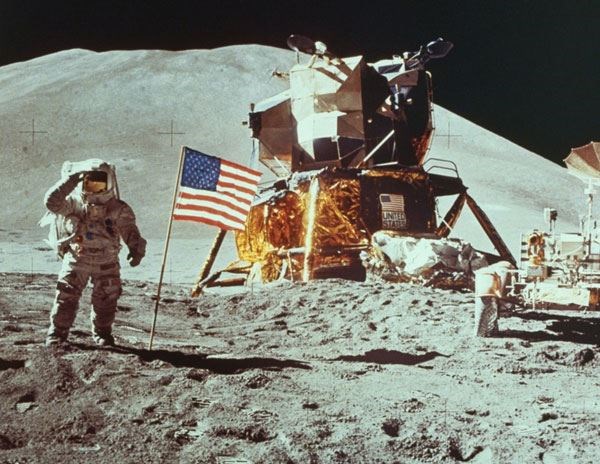
Neil Armstrong presented a great deal of courage by leading an adventurous mission to the moon. During his mission, he went through the hardships of space and many other difficulties but strongly pulled through it all. "A little less than seven hours later, after eating a meal and waiting for the cabin to depressurize, the two astronauts opened the hatch of the landing craft, and Armstrong climbed out onto the ladder. He climbed down the nine steps, and at 10:56 p.m. became the first human to reach the surface of the Moon...The three men splashed down in the Pacific Ocean on 24 July. It took about 60 hours to cover the 236,642 miles from the moon to the Earth."("Neil Armstrong."). Armstrong's accomplishments included dangerous feats like maneuvering a large spacecraft to and from Earth, making accurate scientific observations for the sake of research, and representing the successful and historical first step to man's growing journey into space. The whole world was anxiously waiting for the honorable moment. "...on July 20, a major portion of the earth population was listening to Armstrong's transmission.’Houston, Tranquility Base here. The Eagle has landed.'"("Neil Alden Armstrong."). Armstrong obviously presents a major characteristic of courage by creating one of the most memorable moments in US history from a world away. He engraved this glorious milestone into the heart of the people who were present during this event and in science as we know it. Courage is a valuable prospect, and a man who has traveled to the moon clearly obtains it.
 |
| (http://mechanicsnationalbank.com/timeline/1900/) |
Neil Armstrong is a man who is famous for his great dedication to science, his courage for having completed a supposedly impossible task, and successfully doing so for the sake of a breakthrough for mankind. Neil landed a spaceship on the moon, after years of preparation and devotion. His skills and persistence lead to this great achievement. Simply put, Armstrong not only attempted something so profound, but he completed it. That is why he inspires me along with millions of others. Neil proudly stated a quote, many know by heart, with an echoing heroic impression. This quote strongly represents the moral and importance of the distance man has traveled, not only through space, but through the advancement of human success. "That's one small step for man, one giant leap for mankind."("Neil Armstrong").
Works Consulted
“Armstrong, Neil Alden (1930-)." Encyclopedia of World Biography. Detroit: Gale, 1998. Gale Student Resources In Context. Web. 4 May. 2011.
“Neil Alden Armstrong." Encyclopedia of World Biography. Detroit: Gale, 1998. Gale Student Resources In Context. Web. 11 May 2011.
“Neil Alden Armstrong." Science and Its Times. Ed. Neil Schlager and Josh Lauer. Vol. 7. Detroit: Gale, 2000. Gale Student Resources In Context. Web. 4 May. 2011.
“Neil Armstrong." American Decades. Ed. Judith S. Baughman, et al. Detroit: Gale, 1998. Gale Student Resources In Context. Web. 6 May. 2011.
"Astronaut Bio: Neil Armstrong (12/1993)." NASA - Johnson Space Center. NASA. Web. 20 May 2011. http://www.jsc.nasa.gov/Bios/htmlbios/armstrong-na.html.
Philadelphia, Industry Of. "Mechanics National Bank - Timeline (1900’s)." Mechanics National Bank - Home. National Mechanics, 2008. Web. 20 May 2011. http://mechanicsnationalbank.com/timeline/1900/.
"July 2009." The Drawn Cutlass. Web. 20 May 2011. http://thedrawncutlass.blogspot.com/2009_07_01_archive.html.
Page created on 5/21/2011 12:00:00 AM
Last edited 5/21/2011 12:00:00 AM