 |
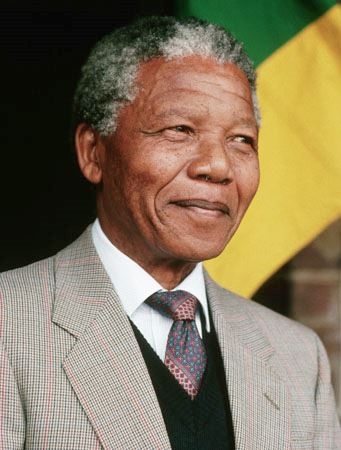
| Nelson Mandela |
Nelson Mandela: A True Hero
The hard floor of
the tiny cell is cold under your feet.
The sun's final rays are filtering in through the small, barred window in
the wall. Your arms and back are aching
from heavy labor all day. Now though,
all you can think about is crashing onto the tiny mat on the floor along the
wall and closing your eyes. Just as you
feel as close to comfortable as you know you'll ever get, you hear yelling -- angry
yelling. Through the bars that form your
door you see the guard shouting at someone in the cell over. For a second you can't even remember why you
are here in the first place. Then you do
remember. You believe that all men should be free, regardless of race. And for that, they sent you to prison. These are the conditions that Nelson Mandela
lived in for nearly 28 years, and all because he believed that all people
should have an equal say in government. Rolihlahla Mandela was born
July 18, 1918 in Mvezo, a small village in South Africa. The son of a tribal chief, he learned the long
history of his family's bravery during the wars against white settlers. From an early age Mandela dreamed of
contributing to the struggle of his people.
South Africa was governed solely by the white minority, who enforced the
brutal rule of apartheid (only whites had certain rights, including the right
to vote). After his father's death in
1927, Mandela went to school where he received the name Nelson. In 1944 Mandela joined the African National
Congress (ANC) and resisted the government's apartheid. In 1960 the ANC was banned, and Mandela
supported the formation of a military wing of the party. In 1961 the ANC considered using violence
against the government, under command of Nelson Mandela. In 1962 he was arrested and sentenced to five
years in prison, but he was brought back to trial in 1964 along with seven other
ANC leaders and was sentenced to life imprisonment. Mandela was incarcerated at two of the nation's
toughest prisons, Robben Island and Pollsmoor Prison. During his time in prison, Mandela grew a reputation
as one of the most important black leaders in South Africa. Under great international pressure, on
February 11, 1990, the government released Nelson Mandela from prison. At that point, he started working with the government
to abolish apartheid. In 1993 Mandela was awarded the Nobel Peace Prize for his
now peaceful efforts to equalize South Africa.
In April 1994 Nelson Mandela cast his first vote in the first free
elections. In May of the same year he was elected
president. He served one term then
stepped down. Since that time he has gone
around the world speaking out against racism and inequality. This hero is now 93 years old and lives in South
Africa. A hero cannot be just like everybody else, he must possess special
traits that set him apart from the rest of us.
Nelson Mandela possesses heroic traits such as hope, determination, and
he is a pioneer for good.
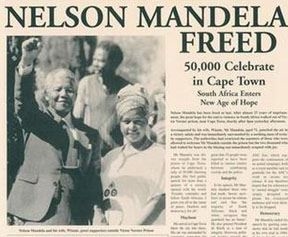 |
| Mandela went free on February 11th 1990. ( ) |
Nelson Mandela was
born into a hostile world. South Africa
was under the control of a racist government that enforced the brutal rule of
apartheid. Even though the future looked
bleak for him and all of South Africa, Mandela never lost hope that he could
help to make the world a better place. Because
he spoke out about his belief that all people, black or white, should be considered
equal and have an equal fair say in government, Mandela was put in prison for
nearly 28 years. But even that was not
enough to diminish his hope in the future.
"Let the strivings of us all, prove Martin Luther King Jr. to have been
correct, when he said that humanity can no longer be tragically bound to the
starless midnight of racism and war. Let the efforts of us all, prove that he
was not a mere dreamer when he spoke of the beauty of genuine brotherhood and
peace being more precious than diamonds or silver or gold. Let a new age dawn!"
(Nobelprize.org). Even after 27 years in
prison, Mandela bore no animosity toward his jailers, and he put his prejudices
aside to help work toward what he hoped would be a brighter future, not just
for South Africa, but for the world. Many
people in his position may have been bitter and angry with the world and would
have sat unforgivingly until that anger consumed them, and anything useful they
could have offered to society. But Mandela's
vision of the future pushed him to work with his former enemies to reach his
goal of a better South Africa. By 1994
his dreams were well on their way to becoming a reality when, on the 10th
of May 1994, Nelson Mandela was inaugurated president of the Republic of South
Africa. On May 12th he addressed
the people. "This is one of the most important moments in
the life of our country. I stand here before you filled with deep pride and
joy-- pride in the ordinary, humble people of this country. You have shown such
calm, patient determination to reclaim this country as your own, and now the
joy that we can loudly proclaim from the rooftops: 'Free at last! Free at last."
(Gale Biography). All the hard
work Mandela had put into improving his country had finally culminated in his
being elected the first black president of South Africa, and it is obvious that
he felt that the peoples' patience and hope had finally paid off. As the president, Mandela continued to try to
mend the wounds inflicted by the apartheid regime and to spread his message of
hope and forgiveness throughout South Africa and the world. Mandela's
never-dying hope in the people of his country and in the future is an
inspiration to all of us.
Although Mandela faced many seemingly insurmountable obstacles, he was determined to let nothing stand in the way of his dream for South Africa. Even as he walked out of the prison gates, Mandela was determined to continue his fight for equality. "Nelson Mandela was released on February 11, 1990. After his release, he plunged himself wholeheartedly into his life's work, striving to attain the goals he and others had set out almost four decades earlier." (Nobelprize.org). Not even 27 years in some of the toughest prisons in South Africa, forced to do intense physical labor, could dampen his resolve to attain freedom. Nothing was more important to Nelson Mandela than his determination to achieve equality in his home nation. He was even offered freedom from prison if he would stand down and give up his fight for equality. But Mandela refused. When he finally was released, "he said he was accepting freedom to work for peace." (Gale Biography). His determination to turn South Africa into an equal nation pushed him to do something many would deem unthinkable. He began to work with his former jailers, the government he had openly opposed all his life, to reach his dreams. Mandela is quoted in saying, "If you want to make peace with your enemy, you have to work with your enemy. Then he becomes your partner" (Nelson Mandela). Through his determination, Mandela's dreams were realized -- in April 1994 he cast his first vote. Later the next month he became President of South Africa.
Nelson Mandela possessed an incredible amount of hope and determination, and he is a person who isn't afraid to follow a new path. He is a hero. A hero isn't just another face in the crowd. A hero possesses certain traits that make him or her different from the average person. Nelson Mandela inspires me to hope that no matter the circumstances, no matter the odds, there is a brighter future waiting. He also inspires me to be able to set my mind to something and just do it, no matter who tries to stand in my way. He further inspires us all to stand up and try something new, something unique; in a way, to just be ourselves. Nelson Mandela truly is a hero worthy of recognition. He has pushed his way through all life had to throw at him and made it to where he wanted to be. The actions of this great man have been felt and seen all over the world and will continue to be long into the future. He has helped to bring the world into a new age of freedom and equality, and has shown the everyday people of this world that their voice should and does make a difference. Nelson Mandela has truly changed the world for the better. He is the very definition of "hero."
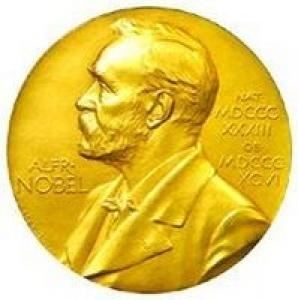 |
| Nelson Mandela won the Nobel Peace Prize in 1993 |
Nelson Mandela was a pioneer of his country. In 1993, Mandela and President de Klerk were awarded the Nobel Peace prize "for their work for the peaceful termination of the apartheid regime, and for laying the foundations for a new democratic South Africa" (Nobelprize.org). Mandela played a major role in the dismantlement of apartheid and helped pave the way for the social reform that was to come by his hand. By 1994 blacks all across South Africa had gained the right to vote, in no small part due to the work done by Mandela, and the first free elections were held in South Africa -- Mandela was elected the first black president, and he did all he could to move the country in the right direction. "I am your servant. This is the time to heal the old wounds and build a new South Africa" (Gale Biography). Nelson Mandela was given the daunting and unprecedented task of convincing the people to believe in this new South Africa, where all were equal. His ever-present hope and determination helped him to fix and rebuild a broken country. Nelson Mandela became the standard bearer of freedom, equality, and democracy, and he proudly waved that flag for the whole world to see.
Page created on 5/20/2012 12:00:00 AM
Last edited 5/20/2012 12:00:00 AM