 |
| (http://abcnews.go.com/topics/news/history/nelson-m ()) |
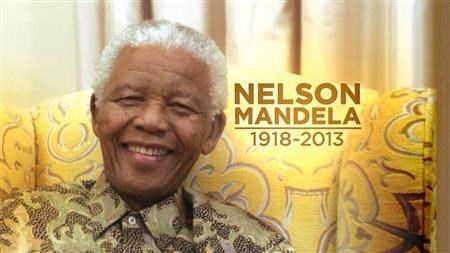
"When a man is denied the right to live the life he believes in, he has no choice but to become an outlaw." Such words were spoken by and true for a man by the name of Nelson Mandela, who spent most of his life fighting to reform South Africa to the point where they threw him in jail for rebelling. Mandela was born on July 18, 1918 to Henry Mandela and Nonqaphi Nosekeni. When Henry died, a close friend of his, Jongintaba, adopted Nelson (Compton, 17). Nelson Mandela spent his whole life trying to make South Africa a place where everyone treated each other equally. As a result of this, the government sent Mandela to Robben Island prison on June 11, 1964 where tiring labor ensued day after day. On February 11, 1990, 27 years later, the regime released Mandela from prison. The citizens later elected him as president and he began working to change the country. Today there is a statue of Nelson Mandela to honor his accomplishments at Port Elizabeth in South Africa. Despite his death on December 5, 2013, people revered Mandela as a hero. A hero is being a role model people can follow. Heroes can have many qualities: two being endurance and integrity. Endurance means having the will to carry on; to face challenges and to persist through them without giving up. Having integrity means being fair and impartial; being unbiased on all occasions and sticking to one's ideals. As one of the most influential people of all time, Nelson Mandela is a hero because of the integrity and endurance he displayed throughout the hardships he faced while trying to reform South Africa.
One of the main reasons why Nelson Mandela became a popular face in South Africa but encountered hardships was because of his integrity towards the citizens of South Africa in the face of the Apartheid government, a system that segregates races. After illegally leaving the country, the police arrested Mandela and tried him. At the court he told the jury: "I want at once to make it clear that I am not a racialist and do not support any racialism of any kind, because to me racialism is a barbaric thing whether it comes from a black man or a white man" ("Nelson Rolihlahla Mandela"). Using the word racialism, Mandela brought forth a negative connotation. The people of South Africa were slaves to racialism and so they hated the thought of it. However, by stating his unwillingness to agree to racialism, he showed his fairness to everyone; not outcasting either side and remaining impartial. While the court decided to only sentence Mandela to five years of prison, he was once again brought back and tried while new evidence of his crimes arose. Choosing to stick to his ideals Mandela declared: "I have fought against white domination, and I have fought against black domination. I have cherished the ideal of a democratic and free society in which all persons live together in harmony and with equal opportunities. It is an ideal which I hope to live for and to achieve" ("Biography of Nelson Mandela"). By saying he fought against white and black domination, readers can infer that Mandela was unbiased. Mandela wished for a place where everyone could live peacefully together as equal beings. In addition, he refused to change his thoughts; showing he was willing to die for his beliefs. Through his statements at the trials and in objection to the ways of the Apartheid government, Nelson Mandela became a hero in the eyes of the people. However, this also brought about consequences; consequences that forced him to spend a third of his life to pay.
 |
| (http://www.quarrymagazine.com/Article.aspx?id=3522 ()) |
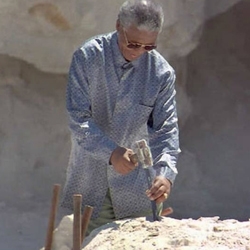
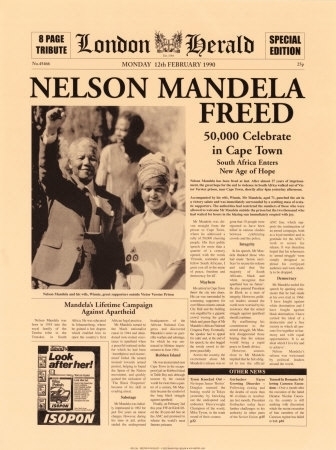
As a result of his display of integrity, the government threw Nelson Mandela into Robbens prison and forced him to endure grueling labor day after day. While contemplating on Mandela's life after the trial, it was said that: "During the 27 years that Mandela spent in prison, hidden from the eyes of the world while he quarried limestome and harvested seaweed, his example of quiet suffering was just one of numerous pressures on the apartheid government. Public discussion of Mandela was illegal, and he was allowed few visitors. But as the years dragged on, he assumed the mantle of a martyr" ("Nelson Rolihlahla Mandela"). For these 27 years Mandela worked hard in the prison while refusing to give up. Forced to do vigorous labor Mandela grew tired and old but it never got to him. On February 11, 1990, the world watched as Robbens Island released Nelson Mandela. Reporters proclaimed that:"'Anyone could see that the years of prison had ravaged only the body, not the spirit; they had, if anything, solidified his resolve and raised his stature as the embodiment of black liberation" ("Nelson Mandela"). Using the word "ravaged," the author brought to mind a gloomy picture. Nelson Mandela grew old and his body thin, but his soul remained untouched. His will held endurance and he was ready to spring back. Mandela was an incredibly resilient person. Despite all that happened his will was still as impenetrable as iron and he was unwavered by the events and stayed focus on his goal.
 |
| (http://www.blackpast.org/1990-nelson-mandela-we-ha ()) |
With a goal of reforming South Africa, Nelson Mandela showed his endurance and integrity in the face of hardships and eventually became an inspiration and hero to numerous people around the world. He fought for the rights of all South Africans; which eventually led authorities to arresting Mandela and throwing him in prison. For 27 years Mandela remained in there, but it failed to become a roadblock for him. As soon as he came out people elected president. Nelson Mandela has become an inspiration to me and others through his courageous actions and heartfelt words. When offered a chance to leave prison in exchange for subduing the protests Mandela replied: "I cherish my own freedom dearly, but I care even more for your freedom. Too many have suffered for the love of freedom. I owe it to the widows, to their orphans, to their mothers and to their fathers who have grieved and wept for them. Not only I have suffered during these long, lonely wasted years. I am not less life-loving than you are. But I cannot sell my birthright, nor am I prepared to sell the birthright of the people to be free" (Crompton, 68-69). Mandela put the lives of the people of South Africa before his own. He contemplated about their losses and chose to fight for them. He was not selfish, but rather selfless. He heard their sufferings and his heart was too charitable to sell them out for his own freedom. To me, this was spectacular because other leaders failed to have the courage and endurance to stay in prison for their people. He inspired me to stand up for what I believed in, no matter the consequences. Mandela gave me the courage to strengthen my beliefs and to pursue my dreams regardless of obstacles. He taught me that no matter how hard life can be, fighting for what your beliefs will result in the best of outcomes. While Nelson Mandela was successful in reforming South Africa, multitudes of other countries were still embracing Apartheid in their governments. Mandela said that if people were to lose their rights, then they must turn against their ruling body but what if there were not just the citizens. What if we all gave a hand to make a difference in these countries and in the end, the world? Works Cited "Biography of Nelson Mandela." Biography - Nelson Mandela Foundation. Nelson Mandela Foundation, 2015. Web. 07 May 2015. Crompton, Samuel Etinde. Nelson Mandela: Ending Apartheid in South Africa. New York: Chelsea House, 2007. Print. "Nelson Mandela." Contemporary Black Biography. Vol. 77. Detroit: Gale, 2010. Biography in Context. Web. 30 Apr. 2015.
Page created on 5/20/2015 12:00:00 AM
Last edited 5/20/2015 12:00:00 AM