 |
Heroes are ubiquitous throughout history and lore. We often characterize them as heavenly, mythical beings of noble descent, rising to fame by Oedipian wit, Herculean strength, or Alexandrian determination. Perhaps more incredible, however, are those unforeseen citizens who strive for the greater good, motivated by some internal righteousness superseding fame or fortune. In contrast with the stereotypical hero who may be intuitively compelled by some supernatural power, everyday heroes channel innate qualities into decisions with remarkable repercussions. Oskar Schindler was such an individual: a German businessman who transcended his circumstances to become an altruistic savior. Born on April 28, 1908 in Moravia, Schindler resided in German-controlled Poland during the Holocaust (Tyle). Unable to spectate the massacre of Jews without action, Schindler arranged to have his enamelware factory “Emalia” relocated to Czechoslovakia in 1944 in order to save his 1,200 Jewish workers (Bülow). By the end of war in 1945, his workers were liberated with the rest of the captive Jews (Tyle). Schindler’s decision marked a courageous break from extreme racism in Germany, because he not only defied the feared Nazi power of his time, but also the later maligned nonchalance of his countrymen. Compassion and courage lent Schindler the foresight and strength to succeed in his historic lifesaving feat.
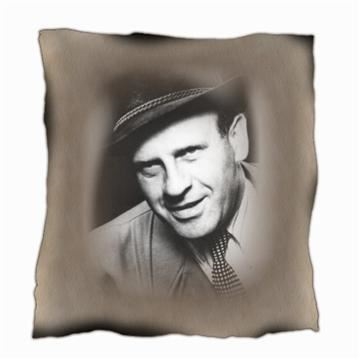 |
| (http://www.mengele.dk/Courage/Albums/Album2/Oskar2.htm) |
Schindler’s compassion prompted him to sacrifice his financial welfare and laidback lifestyle for his Jewish workers. He furnished his Emalia factory with numerous, easily accessible facilities, such as latrines, food stores, and barracks (Tyle). Although these quarters were simple, they seemed comparably luxurious to the many German concentration camps that lacked basic necessities. By constructing Emalia, Schindler lavished care on his workers, making sure their needs were fulfilled. Although basic goods were outrageously priced, Schindler’s workers could “count on eating much better than those imprisoned in the main camp at Plaszow because their boss regularly purchased his supplies on the black market” (Rooney). Schindler’s workers were fed 2,000-calorie meals, a feast compared to the 900-calorie fare at other labor camps (Bülow). Ordinarily, a businessman like Schindler would focus on profit-making, cutting workers’ pay and other unnecessary items. However, Schindler decided to discard a luxurious lifestyle and instead become responsible for these Jewish workers. Because wartime is always a period of frugality, it is incredible that he would voluntarily pay for full meals of 1,200 people. However, Schindler not only felt strongly for his Jewish workforce as a whole, but for each laborer. Multiple reports indicated that Schindler showed individual workers special kindness, whether it be giving one individual extra food or saving another from punishment (Bülow). These incidents contradict the claim that Schindler sheltered his workers for their cheap labor (Tyle). On the contrary, Schindler genuinely cared for his workers as human individuals, determined to help them in any way he could. As he once said: “I just couldn't stand by and see people destroyed. I did ... what my conscience told me I must do" (Tyle).
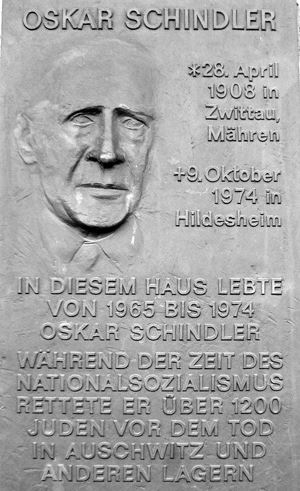 |
| (http://www.harrimantravelbooks.com/Frankfurt_3_Sights.html) |
Schindler’s courageous attitude aided his efforts as a savior of his Jewish workers, battling many risks he had to overcome. His greatest act, though fraught with dangers, was that he “…risked his life so many times…in an effort that saved the lives of at least 1,200 Jewish people during World War II” (Tyle). Because interaction with any member of the Jewish population was illegal, such an action would be met with severe consequences: jail, rejection by the German public, or death. Every day, he disregarded the risk of being reported to Nazi officials by his countrymen and instead, persisted in what he believed was morally correct. Although his actions exemplified treasonous behavior, Schindler was willing to fight Nazi conformity despite the hazardous situations bound to come his way. He personifies the rare individual who protects outcasts from schoolyard persecutors, though risking ridicule himself. Furthermore, to avoid the liquidation of his young and old laborers, Schindler listed his elderly workers “as being 20 years younger” and the children as adults (Bülow). In governments throughout the world, producing false files is punishable by law. Schindler’s act of fabrication essentially helped the Jewish workers from death, and if discovered, Schindler would be indubitably punished for breaking the Nazis’ strict regulations. Therefore, Schindler’s courage helped him through the many obstacles he had to overcome in order to achieve his goal.
An unexpected hero, Schinder combined compassion and courage in his act of civil disobedience. He took action to revolt against his surrounding circumstances, continuing 1,200 Jewish lives (Tyle). Schindler exhibited compassion through his acts of kindness, feeding his workers and supplying them with essentials when such goods were dear. Furthermore, his courageous behavior defined an impetuous nonconformity that dared to defy the Nazi regime. Ultimately, Schindler shows that a hero is a conglomerate of interacting qualities: the impetus to commit the deed as well as the momentum to carry it out. On a ring given to Schindler by his gratified workers, the inscription reads, "He who saves one life, it is as if he saved the entire world" (Rooney). In saving 1,200 lives, Schindler became a galaxy’s immortal star of hope and acceptance.
Bülow, Louis. "Courage." Oskar Schindler's Legacy. N.p., n.d. Web. 8 Jan. 2011.
“Schindler, Oskar (1908-1974)." Encyclopedia of World Biography. Ed. Terrie M. Rooney. Vol. 18. 2nd ed. Detroit: Gale Research, 1998. Student Resource Center - Junior. Gale. DEL NORTE HIGH SCHOOL. 12 Dec. 2010
“Schindler, Oskar.” U*X*L Encyclopedia of World Biography. Ed. Laura B. Tyle. Vol. 9. Detroit: UXL, 2003. P 1678-1681.
Page created on 1/15/2011 12:00:00 AM
Last edited 1/15/2011 12:00:00 AM