 |
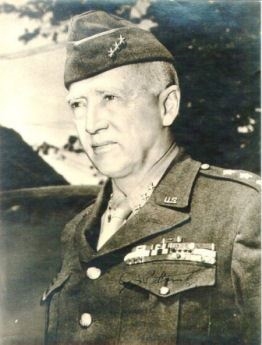
| The General in all his Awesome Glory (http://en.wikipedia.org/wiki/George_Patton) |
Patton had true heroic blood in him, and came from a long line of heroes before him that gave him interest in pursuing his dream. He had been inspired by the stories of his father’s friend, John Singleton Mosby, who had fought as a cavalry and a guerilla soldier. Then there was his Grandfather, also George Patton, who was a Brigadier General. After that came countless more tales about his ancestors that had fought in conflicts such as the Civil and Revolutionary War. There was even a rumor that Patton’s mother had kept paintings of Robert E. Lee and Stonewall Jackson, who Patton commented on by saying, “Until I was old enough to know better, I thought those were pictures of God the Father, and God the Son.”
Patton’s desire to become a military leader could not have been stronger (especially given his upbringing), but early on in his career he was faced with the most troublesome of difficulties. After attending the Virginia Military Institute for a year, he transferred to West Point. He flunked out there due to poor mathematics skills. Not only did that get in his way, but it is also argued by historians that he suffered from dyslexia, due to his written works, late start at learning to read, and the fact that he never learned how to spell words correctly. As you can well imagine, this kept him from getting far ahead in life fast enough, and it delayed his graduation from the academy to the year 1909. Through all his troubles he was not only able to graduate, but was also honored with serving in the Summer Olympics of 1912, where he participated in the Olympic’s first modern-day pentathlon, and did exceedingly well at that. After he had returned to the states, he continued research on a subject of fascination to him, cavalry techniques, and designed the M1913 Cavalry Saber. Thus, through all of his difficulties, he was able to conquer them and begin his road to success.
After the he fought in World War I he met Dwight D. Eisenhower, whom he became close friends with, and who would play a major role in his life. During this time he pushed Congress to create an armored division of troops. Because of his failure, he transferred back to Cavalry to further his military success. However, he was eventually able to get it to pass after the Blitzkrieg attacks in England. This allowed him to be promoted to Brigadier General and control the armored brigade, and soon after a major General before the United States became officially involved in the Second World War. Patton was a master of rising through the ranks and knew what it took to get to the top. He once said, “I do not fear failure. I only fear the ‘slowing up’ of the engine inside of me which is pounding, saying, "Keep going, someone must be on top, why not you?”
Patton became most famous for his actions and success during World War II, in which he began leading the II Corps. He soon became known to be a no-nonsense General who never cut his men any slack- Nevertheless, they adored him. He was able to get any man to follow him, as he and Eisenhower traveled through the ranks. In 1943 he was assigned leadership of the Seventh Army, who respected him as well as he led them in the Sicilian Campaign, which led to a famous incident in his career.
Patton’s harsh words and hard-core attitude were some of his greatest strengths, but also his greatest weakness. The public saw him in a cruel light, as a person who did not care for his troops, which was indeed quite the opposite. He cared for them so much that he wanted to force them to be the best they could be, to keep them from slacking off and instead become a confident workforce. One may argue that he didn’t care for his soldiers individually, which may have been true but he certainly cared what they could accomplish as a whole. "An army is a team. It lives, eats, sleeps, fights as a team. "This individuality stuff is a bunch of bullshit." Patton made sure his men were as well fed as possible but would not cut them any slack. Without a tight grip on his men, he knew he would not be able to control them. However there were times when he went overboard. During his campaign in Sicily, he slapped two hospitalized soldiers and verbally assaulted them. His friend Eisenhower had finally worked his way up as his senior, and ordered him to apologize to them, and his entire regiment. They both tried to keep him out of the public eye. Many agree that had anyone other than Eisenhower been in charge of him, he would have been court marshaled and sent back to the States. However he fortunately got off easy, and was merely suspended from his duties temporarily. Of course this was a major blow to his reputation as a general. Well what we know now, for better or for worse is that the two abused soldiers were suffering from “shell-shock,” a form of Post Traumatic Stress Disorder, but that was not diagnosed at the time.
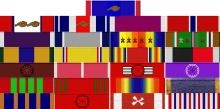 |
| Patton's Modern Day Military Ribbons (http://en.wikipedia.org/wiki/Image:PattonRibbons.jpg) |
Patton had other tremendous accomplishments throughout the war. In Normany, he used the Nazi’s Blitzkrieg tactics to his advantage, allowing him to cover in just two weeks, 600 miles. Another accomplishment was using his men to liberate much of Northern France. Patton, even was still too outspoken even after the war was over for people to appreciate his disciplinary skill. They were blinded instead by his passionate remarks which led to his decline in popularity. He had lost his friendship with Eisenhower, made negative comments about decisions being made in the government and military, and had given the press VERY interesting things to write, not caring what it would do to his image: just expressing his opinion. When victory was won in Europe and he was asked what he would do about the new boundaries and the Soviet Union, he replied, “I would have you tell the Red Army where their border is, and give them a limited time to get back across. Warn them that if they fail to do so, we will push them back across it.”
After the War in Europe was over and Patton had been promoted to General, but he suffered from a severe car accident which resulted in paralysis from the neck down and an embolism that ended his life.
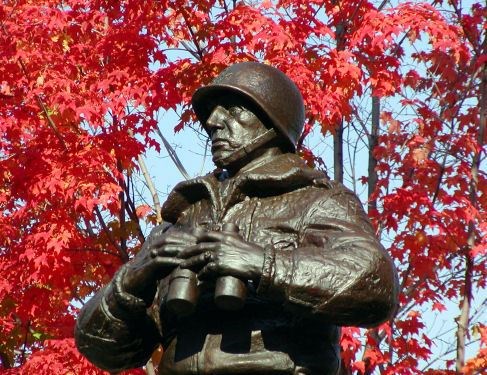 |
| A Monument Dedicated to Patton's Glory (http://www.usma.edu/PublicAffairs/Press_Kit_files/ImagesCurrent.htm) |
Regardless of how ruthless he could be, one cannot deny success, and his methods proved very successful in Europe during both World Wars. Patton’s serious attitude and razor-edge discipline gave him the power to command the respect from his troops that he needed to bring him to the top. As Patton once said, “You cannot be disciplined in great things and undisciplined in small things. Brave undisciplined men have no chance against the discipline and valor of other men.” Patton made his men the best they could be. He gave them everything.
Page created on 5/4/2006 12:00:00 AM
Last edited 5/4/2006 12:00:00 AM
"Lead me, follow me, or get the hell out of my way."
"Prisoner of War guard companies, or an equivalent organization, should be as far forward as possible in action to take over prisoners of war, because troops heated with battle are not safe custodians. Any attempt to rob or loot prisoners of war by escorts must be dealt strictly with."
“It is absurd to believe that soldiers who cannot be made to wear the proper uniform can be induced to move forward in battle. Officers who fail to perform their duty by correcting small violations and in enforcing proper conduct are incapable of leading.”
“You cannot be disciplined in great things and indiscipline in small things. Brave undisciplined men have no chance against the discipline and valour of other men. Have you ever seen a few policemen handle a crowd?”
"War is an art and as such is not susceptible of explanation by fixed formula"
"If everyone is thinking alike, someone isn't thinking."
"Infantry must move forward to close with the enemy. It must shoot in order to move…. To halt under fire is folly. To halt under fire and not fire back is suicide.”
"All men are timid on entering any fight. Whether it is the first or the last fight, all of us are timid. Cowards are those who let their timidity get the better of their manhood."
“Wars may be fought with weapons, but they are won by men.”
“I would rather have a good plan today than a perfect plan two weeks from now.”
“It is foolish and wrong to mourn the men who died. Rather we should thank God that such men lived.”
“Never tell people how to do things. Tell them what to do and they will surprise you with their ingenuity.”
“I do not fear failure. I only fear the ‘slowing up’ of the engine inside of me which is pounding, saying, ‘Keep going, someone must be on top, why not you?’”
“I don't measure a man's success by how high he climbs but how high he bounces when he hits bottom.”