 |
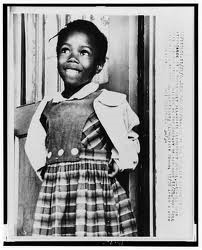
| Ruby Bridges, 1960. (http://digitaldocsinabox.org/) |
A small black girl carefully climbs out of a car, clutching her books to her chest. Her eyes dart back and forth as she takes in her surroundings. Hordes of white protestors, both men and women, barricade the entrance to the school, waving picket signs with obscene words scrawled across them in block letters. The sound of the crowd resembles that of an applauding audience at a concert, but rather than sounds of appreciation and approval, this crowd hurls insults at her. The deafening sound envelops the girl as she carefully follows the two marshals in front of her, who shove their way through the crowd, trying to clear a path to the school doors. A bold expression is set on the little girl's face; she holds her head high and stares straight ahead, trying desperately to tune out the tense atmosphere. This little African American girl is Ruby Bridges, who was born in September of 1954 in Mississippi. In the 1950s, the United States struggled with ending racial segregation, the separation of whites and blacks. The U.S. Supreme Court declared segregation unconstitutional in public schools, and ordered the cities to desegregate their schools. In Kindergarten, Bridges, along with other African Americans, was allowed to take a test for possible admission into the white schools. Ruby passed, and was chosen to integrate William Frantz Public School in New Orleans in 1960. After Bridges graduated from an integrated high school, she began working as a travel agent. Later, she married and spent her time bringing up four children. Currently, Bridges works to eliminate racism through the Ruby Bridges Foundation. U.S. President Bill Clinton awarded her the Presidential Citizen's Medal in 2001 for her efforts. A true hero is a person honored for their kindness, selflessness, and courage; they help us define and live up to our values. Ruby Bridges's determination to not let people's hateful behavior dissuade her and her dedication toward putting an end to racial discrimination confirm that she is an inspiration and a true hero.
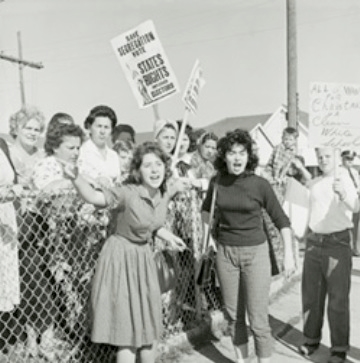 |
| Protestors outside William Frantz. (http://rubybridgesfoundation.org/) |
Today, people remember Bridges for her mental strength, which she strived to display every morning as she walked into school. Although crossing the screaming group of protestors presented a great physical challenge, it was more of an emotional challenge. Bridges relates her experiences: "I tried not to pay attention to the mob. Someone had a black doll in a coffin, and that scared me more than the nasty things people screamed at us...The people I passed every morning as I walked up the schools steps were full of hate...I saw white parents pointing at us and yelling, then rushing their children out of the school. In the uproar I never got to my classroom" (Bridges, Ruby. "The Education of Ruby Nell"). The whites possessed an immense amount of hatred for Bridges, because they resented the fact that a black girl would be attending the same school which their children were attending. Most children would break down or cry in such a situation, but Bridges surprised people with her tolerance for hatred. Instead of letting the crowd's atrocious behavior affect her, she made a conscious effort to not pay attention to the hatred. Her determined attitude is a strong value which many people admire about her. Bridges's mother advised her to say a prayer if she ever felt frightened. Bridges says: "I started praying on the way to school. The things people yelled at me didn't seem to touch me. Prayer was my protection...Please be with me, I'd asked God, and be with those people too. Forgive them because they don't know what they're doing" (Bridges, Ruby. "The Education of Ruby Nell"). Prayer aided Bridges in successfully making the journey from the car to the school's entrance each morning. Determined to find a way to be unaffected by the hatred displayed toward her, she grasped onto praying. It protected her and kept her feet on the ground; it helped her ignore the screams and taunts from the angry crowd. Not only did Bridges pray for herself, but she prayed for the malevolent people; she prayed to God to forgive their behavior. It shielded her against the abhorrence, so she clung onto praying, as she was motivated to be undeterred. Bridges displayed a mature attitude during certain incidents throughout the school year. When a boy at Bridges's school told her that his mother forbade him from playing with her, Bridges didn't seem hurt. She later reveals that she "wasn't angry with him because he said, 'My mom told me.'" She goes on to explain that "she was an obedient child, and if her parents had told her not to play with someone because he was Hispanic, Indian, mixed-race, she wouldn't have played with him" ("Story of student who braved mobs for school still teaches"). Bridges didn't let the incident bother her. Instead, she put herself in the boy's point of view and accepted his reason for not playing with her. Bridges was determined to be unaffected by the demeanor of others, so she handled the situation in a mature way. She may have felt hurt, but her response to the incident shows her effort to ignore the put-downs from others. Bridges's ability to see past the odium and disregard the insults makes her a person of strength and determination.
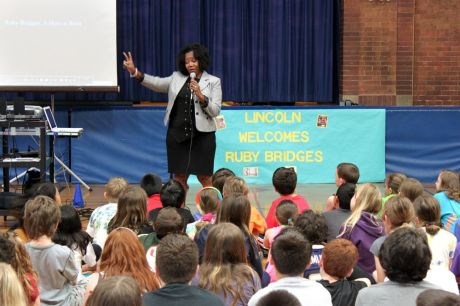 |
| Bridges, educating students about racism. (http://triblocal.com/) |
As Bridges grew older, she started devoting her life to supporting education and putting an end to the prejudice which she once dealt with. She felt that she could use her own experiences to make an impact on others about the issue, so she founded the Ruby Bridges Foundation in 1995. The foundation's mission is to promote interracial harmony and education. Throughout the years, William Frantz started to deteriorate. There wasn't sufficient funding, so many white families withdrew their children, leaving black children remaining at the school. She states: "I needed to find a way to give the William Frantz kids an equal opportunity to fulfill their hopes and dreams and enjoy school the way I did. I needed to find a way to help strengthen the school. That's what led me to establish The Ruby Bridges Foundation" (Bridges, Ruby. Through My Eyes). Like a true hero, Bridges is committed to helping and serving others. When she came to know that William Frantz was having troubles with their education funding, she immediately stepped up and built the foundation, through which she raised money for William Frantz. Her desire to create equality for students in school and make their dreams come true is an admirable quality. Bridges's main work consists of trying to eliminate racial discrimination. "She said it is her life's work to help eradicate the prejudice that kept the races segregated for so long" ("Story of student who braved mobs for school still teaches"). Bridges has dedicated her life to ending racial discrimination. Because she was a victim of this bigotry in her early life, she feels as if it is her duty to spread her message and educate people about the subject so no person will have to experience what she went through. "Today, Bridges speaks to kids about the importance of treating one another equally. She has never forgotten her experience at William Frantz Public School, and she shares details about her first day there in her speeches" ("Walking tall: how did Ruby Bridges make history 50 years ago? (Cover story)"). Since Bridges has experienced racial discrimination first-hand, the significance of her message is powerful and packed with emotion. She spreads her views about racial discrimination to students, and educates them about how wrong it is. Her efforts in spreading her message and working to end racism reveal that Bridges is an altruistic and selfless person who encourages goodness and righteousness in our world. Bridges's commitment to promoting good values and her love for helping others are selfless characteristics which make her a hero.
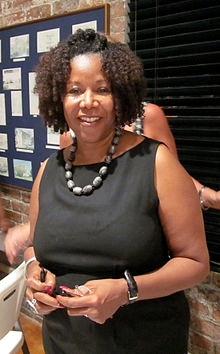 |
| Ruby Bridges, today. (http://en.wikipedia.org/) |
Today, thanks to Ruby Bridges, schools in our country are mixed and diverse, filled with students from many different countries. She is considered a hero because of her determination to ignore the hatred that she had to deal with, and her devotion to ending racial discrimination and promoting equality for everyone. Her effort to see past people's detestation of her is what pushed Bridges through the hardships of integrating the school. Despite her young age, Bridges possessed the mental strength and determination to overcome the hatred. She understood people's hatred for her and made an effort to not let it bother her. Her determination from her school days inspires people from around the world. "Many people have memorialized, chronicled, and examined Bridges's experience in 1960. John Steinbeck, for instance, wrote of her courage in Travels With Charley, and Norman Rockwell immortalized that first day of school in his famous painting 'The Problem We All Live With'" ("Ruby Bridges." Gale Biography in Context). Bridges's commitment to eradicating racism and supporting education is also helping to change the lives of many people. She raises money through her foundation for education, as she considers education an essential part of youth. She visits schools around the country and teaches students the significance of viewing every person as the same, despite the color of their skin or their ethnicity. Her efforts have helped raise awareness of racism, and she has inspired people to treat each other equally. Her strong-willed and altruistic personality is why I consider her my hero. Bridges has shown me that perseverance is all that is needed for me to face the struggles in my life. Just as she faced the seething crowd in 1954, I need to confront my own battles while reaching out to others, which may end up making a difference in our world.
WORKS CITED:
Bridges, Ruby. "The Education of Ruby Nell." Rubybridges.com. Mar. 2000. Web. 26 Mar. 2012.
Bridges, Ruby. Through My Eyes. New York: Scholastic, 1999. Print.
"Ruby Bridges." Gale Biography in Context. Detroit: Gale, 2010. Gale Biography In Context. Web. 21 Mar. 2012.
"Story of student who braved mobs for school still teaches." Virginian-Pilot [Norfolk, VA] 7 Feb. 2012.
Gale Student Resources In Context. Web. 24 Mar. 2012.
"Walking tall:
how did Ruby Bridges make history 50 years ago? (Cover story)."
Weekly Reader
News Edition 4-6 (a Weekly Reader publication). 89. 9 (Nov 12, 2010): 4(3). Student
Resource Center - Junior. Gale. DEL NORTE HIGH SCHOOL. 24 Mar. 2012.
Page created on 4/22/2012 12:00:00 AM
Last edited 4/22/2012 12:00:00 AM