 |
| A Demonstrator In Memory |
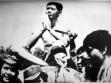
Soe Hok Gie (1942/12/17–1969/12/16) was an Indonesian activist, who opposed the successive dictatorships of President Sukarno and Suharto. Gie was an ethnically Chinese Roman Catholic. The name "Soe Hok Gie" is from the Hokkien dialect; in Mandarin his name would be "Su Fu-yi". Soe Hok Gie was the fourth of five children in his family; his elder brother Arief Budiman (also known as Soe Hok Djin or Su Fu-qin), a sociologist and lecturer at the Christian Satya Wacana University, was also quite a vocal critical voice in Indonesian politics. After spending his final years of senior high school at Canisius College, Gie attended the University of Indonesia from 1962 until 1969. Upon finishing university he became a lecturer at his alma mater until his death. It was during his time as a student that Gie became an active dissident, protesting against President Sukarno and the PKI. Gie was a productive writer, with articles published in such newspapers as Kompas, Harian Kami, Sinar Harapan, Mahasiswa Indonesia, and Indonesia Raya.
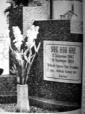 |
| Gie's grave in Tanah Abang |
An avid proponent of living close to nature, Gie quoted Walt Whitman in his diary: "Now I see the secret of the making of the best person. It is to grow in the open air and to eat and sleep with the earth". In 1965, Gie helped found Mapala UI, a student environmentalist organization. He enjoyed hiking, and indeed died through inhaling poisonous gas while hiking up the volcanic Mount Semeru on the day before his 27th birthday.
His diary was published in 1983, under the title Catatan Seorang Demonstran (English: Annotations of a Demonstrator). Gie's university thesis was also published, as Di Bawah Lantera Merah (Under the Red Lantern). Based on the quotes of his writings, we could sense his outstanding stance and opinion. For example, Soe once wrote: I had a dream of a world where the intellectuals – the labours – and the youth got up and said – stop all the hypocricy, stop all the murder. No more hatred to anybody, any religion, any nation. And forget the war and hatred, and get busy developing a better world.
We notice that Soe Hok Gie had been interested in politics and national events since he was still very young. But his passion to politics was minor to his opinion that politics was basically dirty. He believed that all people close to Soekarno were corrupt and greedy, and the head of political parties and the leading politicians were no more than “Soekarno’s pets” or “yes men”. Soe had made up his mind. He preferred hiking to taking part in the practical politics. He chose to be independent. He productively wrote articles containing his opinion and criticism in various printed media. But Soe also expressed his anxiety in lovely poems. One of them is Mandalawangi – Pangrango which is popular among hikers.
I think it is obvious why I choose him, Soe Hok Gie, to be my hero. His enthusiasm to keep up the struggle, fight for what he believed in although people don’t give him endorsement. I would like to express my respect to the memory of Soe Hok Gie, the most promising intellectual from the independence generation. His absolute commitment for the modernization of democracy, his honesty, and his confidence in fighting what he believed in. This is the message he sent us through his short lived life. Youngsters and especially student demonstrators should read a part of Soe Hok Gie’s poem that appeared long after his death in Sinar Harapan daily on 18th of August 1973. The tittle is “Message” and the important quotes are:
Today again I see
Soft faces yet harsh
Talking about independence
And democracy
And planning
To put an end to the tyrants
I know them
Whose soldiers are none
Willing still to fight dictators
Who is moneyless
Willing still to stop corruptions
My friends
I give you my love
And will you shake hand with me
Always?
Gie's diary served as the inspiration for a 2005 film, "Gie," which was directed by Riri Riza and starred Nicholas Saputra as Soe Hok Gie. Gie is also the subject of a 1997 book, written by Dr John Maxwell and entitled Soe Hok-Gie: Diary of a Young Indonesian Intellectual. The book was translated into Indonesian language in 2001, and re-titled Soe Hok-Gie: Pergulatan Intelektual Muda Melawan Tirani (which roughly translates to English as Soe Hok-Gie: A Young Intellectual's Struggle Against Tyranny).
Page created on 4/1/2006 12:00:00 AM
Last edited 4/1/2006 12:00:00 AM