"On my business card, I am a president. In my mind, I am game developer. But in my heart, I am gamer" (Tach). These were the first words that the President of Nintendo, Satoru Iwata, said as he walked onto the stage during the Game Developer's Conference in 2005. In life, it is clear to see that these were the words he abided and lived by. Now that he has passed, they are the foundation of the legacy he has left behind for his company, co-workers, fans, and admirers alike. To many, myself included, he was the man who crafted and made possible many childhood-shaping games, bringing classic Nintendo intellectual properties to the west such as Earthbound, the Kirby series, and Super Smash Bros, among others. Today, I look around me and see many different types of heroes, each gifted with their own set of unique, distinctive abilities. However, none of them will ever come close to inhabiting the same plane of respect and admiration I have for Satoru Iwata. He is a hero to me for the mastery of his craft, conviction and strength as a leader, and-most of all-his kind heart.
My hero was born in Sapporo, Japan on December 6, 1959. He demonstrated his prowess as a software engineer at an early age, making his first (albeit simple) game while still in high school. When it came time for young Satoru Iwata to further his education as a programmer, he elected to attend the Tokyo Institute of Technology. It was there that his skills in writing code truly flourished, as his professor, Tomohiko Uematsu, noted that he was much more proficient and accurate at programming than any of his other students ("Satoru Iwata"). In time, Satoru Iwata would expand his wealth of knowledge from being purely software-oriented to hardware as well. By the end of his college career, Satoru Iwata was ready to display his mastery of engineering to the rest of Japan.
In my mind, in order for someone to be considered a hero, they must display a certain degree of skill. Not only was Satoru Iwata skilled at his craft, he mastered it. This was one of Iwata's many traits that his colleagues recognized early in his professional career, starting when he was hired as the sole, full-time programmer at HAL Laboratory. It was there that Satoru Iwata first made contact with the company that allowed him to make a name for himself in the gaming industry. Shortly after joining HAL Laboratory in 1983, Iwata requested permission from Nintendo to develop games for their fledgling console, the NES (or Famicom as it was known in Japan). They happily obliged and allowed him to release now-iconic games such as Balloon Fight, Kirby's Dreamland, and Earthbound. Following the success that came with the release of the aforementioned titles, Iwata was promoted to President of HAL Laboratory. By this time in his career he should have been able to keep coding to a minimum. This was not the case when some of his developers were having trouble porting code from Pokemon Red and Green to Pokemon Stadium in 1999. The following quote comes from Shigeki Morimoto after he heard of Iwata's work on Pokemon Stadium. "I created that battle program and it really took a long time to put together. But when I heard that Iwata-san had been able to port it over in about a week and that it was already working. Well, I thought: 'What kind of company president is this?'(Nichols)" Much more recently, a similar sentiment was echoed when President of Nintendo of America, Reggie Fils-Aime, referenced Iwata's vast knowledge as a reason for his strong leadership in a speech dedicated to him during last week's Game Awards. "If you were to design the perfect person to lead a video game company you'd want someone who understood electrical engineering, who understood software design, and who understood business. Not many could claim this broad kind of background, but Mr. Iwata did. And, not only did he understand all of these areas, but he was accomplished in every one. If you've read the Iwata Asks series, you know he could drill down into the particulars of, both, hardware and game design. No one could lose him in the details" ("Nintendo's Reggie Fils-Aime Remembers Satoru Iwata - The Game Awards 2015"). Satoru Iwata's mastery of his craft is one of the biggest reasons he is a hero to me. However, it is not the only one. Another reason he will forever remain a hero in my eyes, was his strength and conviction as a leader.
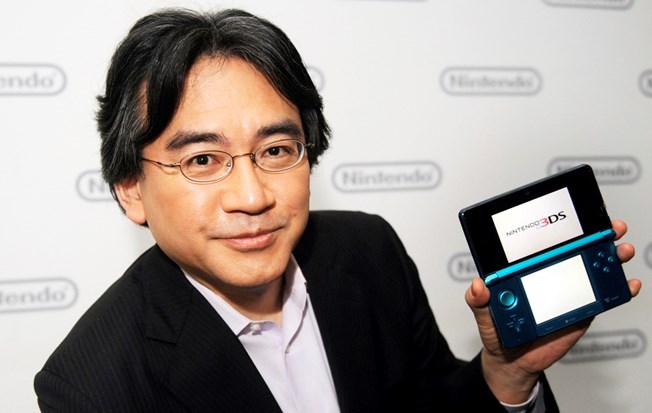 |
| Satoru Iwata at a 3DS press conference (GameSpot (Eddie Makuch)) |
If someone is strong, but lacks the conviction and desire to carry his ideas through to completion, what use is their strength? Satoru Iwata is a hero to me because, not only did he possess the strength to be a truly great leader, he had the conviction required to make sure his ideas didn't remain ideas, but were transferred to our reality. A clear example of this can be seen shortly after his taking on the role of president at Nintendo in 2002. Iwata was the very first member of Nintendo outside of the founding Yamauchi family to be named President, and only the fourth since the company's founding. Hiroshi Yamauchi, having served as President of Nintendo since 1949, lauded Iwata's skills as a businessman, stating that he "has the instincts to survive in the business" ("Satoru Iwata's Lifetime of Accomplishments"). The fact that Iwata was even allowed to assume the mantle of president speaks volumes to the amount of strength as a leader he must have possessed, but that this responsibility was relinquished to him with such confidence even further proves why he is my hero. Iwata's first console release as President of Nintendo should have been doomed from the start-and nearly was-had he not had the incredible conviction to champion his ideas. The Nintendo DS was the successor to the critically acclaimed and extremely profitable Game Boy, a console that sold a worldwide sum of over eighty million units. The crushing pressure that Iwata faced internally to deliver on his console debut is something I do not envy. To make matters worse, Iwata wanted to release a dual-screen, relatively underpowered device as the Game Boy's successor. The amount of opposition Iwata received from within the company itself was enormous, yet he had the conviction and vision to champion his idea and made sure it was released. He was rewarded with groundbreaking sales of the Nintendo DS. In fact, it sold over one hundred and fifty million units over the course of its entire lifespan, putting it in the top five selling game consoles of all time. Iwata was faced with the exact same situation when it came time to release his next product, the Nintendo Wii, another odd, relatively underpowered system (compared to other systems available on the market) with an even more odd, motion-controlled remote to serve as the primary controller. And, yet again, Iwata's conviction didn't fail to deliver. The Wii-like the DS-sold a total of over a hundred million units worldwide. Iwata's conviction as a president didn't fail him until the launch of the successors to, both, the Wii and the DS. The 3DS and Wii U stumbled out of the gate, failing to meet industry projections and sales forecasts. Iwata's reaction to this only made me admire him more, as he cut his salary in half and assumed full responsibility of the lack of performance of his two new consoles, instead of blaming the market as others in the same situation had done previously. Iwata's actions as President of Nintendo through the good times and the bad have inspired me to become as much like him as I can in my future career-no matter what career path I take-and have permanently cemented him as one of my greatest heroes. Satoru Iwata was clearly a shrewd businessman who knew his craft well, but he had one quality that set him apart from every other president of any other company-his kind heart.
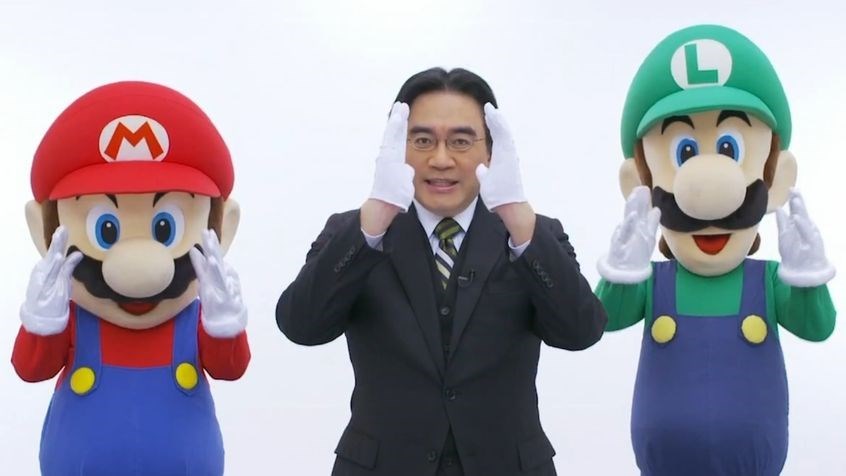 |
| Satoru Iwata during a Nintendo Direct (GamesRadar (Henry Gilbert)) |
Ask most people who their hero is and you'll hear a whole slew of responses. That's the nice thing about heroes: you can choose just about anybody you can think of to admire as a hero for just about any reason. Ask most people and you'll probably hear a plethora of names out of history books or a bunch of people who can throw a ball in a hoop. Rarely will you hear about some Japanese guy who ran a company whose devices you most likely enjoyed when you were much younger, and that saddens me. Because unlike those names out of history books, or those people who can throw a ball into a hoop, my hero elected to dedicate his life to serving others over himself by using his incredible qualities and gifts of master craftsmanship, conviction, and kind heart. It is for this reason that Satoru Iwata will forever remain a hero in my eyes.
Page created on 1/10/2016 12:00:00 AM
Last edited 1/10/2016 12:00:00 AM
Plunkett, Luke. "The Video Game Community Pays Tribute To Satoru Iwata." Kotaku.
Wikipedia, Wikipedia. "Satoru Iwata." Wikipedia.
Tach, Dave. "Satoru Iwata''s Lifetime of Accomplishments." Polygon.
Makuch, Makuch. "Satoru Iwata holding 3DS". GameSpot.
Peckham, Matt. "Why Nintendo President Satoru Iwata Mattered." Time.