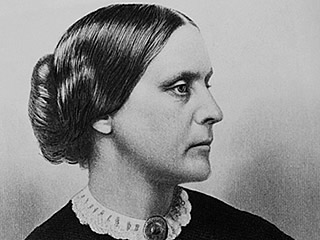
 Susan B. Anthonypetridigs10-racism.pbworks.com - "The past has been a mint/ of blood and sorrow/ That
must not be/ True of tomorrow." The poem "History" by Langston
Hughes depicts Susan B. Anthony perfectly. For Anthony, there was much sorrow
from "the past" as she dealt with society's prejudice to make a
brighter future. However, instead of looking back and cursing the government
for not giving women and blacks the same rights as white men, she took action.
She made sure that the same injustice would not happen in the future. Anthony
was born on February 15, 1820 into a Quaker family with strong moral values. Growing
up in a family who strongly supported women's rights and abolition, Susan B.
Anthony saw how white men had more rights than women and blacks. Angered by the
inequality, she decided to act against the prejudice by fighting for the rights
of the oppressed. As a result, Anthony ended up fighting public abuse and sarcasm along with questioning looks from other women. However, the public's reactions did not discourage her; in fact it strengthened her belief of what was right and made her fight back even harder. Through her unrivaled passion and honesty, Susan B. Anthony embodies the true definition of a hero. Like Anthony, a hero is someone who is truly dedicated to what he/she is doing. During a time period where laws administered a common belief that women and blacks were of lesser value than white men, it was extremely difficult to stand up for minorities. However, with passion and sincerity, Susan B. Anthony stood up for what she believed was right.
Susan B. Anthonypetridigs10-racism.pbworks.com - "The past has been a mint/ of blood and sorrow/ That
must not be/ True of tomorrow." The poem "History" by Langston
Hughes depicts Susan B. Anthony perfectly. For Anthony, there was much sorrow
from "the past" as she dealt with society's prejudice to make a
brighter future. However, instead of looking back and cursing the government
for not giving women and blacks the same rights as white men, she took action.
She made sure that the same injustice would not happen in the future. Anthony
was born on February 15, 1820 into a Quaker family with strong moral values. Growing
up in a family who strongly supported women's rights and abolition, Susan B.
Anthony saw how white men had more rights than women and blacks. Angered by the
inequality, she decided to act against the prejudice by fighting for the rights
of the oppressed. As a result, Anthony ended up fighting public abuse and sarcasm along with questioning looks from other women. However, the public's reactions did not discourage her; in fact it strengthened her belief of what was right and made her fight back even harder. Through her unrivaled passion and honesty, Susan B. Anthony embodies the true definition of a hero. Like Anthony, a hero is someone who is truly dedicated to what he/she is doing. During a time period where laws administered a common belief that women and blacks were of lesser value than white men, it was extremely difficult to stand up for minorities. However, with passion and sincerity, Susan B. Anthony stood up for what she believed was right. Susan B. Anthony passionately spoke up for the rights of
the oppressed, and her passion drove her to do many different things that even
people today would be afraid to do. For example, she lost her job due to her
strong passion: "Her first job was with the New York state school system,
which she joined in 1839. Her weekly salary amounted to only one-fifth that of
a male counterpart, but when she protested the inequity, members of the school
board were less than pleased. That issue, combined with her regular visits to
African Americans in their homes, eventually caused her to lose her job" (Contemporary Heroes and Heroines). Seeing the inequity between her and her male coworkers
caused Anthony to stand up and fight for her rights. Unlike most people back
then, she did not see blacks and women as inferior to white men. It is apparent
from her protests and her regular visits that, in Anthony's eyes, everyone
regardless of color and gender were equal. Risking her job and her security, Anthony protested for her beliefs and fought the injustice that she saw. Unfortunately, Anthony lost her job, but this just made
her more passionate to fight for others who were oppressed like herself. In
order to help express her beliefs, she gave many speeches " which meant
many more hard miles of traveling. Her speeches - whether for pay or on behalf
of a suffrage campaign - took her to almost every area of the country,
including the rugged states and territories of the Far West. When the train
lines had yet to reach the town she sought, she sometimes slogged her way to
meetings on stagecoaches, wagons, and even donkeys." (Hill 107)
Since her employer did not listen to her, Anthony wanted to make sure the
rest of America would. Before she had time to lament the loss of her job,
Anthony was running to different places in America in order to spread her
beliefs. The norm of women back then was to cook, clean, and care for their
husband. For most women, the farthest they had ever gone from home was the
grocery store. On the other hand, Anthony was going everywhere in various means
of transportation. Although it was
uncomfortable, Anthony was more than happy to ride a donkey in order to get to
her destination. This truly shows her passion because no matter how many
obstacles were in the way, Anthony simply kept going. With a burning passion in her heart, Anthony ignored the risks of speaking up, and unlike
other women, she visited many different places to explain why women and black
people needed the same rights as white men.
Susan B. Anthony worked sincerely for her cause; she did not work
for fame, but instead for the happiness of women and blacks. During her
protest, Anthony decided
to display civil disobedience to prove to
America that she was tired of the few rights that women and African-Americans
were given: "Anthony's attorney, who had mounted a credible defense, lost
no time in calling for a new trial on the grounds that his client had been
denied the right to a verdict by jury. The motion was denied, however, and
the defendant was sentenced to pay a $100 fine." (American Eras).
When Anthony decided to vote, she knew that she was making a dangerous
decision. Although she could foresee the consequences, such as a fine or imprisonment, she still continued with her action. This proves that
Anthony fought for a sincere cause, not just for fame, for when one displays civil
disobedience, the first thing that comes up in one's head is not a Nobel Peace
Prize. The first thing that comes up in one's head are the dire consequences, yet Anthony still cast her vote. What makes Anthony even more
amazing than other men and women who display civil disobedience is that she
took it one step further when she refused to pay the fine that she was issued.
Instead, she gave a speech explaining her actions. At this point it is evident
that Anthony's eyes were not on a prize, for not only did Anthony disobey the
law, but the public also looked down on Anthony: "Fiercely independent and
zealously moral, she endured years of public abuse and sarcasm from those who
made light of her work or who saw in her a dangerous threat to the status
quo." (Contemporary Heroes and Heroines). Although society looked at her in a disapproving manner,
Anthony kept going. Anthony was constantly abused by the public, and she had to
face many articles and cartoons questioning her motives and ridiculing her
actions. Despite the mockery, Anthony ignored her critics and she constantly
fought for the rights of the oppressed. With her act of civil disobedience, and
with almost everyone hating her, it would have been excruciatingly difficult
for her to get an award, but because she honestly wanted women and black people
to have the same rights as white men, she fought on.
It was very
difficult for anybody to stand up for anything they believed was right in the
time period that Susan B. Anthony lived in simply because the government was
headstrong. In fact, it is still difficult for people to muster up the courage
to stand up for what they believe in. However, Anthony was able to stand up and
face the public and the law with passion and honesty. Susan B. Anthony had
passion inside of her. Her passion caused her to lose her job; nevertheless,
she tirelessly did anything and everything to help spread the word about
oppression. She did not let anything come between her and her
mission. Not only was she passionate, but she was also very
sincere. Anthony never won any prize; in
fact, she was usually the center of mockery. Despite this fact, she ignored
everything that everyone said about her, and she continuously fought for
women's rights. It is sad that Anthony was not alive to see the 19th amendment
pass: the amendment that allows women to vote. However, if it was not for the
arduous work she had done, who knows where America would be in the present?
Although the general public looked at her disapprovingly, Susan B. Anthony kept
her head high and did what she believed was right. Anthony is an inspiration
because she did what was right despite the perils that it put her in. She has
inspired many people, including me, to fight for their beliefs, despite what any one else thinks of them. Anthony was a brave woman who fought long
and hard for her beliefs. Anthony was obviously not reading Langston Hughes's
poem when she was standing up for minority rights. However, it is pretty
surprising how well she follows his poem "History". She did not care
about what happened in the past; she just wanted to make sure it did not happen
in the future.
Works CitedHill, Jeff. Women's Suffrage. Detroit, MI: Omnigraphics, 2006. Print"Susan B. Anthony 1820-1906." American Eras. Detroit: Gale, 1997. Gale Student Resources In Context. Web,. 21 Mar. 2012"Susan B. Anthony." Contemporary Heroes and Heroines. Vol. 3. Gale, 1998. Gale Biography In Context. Web. 21 Mar. 2012
Page created on 4/24/2012 12:00:00 AM
Last edited 7/26/2026 4:19:20 AM