 |
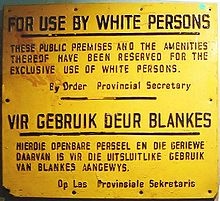
| Apartheid (http://simple.wikipedia.org/wiki/Apartheid) |
Apartheid originates from the Afrikaans word for apartness. Three racial categories were formed under the Population Registration Act of 1950, Black Africans, Whites and Colored (mixed race). Asian was added as the fourth category later on. In 1950 laws were passed to enforce the apartheid system. New laws included the Group Areas Act (1950) and the Land Act (1954-55). The Group Area Act restricted different races from interaction, assigning them to separate business and housing areas. The Land Act implied similar restricting, banning nonwhites from white land. The Bentu Authorities Act (1951) along with the Promotion of Bantu Self-Government Act (1959) excluding blacks from politics by titling them as citizens of their own homeland. Conditions lacked sufficient resources, daily life proved to be a consistent struggle. Conversely, Afrikaans benefited greatly from this system. Peacefully living out their lives, most Afrikaners were completely unaware of the conditions black and other races suffered through.
Opposition was repressed greatly. However, various tactics were used in the fight against Apartheid. Campaigns, strikes, sabotage, demonstrations and groups such as the ANC formed in the fight against the system. Walter Sisulu, along with many others, played a great part in the fight against Apartheid. It wasn’t until early 1990 that the Apartheid System began to disassemble.
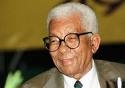 |
| Walter Sisulu (http://www.zar.co.za/sisulu.htm) |
Walter Sisulu was born on May 18th, 1912 in the village of Qutubeni in the Engcobo district. He was raised by his grandmother and uncle. Sisulu didn’t live with his mother until he was six years old. At the end of his sixth grade in school Sisulu dropped out. The reason for his dropout was because of his Uncle's death. He was fifteen at the time.
His first job was at a dairy farm in Johannesburg. He took the job to help support his family. Later he worked in a bakery. However, in 1940 he was fired when he attempted to organize a strike for higher wages. In 1941 he met Albertina Thethiwe. In 1944 the two married in a small ceremony. Five children followed. The same year of his marriage Walter attended a conference at the ANC. He was then elected as an executive committee in the new branch of the ANC, The Youth League. His Involvement in the ANC is highly recognized. On May 5th, 2003, Sisulu died in Johannesburg
The fight against apartheid was arduous. Brave people, such as Walter Sisulu risked their lives to establish equality between all races. During his life Walter Sisulu planned and carried out many methods and approaches of resistance to this unjust system. Ranging from sabotage, campaigning and group alliances, Walter Sisulu spent a good portion of his life fighting against apartheid.
In 1994 Walter Sisulu was elected as an executive member in the Youth League. During his life Walter Sisulu became part of the Congress of the People (1956), Underground Communists and Transvaal executive.
When World War Two began Walter Sisulu started his first campaign against black South Africans joining the army. Among the many campaigns Walter participated in were the Freedom Charter, 1952 Defiance and Congress Alliance.
Walter Sisulu along with 156 other people were arrested on December 5, 1956. This event, known as the treason trail, started August 3, 1958. It wasn’t until March 29, 1961 that Sisulu and the rest were finally acquitted. Walter Sisulu ideology and beliefs concerning the issue of Apartheid were similar to the Anti-Apartheid group ANC. He belonged to the Anti-Apartheid group ANC so it would make sense that most of his beliefs were parallel. The group believed in “fighting” Apartheid in a peaceful way. The main focus was appealing to not only black South Africans but also to the other South Africans, including Whites and Afrikaners. The Youth League, a branch from the ANC, believed that their peaceful approach wasn’t efficient enough to aid in dismantling the Apartheid System. Remaining a member of the original ANC group and becoming a representative in the new branch the Youth League, Walter Sisulu became a distinguished assent in the fight against the unjust system. When peaceful tactics failed, sabotage became the next attempt in this arduous struggle.
The group itself was later banned. Strong in his belief of equality Walter Sisulu persisted. Despite the fact that such acts had become illegal. Although it may have seemed his work left little to no affect on the world around him he continued. He, along with many others, had become restless. He was eager to share with the world what he knew to be right. His courage and unwavering beliefs in equivalence is notable and inspired many. .Brennan, Carol . "Sisulu, Walter ." encyclopedia. 2005. Web. 26 Feb. 2011. http://www.encyclopedia.com/topic/Walter_Sisulu.aspx
"Walter Sisulu." Saho. South African History Online, Web. 21 Feb. 2011. http://www.sahistory.org.za/pages/people/bios/sisulu,w.htm
Robinson, Alonford J. "Apartheid." Africana . Web. 27 Feb. 2011. http://www.africanaencyclopedia.com/apartheid/apartheid.html
Page created on 3/7/2011 12:00:00 AM
Last edited 3/7/2011 12:00:00 AM