REPRINTED WITH PERMISSION FROM THE CHRISTIAN SCIENCE MONITOR
Chocolate is more expensive than ever. So, why aren’t cocoa farmers reaping the benefits? Our correspondent traveled to Côte d’Ivoire to examine what keeps cocoa farmers in poverty and what might lift them out of it.
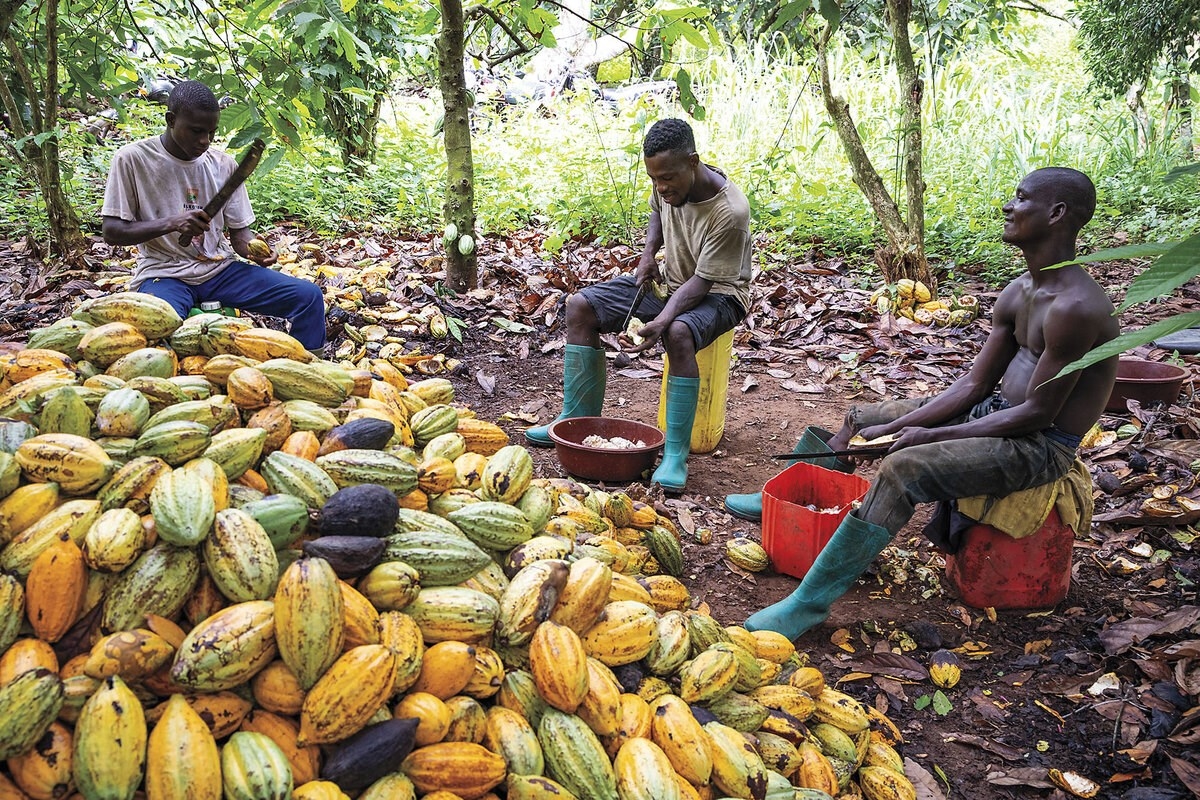 Workers use matches to extract cocoa beans from pods at Odette Kouakou’s farm, April 11, 2026, in M’Brimbo, Côte d’Ivoire. Melanie Stetson Freeman/Staff
| M’Brimbo, Côte d’Ivoire
In the shade of a dense forest canopy, Odette Kouakou paces through her grove of cocoa trees, snapping off dead leaves and poking the ripe yellow pods hanging down from the branches with a stick.
Nearby, a group of men in olive-colored galoshes sits around a heaping mound of the pods, which are roughly the size and shape of footballs. A gentle popping sound echoes through the forest as they crack them open with machetes, scooping out handfuls of fresh, white beans and tossing them into plastic tubs.
Harvests are normally a celebratory time in this cocoa growing community. But Ms. Kouakou is fizzing with anxiety. She still hasn’t been paid for the last 400 pounds of cocoa she harvested, a $1,000 hole in her wallet.
“I always keep some money to the side in case of difficult periods,” says Ms. Kouakou, who runs the farm with her nephew and supports a dozen family members on her income. “But now, that’s all the time.”
Nearly a quarter of Ivorians – between 6 and 8 million people – rely on the cocoa industry for their living. Many of the world’s chocolate lovers, in turn, rely on them. Forty percent of the global cocoa supply originates in Côte d’Ivoire, and each year the country produces 2 million tons of it, enough for roughly 28 billion dark chocolate bars.
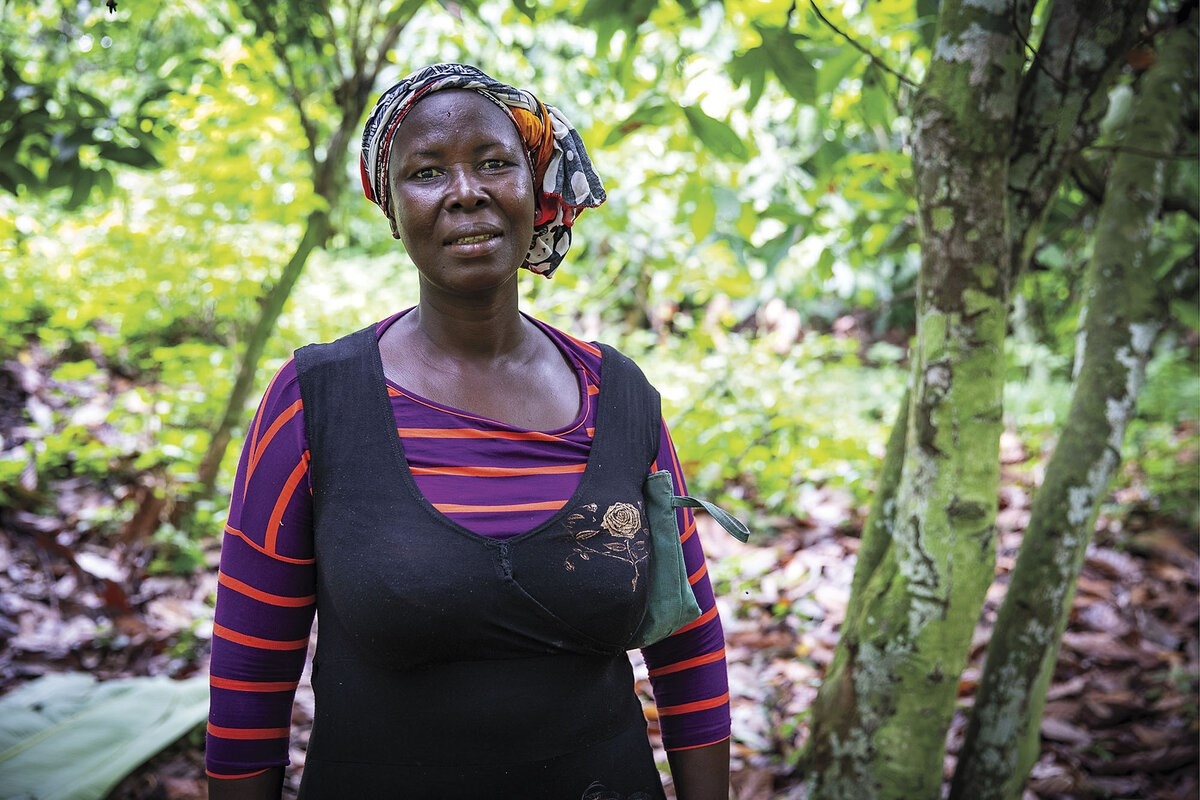 Melanie Stetson Freeman/StaffOdette Kouakou stands in her cocoa farm, April 11, 2026, in M’Brimbo, Côte d’Ivoire. She is a member of a cooperative of local, organic cocoa growers. She supports a dozen family members with her work on land that was handed down to her from her father.
The price of chocolate has risen steadily in recent years – it is up by 23% in the United States since 2024, for example. But consumers paying more for chocolate doesn’t necessarily mean Ivorian cocoa farmers – most of whom live in poverty – are earning more.
That is because the Ivorian cocoa industry remains tethered to the boom and bust of commodity prices. To escape that cycle, experts say the country needs to do more with its cocoa beans than just pick them and export them.
“Cocoa has the potential to build up this country,” says Axel Emmanuel Gbaou, one of the country’s few chocolate makers. “We have lost so much time. Now is the time to act.”
The global cocoa crisis began in 2023, when heavy rains followed by drought led production yields to plummet in West Africa, the region where 70% of the world’s cocoa originates.
At the same time, the war in Ukraine caused fertilizer shortages, pushing up prices for Ivorian farmers who were already struggling to survive. Many let their plantations fall victim to rot; others abandoned cocoa farming altogether.
“Farmers are rational,” says Jean Paul Aka, head of the sustainable development and climate change unit at the United Nations Development Programme in Côte d’Ivoire. “If cocoa is not bringing in any money, they’re going to move onto something else.”
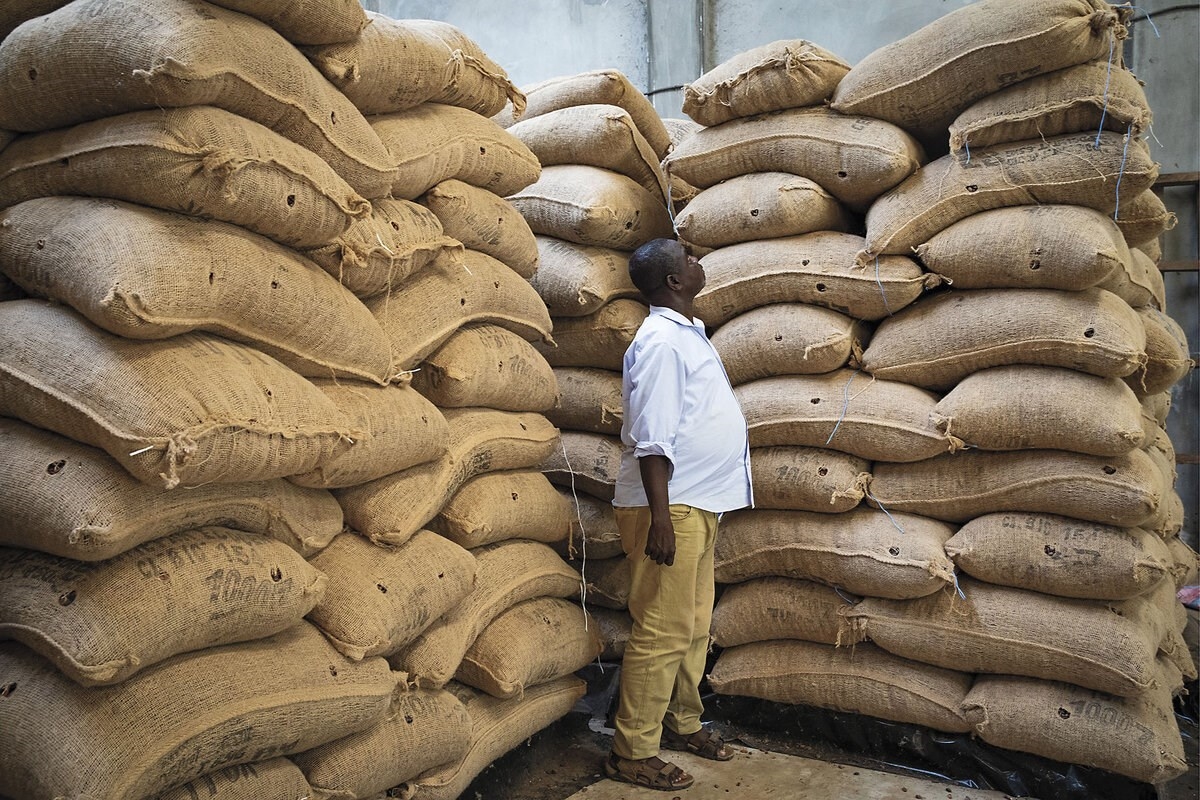 Melanie Stetson Freeman/StaffCocoa producer and warehouse manager Eugene Yao Kacou stands beside bags full of cocoa beans in the store for members of the Société Coopérative Équitable du Bandama, April 10, 2026, in M’Brimbo, Côte d’Ivoire.
As fears grew about a possible supply collapse, the global market went into a frenzy. In just over a year, the price of cocoa more than quadrupled to $12,000 per metric ton in mid-2024. In response, the Ivorian government repeatedly raised the minimum price farmers can be paid for their cocoa beans, also called the farm-gate price. Last October, during his reelection campaign, President Alassane Ouattara announced a price of 2,800 CFA francs ($5) per kilogram – the highest on record and 200% higher than in 2023.
“We felt optimistic when the president set that high price,” says Marcelin Aka, a cocoa farmer. “Like the government finally valued what we’re doing.”
But then the price of cocoa on the global market plummeted. With Côte d’Ivoire’s farmers locked into a higher price, most international buyers refused to purchase Ivorian beans. More than 120,000 tons of cocoa beans piled up in ports and warehouses across the country.
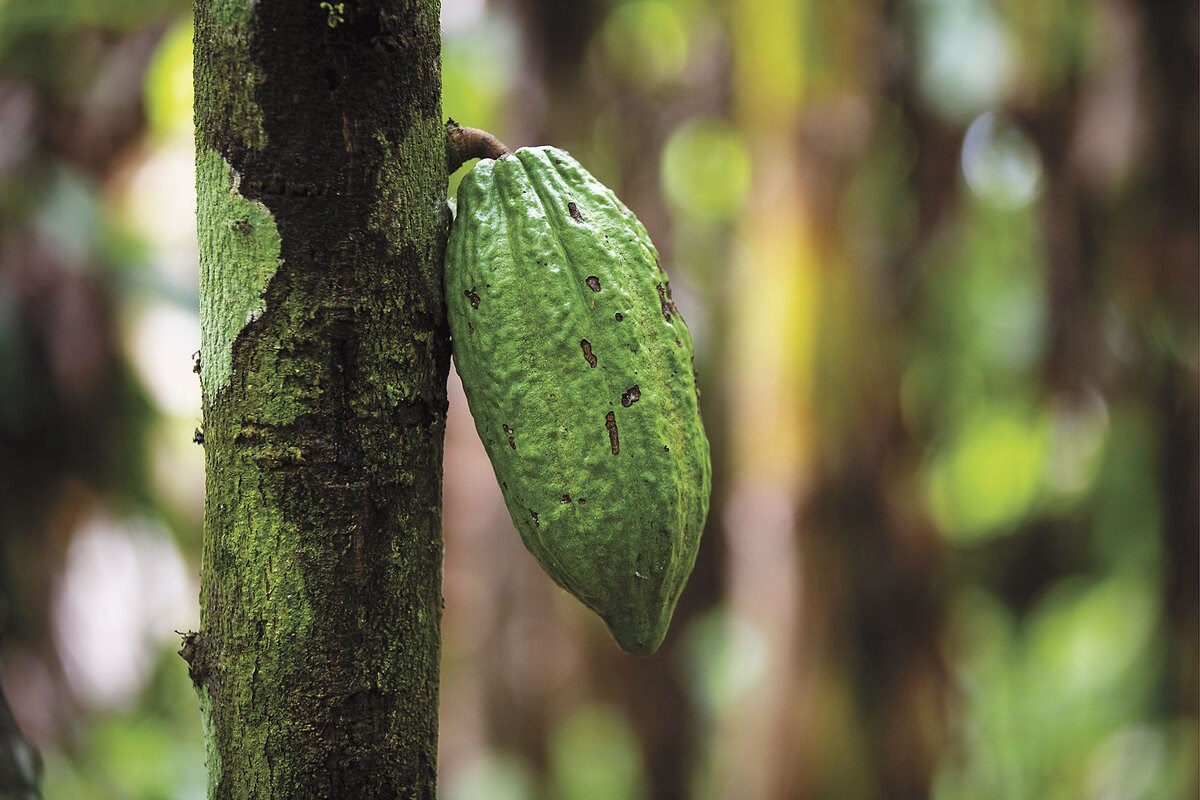 Melanie Stetson Freeman/StaffA cocoa pod hangs on a tree at Odette Kouakou’s farm.
In March, in an effort to salvage the season’s harvest, the Ivorian government abruptly slashed the farm-gate price by more than half, to 1,200 CFA francs ($2) per kilogram. The government also promised to buy up beans that farmers couldn’t sell at the same rate, but growers here in M’Brimbo say it hasn’t happened yet.
That has left cocoa farmers forced to borrow money from family and friends and cut meat and fish from their diets. Some have begun pulling their children out of school at lunchtime because they can’t afford to pay the cafeteria fee of 100 CFA (18 cents) per child.
“We eat worse and less,” says Mr. Aka, whose land is surrounded by dense manioc forests.
The government has tried to provide protections to farmers, like its current buyback scheme and fertilizer subsidies. Yet even under ideal conditions, with good yields and functioning safety nets, most Ivorians who grow cocoa will never make it out of poverty. Experts say there just isn’t enough profit to go around for farmers, who are the weakest link in the chocolate value chain.
For every $1 a customer spends on a chocolate bar, only around 6 cents goes to farmers, with the rest carved up among those who mill the cocoa, make the chocolate, and sell it to consumers. Currently, more than half of Ivorian beans are exported whole every year, without any processing at all. In fact, about 77% of the world’s cocoa is ground outside of West Africa.
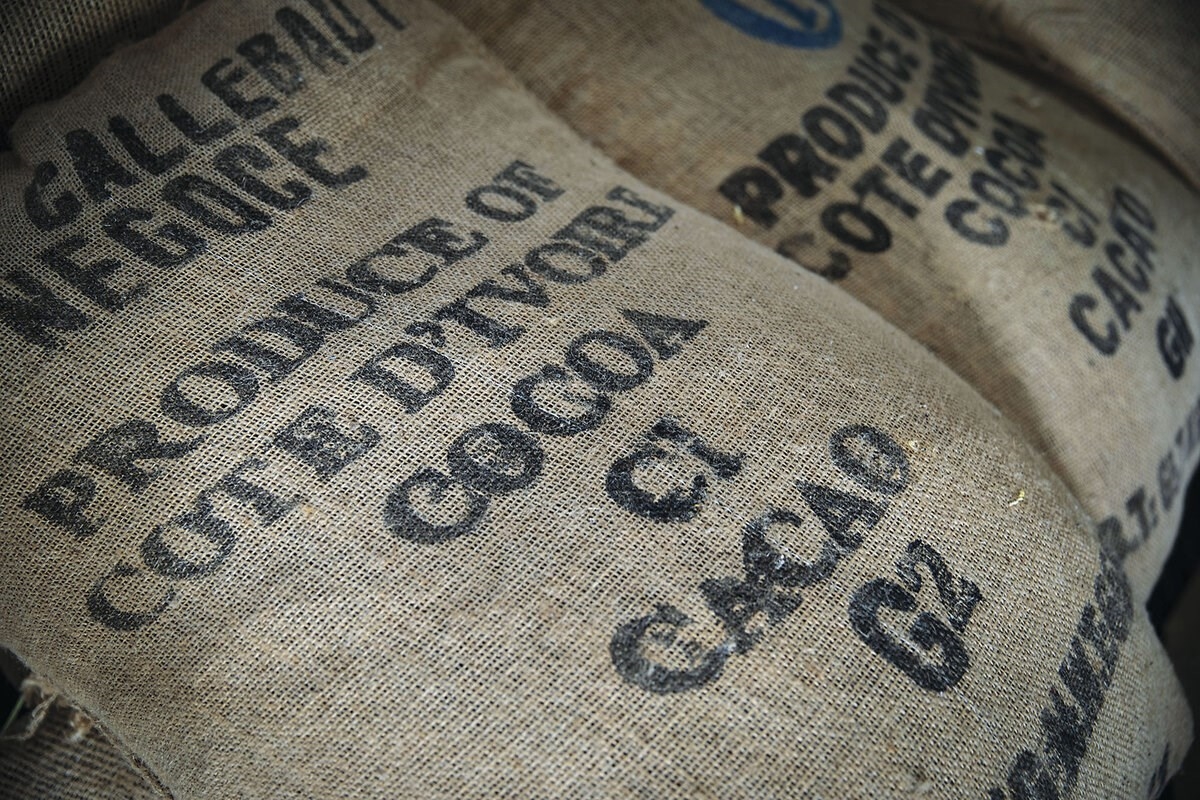 Melanie Stetson Freeman/StaffA bag of cocoa beans belonging to members of the Société Coopérative Équitable du Bandama sits in the warehouse.
That means that Côte d’Ivoire and its neighbors have historically watched international companies like Lindt and Nestlé earn the majority of the profit from their beans.
“There is definitely a sentimental value that ties cocoa farmers to their land,” says Pauline Zei, director of INADES-Formation Côte d’Ivoire, an organization that assists cocoa farmers. But if nothing is done to make cocoa farming more lucrative and “young people become uninterested in this field, we’re going to find ourselves in a complicated situation.”
Experts often point to the need for Côte d’Ivoire to think broader – both in terms of what its farmers grow and in what it does with cocoa.
Cocoa farmer Cedric Tossavi kept hearing about this need to diversify, but he didn’t like what it seemed to imply – leaving Côte d’Ivoire’s cocoa industry behind.
“I thought, what can we do to diversify but keep going with cocoa?” says Mr. Tossavi, who owns a 540-acre industrial cocoa farm just outside of M’Brimbo. Seated at a long table overlooking his garden on a recent day, he pours a glass of an opaque, milky yellow liquid and takes a swig. It’s sweet and smooth.
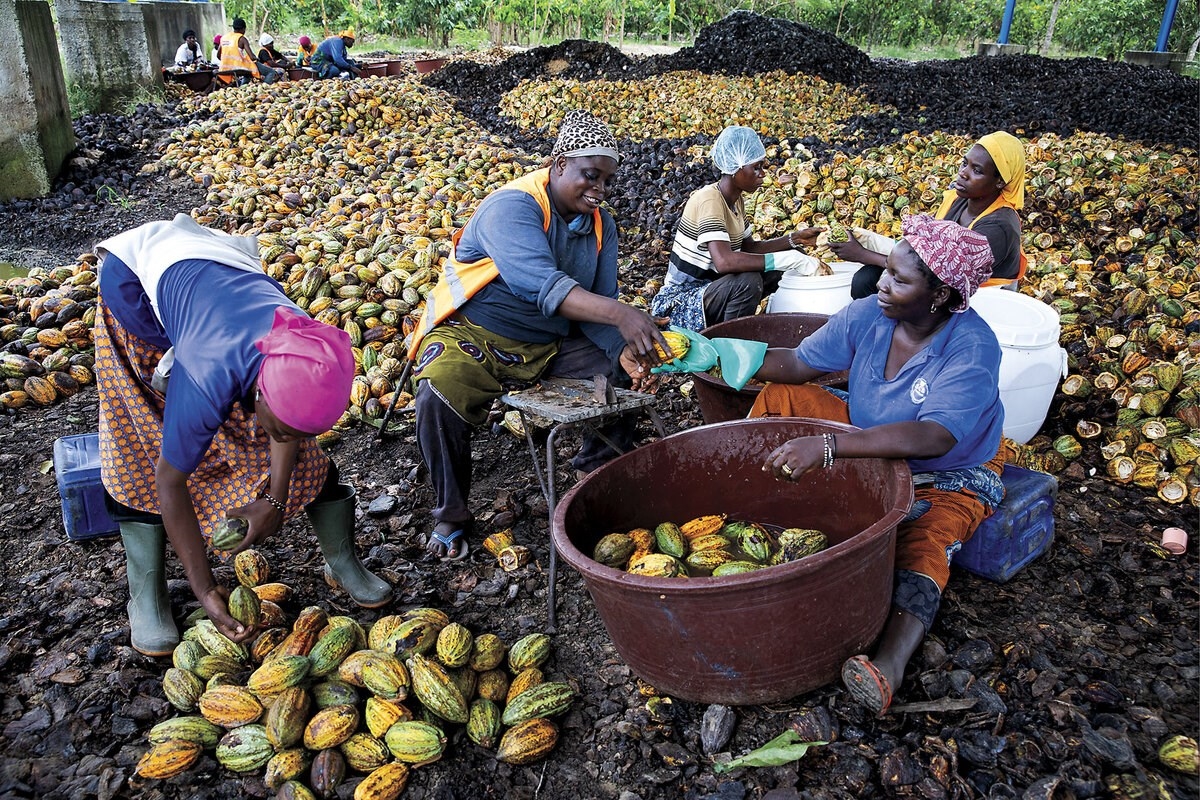 Melanie Stetson Freeman/StaffWorkers on Cedric Tossavi’s industrial cocoa farm extract the seeds from ripe cocoa pods, April 11, 2026, in Tiassale, Côte d’Ivoire. Mr. Tossavi employs 200 workers on his farm. He is an agricultural engineer teaching soil health to growers.
“Fresh cocoa juice,” says Mr. Tossavi, smiling.
Instead of throwing out the white pulp that surrounds the cocoa beans, Mr. Tossavi started putting it to the side and draining the juice. Now, he sells his cocoa juice to stores around the country, along with a homemade cocoa-based honey spread. He’s also working on small-batch cocoa ice cream and chocolate, with hopes of one day selling them on a large scale.
The Ivorian government is increasingly seeing the importance of processing cocoa into chocolate, cocoa butter, cocoa powder, and other products at home. In 2025, Côte d’Ivoire inaugurated two new processing factories, which the government hopes will help the country reach its goal of transforming 50% of its own cocoa in the next two years, up from 42% currently.
But entrepreneurs like Mr. Tossavi say the country needs to both move more quickly and think more radically about what to do with cocoa. For instance, he also creates biochar – a charcoal-like material made of biomass waste used to improve soil health – and he composts what he can. All these projects create an extra income for Mr. Tossavi’s 200 employees.
Industrial farms are one of the few ways cocoa workers can be guaranteed a stable income year-round in Côte d’Ivoire. On Mr. Tossavi’s farm, workers earn the minimum wage, which is 75,000 CFA francs ($133) per month. But they remain few and far between. Around 90% of the country’s cocoa is produced on small family farms of 12 acres or less.
Meanwhile, despite being the world’s largest cocoa producer and boasting a population of more than 30 million people, Côte d’Ivoire counts only about two dozen chocolatiers.
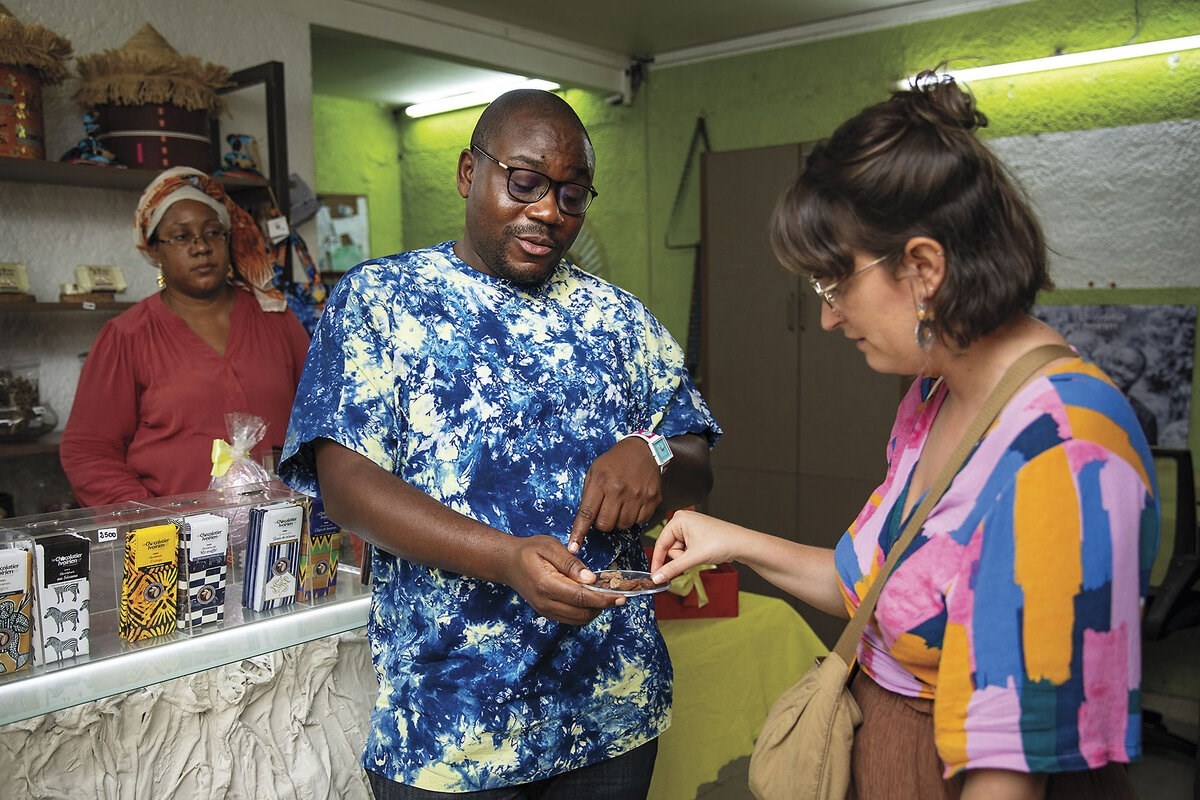 Melanie Stetson Freeman/StaffAxel Emmanuel Gbaou, owner of Le Chocolatier Ivoirien, offers customer Paloma Penas, from Spain, cocoa-covered cashews in his shop, April 7, 2026, in Abidjan, Côte d’Ivoire.
Since 2016, Axel Emmanuel Gbaou has been making 100% Ivorian chocolate bars and selling them out of his tiny shop, Le Chocolatier Ivoirien, in an upmarket suburb of Abidjan.
A former banker, Mr. Gbaou turned to chocolate after realizing that, despite the 2 million tons of cocoa beans the country produced annually, there were hardly any homegrown chocolate bars on Ivorian supermarket shelves. “I found it completely absurd,” says Mr. Gbaou, holding up a bar of cocoa butter in his shop.
Since then, he has gone further, training more than 2,000 women across the country to produce cocoa-based products like cocoa butter and soap to sell in local markets. He also buys the organic beans they grow to make his chocolate.
“Cocoa has the potential to build up this country,” says Mr. Gbaou. “I see the opportunities.”
However, getting Ivorians interested in chocolate is a larger challenge. For now, chocolate remains a luxury item and unaffordable for much of society. Most of the chocolate sold in supermarkets here is made in Europe – and sells at European prices.
Even if the cost of chocolate goes down, Ivorians largely view it as a children’s snack or a treat for special occasions. In the country’s year-round hot climate, most prefer fruit for dessert.
“Not everyone has the habit of eating chocolate, but we need to put more value into making it here,” says Nicolas Djabaré, a university student and an intern at Mr. Gbaou’s chocolate shop. “The rest will come.”
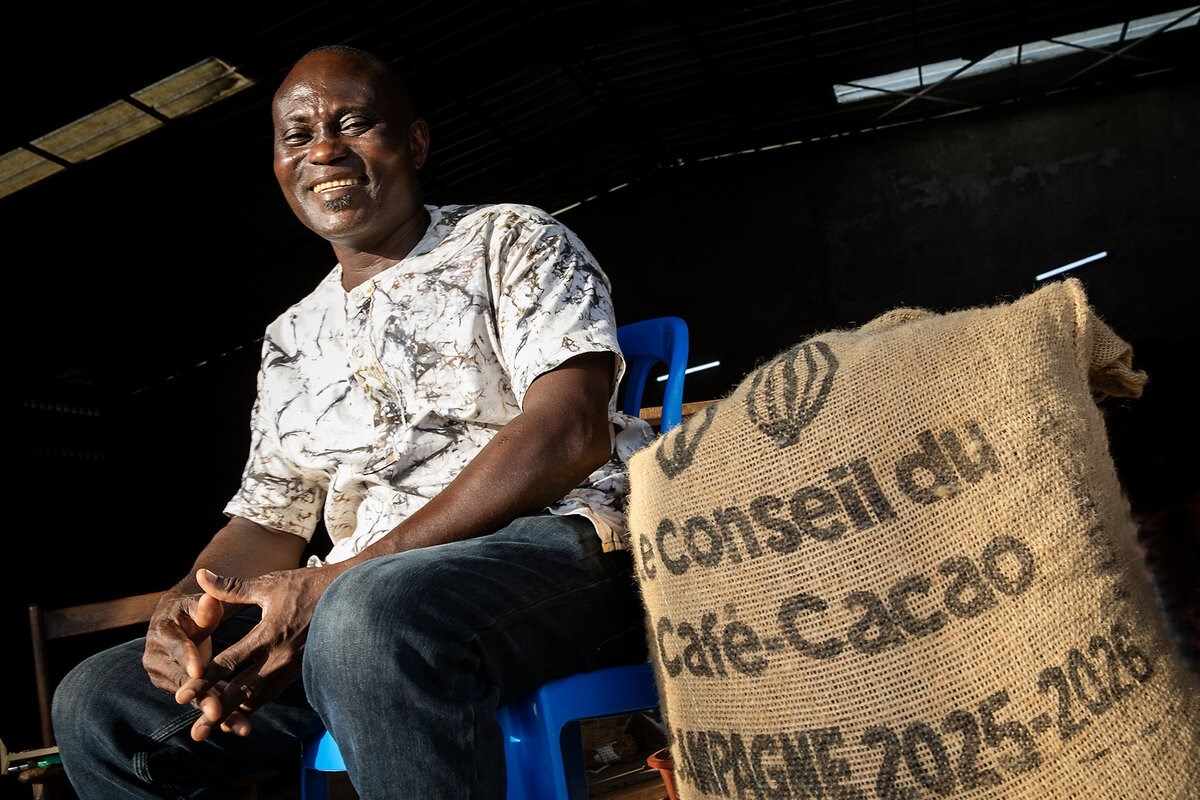 Melanie Stetson Freeman/StaffNestor Adroh Kouassi Aka is president of the Société Coopérative Équitable du Bandama, which represents cocoa farmers, April 10, 2026, in M’Brimbo, Côte d’Ivoire. The cooperative aims to protect the cocoa growers economically. Members are organic farmers who use no pesticides.
Back in M’Brimbo, however, most cocoa farmers still have little connection to the finished product that their beans create. Few see a future for their children in the industry.
On a recent day in harvest season, a handful of men lend a hand on Ms. Kouakou’s farm, sorting through cocoa beans and clearing leaves from the ground. A gaggle of children skips over fallen pods and 6-inch-long millipedes as the men work.
For months now, these neighbors and friends have been helping out for free, waiting on the outstanding payments from buyers or the government. “We want our kids to stay in school, to have more than this,” says Ms. Kouakou’s neighbor Nestor Adroh Kouassi Aka, who is also the president of the Société Coopérative Équitable du Bandama, an organic cocoa cooperative. “But if it doesn’t work out for them, they always have the farm.”
Page created on 8/28/2023 6:50:54 PM
Last edited 8/24/2026 3:59:56 PM