REPRINTED WITH PERMISSION FROM THE CHRISTIAN SCIENCE MONITOR
Some trainees at Curt’s Café are trying to leave gangs. Many have arrest records or are experiencing hardships, which can make it difficult to find employment. The café offers services that address the trainees’ basic needs so that they can flourish on the job.
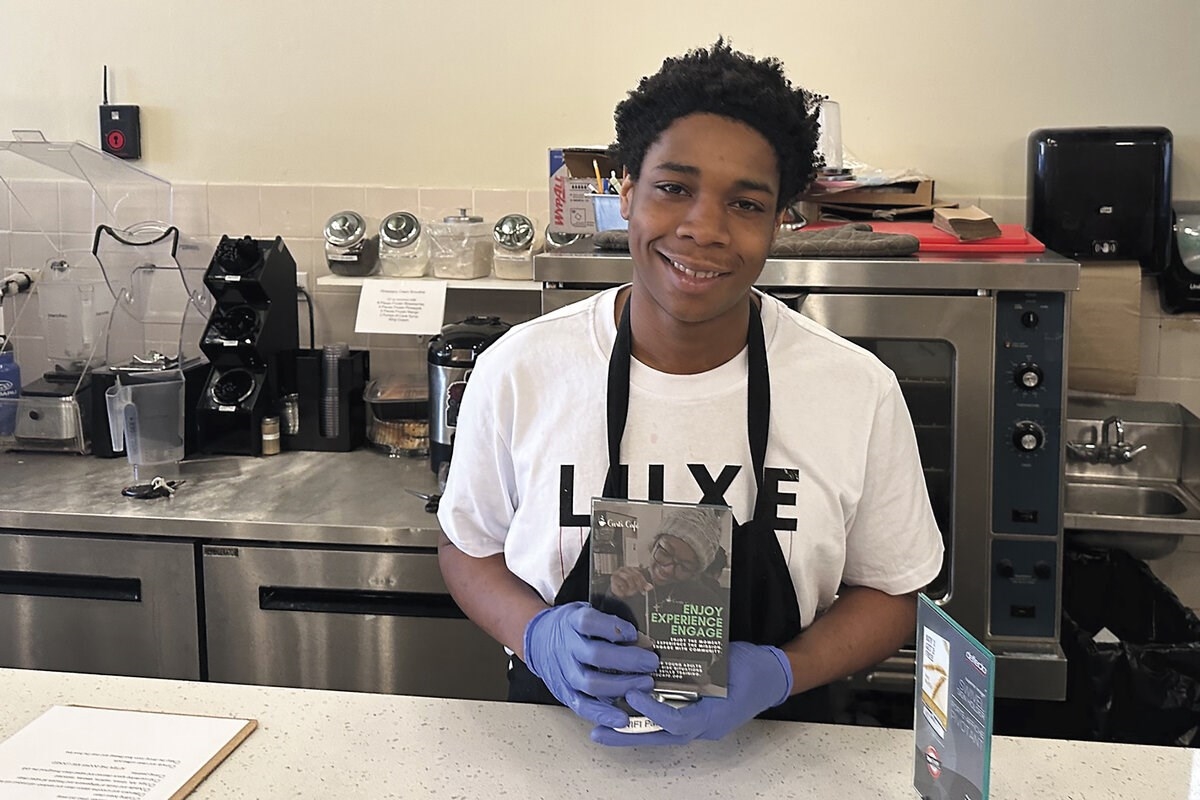 A trainee named Brian takes a break from his shift at Curt’s Café in Evanston, Illinois. “Curt’s helped change my mind, and it helped change my heart,” the 19-year-old says. “I’m on the straight path.” Stephanie Cook Broadhurst/The Christian Science Monitor
| Evanston, Ill.
A trainee named Brian works in the kitchen of Curt’s Café, tossing spices like a master chef. While he experiments with a recipe for grilled-chicken chipotle, he reflects on the three months he has spent in the café’s job-training program. It is clear he has discovered a passion for paprika – and a generous dash of hope.
“The key is to make it smoky and ... sear it [in] a very hot pan,” says the 19-year-old, moving swiftly around the crowded space. (For privacy reasons, Brian asked that his last name not be used for this story.)
Three years ago, he was searching for direction as he sat in a jail cell after breaking into his uncle’s home. When Brian’s mother arrived at the police station, she was in tears. “From that day on, I knew I had to become a better person,” he says. He realized, “This is not who I want to be.”
After the charges were dropped, Brian spent several months sleeping on friends’ sofas. That was when he learned about the nonprofit Curt’s Café through a local organization, Connections for the Homeless. “Curt’s helped change my mind, and it helped change my heart,” Brian says. “I’m on the straight path.”
Susan Trieschmann founded Curt’s Café in Evanston, Illinois, in 2012 to provide job and life-skills training for young people ages 15 to 24. A second café opened nearby in Highland Park in 2019. More than 600 students have completed the cafés’ 500-hour program, with many graduates going on to finish high school or find jobs.
Some students are trying to leave gangs. Many have arrest records or are experiencing hardships, which can make it difficult to find employment, says Tanya Jenkins, the nonprofit’s executive director. New students meet with a social worker, who addresses basic needs and “will get them connected with resources,” Ms. Jenkins says.
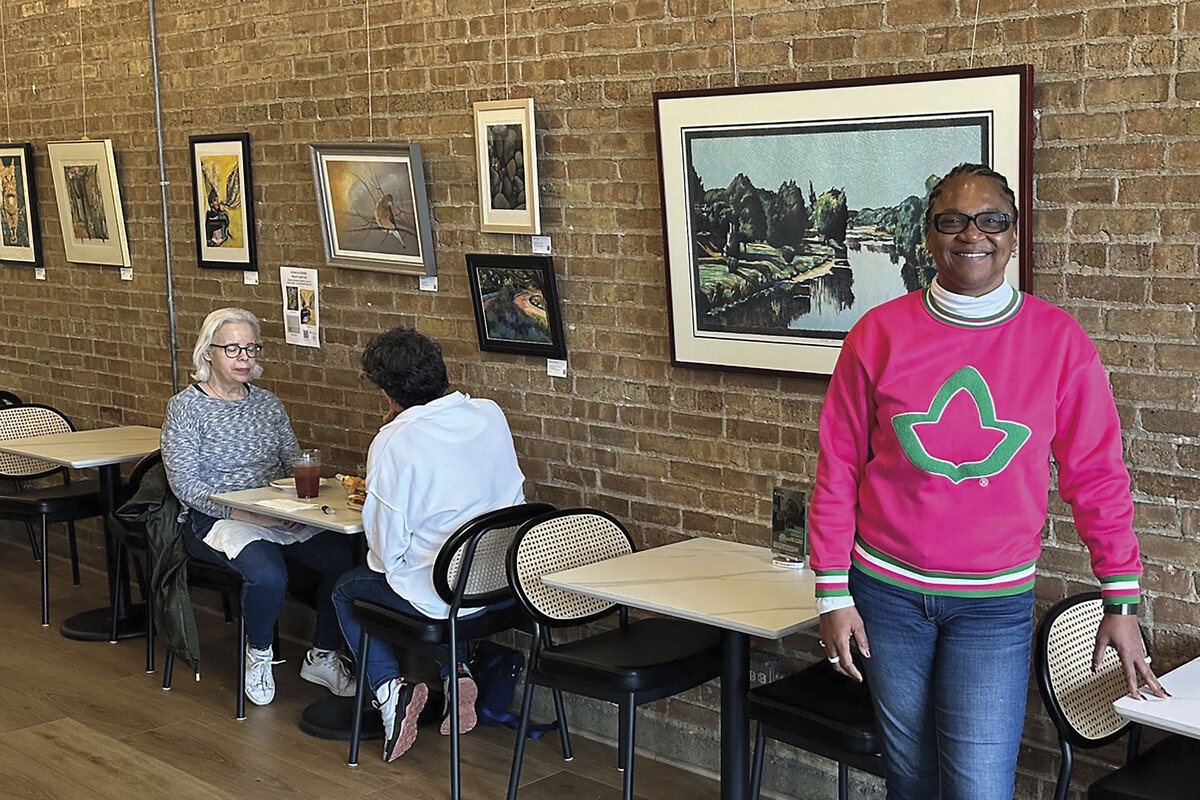 Stephanie Cook Broadhurst/The Christian Science MonitorTanya Jenkins is executive director of Curt’s Café.
Youth intervention programs such as Curt’s tend to have strong success rates because they offer supportive “wraparound” services, says Dallas Wright, an assistant director at Northwestern University’s Center for Neighborhood Engaged Research & Science, an organization that partners with Chicago communities to provide data on public safety.
“They’re able to meet participants’ needs in the most thorough way that they can,” he says. “There’s ... very targeted, very high investment in personal relationships.”
Less than 5% of the students who had been incarcerated before working at Curt’s have returned to prison. The national recidivism rate is over 80% within 10 years, according to the U.S. Bureau of Justice Statistics. Over the past decade, Illinois has invested significantly in intervention-based youth programs, violence prevention, and workforce training.
Students at Curt’s not only learn how to make an omelet or run the cash register; they also learn skills such as conflict resolution, anger management, and how to handle their finances. One year, they learned about the history of graffiti and painted a mural on the side of the Evanston café.
They take field trips to trade schools and colleges, while receiving help with preparing résumés and finding jobs. Curt’s also provides tutoring to help some students earn GED diplomas.
“It’s about opening up the possibilities,” says Joshua Rovner, senior research analyst with The Sentencing Project, a Washington-based organization that studies alternatives to youth incarceration.
As sunlight streams through the café’s large front windows, customers sit on plush sofas choosing from menu items such as kale chicken Caesar wrap and French toast. Local art creates a patchwork of color on an exposed-brick wall, while a painted bench rests in the corner. Warmth is felt not just in the hot soups and freshly baked pastries, but in the café’s purpose.
“We just want to make sure that they’re supported,” says Bri Consalvo, the café’s manager. “This is a place to learn.”
That means giving employees some extra grace, she says. Sometimes, a student is late to work because “it’s clear it’s been a rough night – maybe they slept on a train,” she says. In those cases, she tells them to lie on the couch and rest for a bit while staff members get them breakfast.
For many students, Curt’s provides a kind of stability they have never had before, Ms. Jenkins says.
“Our students can always come back,” she says. “It doesn’t matter when they complete the program. They’ve got a place” at Curt’s.
Ms. Trieschmann, who left the nonprofit in 2022, came up with the idea for Curt’s after working with an organization that helps former criminal offenders reintegrate into society and make peace with those they have harmed. At first, she couldn’t find investors for the café, so she took out a second mortgage on her house – and got to work.
Curt’s was founded on the principle of unconditional love. “Unconditional love gives you an opportunity to see beautiful things,” Ms. Trieschmann says.
Occasional challenges, including theft at the café, have tested that sentiment.
“I would not punish anybody,” she says. Instead, she gathered her crew in a circle. “We would talk about the harm caused when people, you know, take money in a group that’s supposed to be trustful of them.”
On this bright morning, Curt’s is buzzing with conversation and community. A customer strolls in for her carryout order. She smiles and leaves a generous $10 tip on a roughly $30 tab. Ms. Consalvo says it’s common for neighbors to chip in extra.
Beyond practical skills, students acquire something deeper: a sense of dignity.
“I’ve seen students learn to make eye contact and say ‘hello,’” says customer Steve Morton. “You see that they are gaining confidence.”
After students complete 500 hours, there is a graduation. At a ceremony March 28, café staff members, friends, and fellow students form a semicircle around graduates, offering words of encouragement.
Joshua Herrera, who found Curt’s through his probation officer, smiles as he receives his certificate. “Without all of you guys, being a team, I wouldn’t be here,” he says. “Thank you.”
Back in the kitchen, Brian ladles chicken noodle soup into a bowl. He says that after graduation, he plans to complete a culinary program through Chicago’s nonprofit Westside Health Authority and focus on fusion cooking. He’s also compiling a cookbook of recipes he has created. “Any type of art or expressive feeling, you can taste it in my cooking,” he says.
Page created on 7/10/2026 3:48:08 PM
Last edited 7/15/2026 3:46:47 PM