Education has the power to change lives, but for many years, Mexican Americans faced significant barriers to higher education, representation and equal opportunities. Dr. Julian Samora dedicated his life to breaking down those barriers. As the first Mexican American to earn a doctorate in sociology, he became a pioneering scholar, educator and civil rights advocate whose work continues to inspire generations of students, researchers and community leaders.
Born on March 1, 1920, in Colorado to a family of Mexican heritage, Dr. Samora experienced discrimination from an early age. When he began school, he was forced to repeat the first grade without the benefit of testing because Spanish was his first language. Later, when he was chosen as the lead actor in his high school play, some of the Anglo students threatened to quit because they did not want to perform alongside a Mexican American student. The teacher gave in to their demands, leaving Samora deeply hurt. Reflecting on the experience, he simply said, “Oh, it hurt so much.”
Discrimination followed him throughout his life. During his senior year of college, Samora ran for student body president and lost by just one vote. Years later, his roommate admitted that he had cast the deciding vote against him because, as he explained, “Well Julian, I couldn’t vote for a Mexican.”
Growing up, the Spanish-speaking men he knew often worked as labourers, and he had few examples of people from his community pursuing higher education. No one in his immediate family had completed high school, making his own educational achievements even more remarkable.
In 1938, Samora applied for the Frederick G. Bonfils Foundation scholarship, sponsored by the family who owned the Denver Post. He was one of only 29 students selected from more than 580 applicants, allowing him to attend Adams State Teacher’s College in Colorado, where he graduated in 1942 with degrees in history and political science.
His journey was not without further challenges. When he travelled to Fort Collins, Colorado, for a graduate school interview, he encountered signs that read, “No Dogs, Indians or Mexicans Allowed.” He was eventually admitted to a modest hotel when the owner mistakenly believed he was a traveller from India.
Rather than allowing these experiences to limit him, Samora used them as motivation. His determination eventually led him to become the first Mexican American to receive a PhD in sociology, creating opportunities for many others who followed.
Dr. Samora became known as an activist scholar who combined research with a commitment to social justice. Speaking about what motivated his work, he said:
After earning his doctorate, Dr. Samora joined the University of Colorado School of Medicine in 1955 as an assistant professor of Preventive Medicine and Public Health. There, he noticed that many Anglo doctors struggled to understand and connect with their Mexican American patients. He began researching the healthcare experiences of Mexican Americans in Colorado, helping to develop the field of medical anthropology and encouraging future doctors to provide more culturally aware care.
Dr. Samora also recognised that the experiences and contributions of Hispanic communities were often missing from academic research. Determined to change this, he became one of the founders of Latino Studies, an academic field dedicated to exploring Latino history, culture and experiences. His research helped bring greater understanding to important issues including immigration, education, poverty and civil rights.
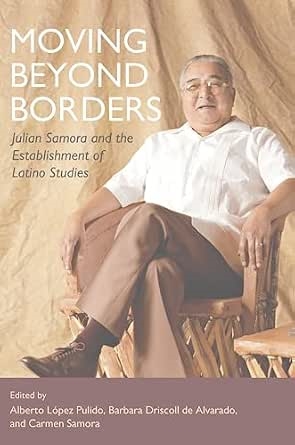 Moving Beyond BordersAmazonOne of Dr. Samora’s important contributions was his work as editor of Moving Beyond Borders: A History of Mexican Americans in the United States. Published after his death in 1993, the book brought together historical research and scholarship to explore the experiences and contributions of Mexican Americans. It reflected his belief that history should include the voices of communities that had often been overlooked and helped future generations better understand the struggles, achievements and lasting impact of Mexican Americans in the United States.
Throughout his career, Dr. Samora taught at several universities before joining the University of Notre Dame, where he became a respected professor of sociology. He inspired generations of students to use education as a tool for positive change, and many of those students went on to become scholars, educators and community leaders.
Beyond the classroom, Dr. Samora worked to improve opportunities for Hispanic communities by advising government agencies, supporting organisations that promoted equality and advocating for fairer public policies. He believed strongly in the importance of history and representation, once saying:
After retiring from the University of Notre Dame in 1985, his influence continued. In 1989, Michigan State University established the Julian Samora Research Institute, the first major university research centre named after a Latino scholar. Reflecting on the honour, Dr. Samora said:
Dr. Samora received many honours during his lifetime, including Mexico’s Order of the Aztec Eagle, one of the country’s highest awards for foreign nationals, recognising his contributions to strengthening understanding between Mexico and the United States. He was also named Professor Emeritus at the University of Notre Dame.
What makes Dr. Julian Samora a hero is not simply that he broke barriers himself. It is that he used his achievements to create opportunities for others. He challenged discrimination, gave a voice to communities whose stories had often been overlooked and showed generations of students that education could be a powerful force for change.
His legacy continues through the Julian Samora Research Institute at Michigan State University and the Julian Samora Legacy Project, which works to preserve and share his life’s work with future generations. The Legacy Project has developed educational resources, including a K–20 curriculum and teacher programmes, to help students learn about Latino history, culture and the contributions of Mexican Americans. Through these resources, Dr. Samora’s belief that education can create understanding and opportunity continues to reach new generations.
Dr. Julian Samora proved that one person’s determination can transform society. He broke barriers in higher education, challenged discrimination and ensured that the experiences of Mexican Americans became an important part of academic research and history. Through his scholarship, teaching and lifelong commitment to justice, he became not only a pioneer in education, but a hero whose work continues to inspire students, educators and community leaders today.
Page created on 7/24/2026 11:44:14 AM
Last edited 8/5/2026 4:27:12 PM