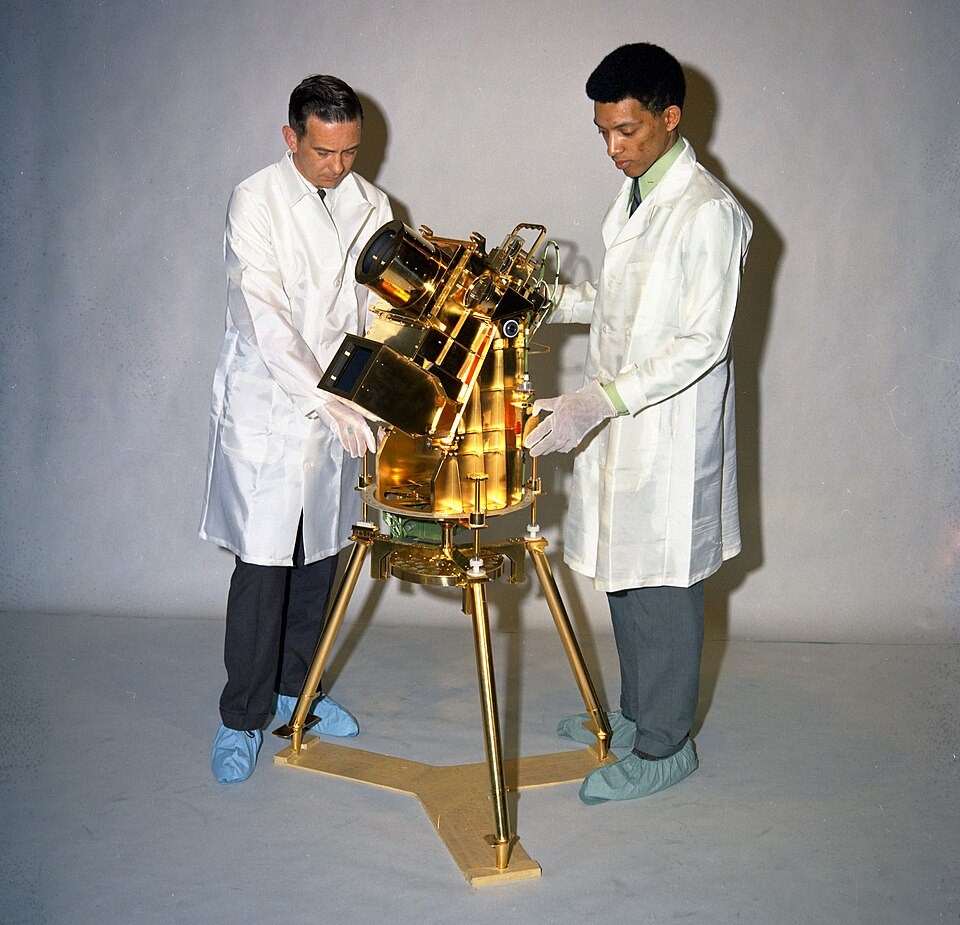
 George Carruthers, right, and William Conway stand beside the first observatory, created by Carruthers.U.S. Naval Research Laboratory via Wikimedia Commons
Born in Cincinnati to a civil engineer at the Wright Patterson Air Force Base, George Robert Carruthers was obsessed with science and space. When his family moved to a small, quiet farm in Milford, Ohio, Carruthers had little to do besides read and study. At just ten years old, with his head buried in an astronomy magazine, he came across a set of lenses for sale and had an idea. He bought the lenses and constructed his own telescopes.
Shortly before Carruthers’ fourteenth birthday his father died unexpectedly, and his mother decided to move the family to Chicago. There, a whole new world opened. “When the family moved to Chicago, then I had access to a much broader range of resources, like public libraries and so forth,” Carruthers once said, “Also, I came into contact with the Adler Planetarium and spoke with some of the astronomers there.”[1]
In school George was quiet and focused, though he always performed much better in science projects and fairs than in the classroom. Recognizing his flair for invention, his teachers supported him in pursuing an education at the University of Illinois where he worked up to a PhD in aeronautical and astronautical engineering.
By 1964, he had completed his PhD and was offered to become the first E. O. Hulburt Postdoctoral Fellow, funded by the National Science Foundation. He was later given a permanent position in their Space Science Division, where he continued to work right up until his retirement in 2002.
Whilst there, George designed and developed an ultraviolet image converter that was compact, simple to use, and captured images that allowed scientists to view Earth in a whole new light. In 1972 NASA’s Apollo 16 mission took a later version of Carruthers’ camera, the Far Ultraviolet Camera/Spectograph to the moon, where it captured nearly two hundred images of Earth. “The most immediately obvious and spectacular results were really for the Earth observations,” Carruthers said of the camera, “because this was the first time that the Earth had been photographed from a distance in ultraviolet light, so that you could see the full extent of the hydrogen atmosphere, the polar auroris and what we call the tropical airglow belt.”[2]
Having been responsible for such a groundbreaking piece of technology, Carruthers quickly became a role model for young scientists, particularly of color, looking to pursue careers in STEM. Recognizing his influence, Carruthers co-founded the Science & Engineers Apprentice Program in the 1980s, giving students the opportunity to spend their summers working alongside the scientists at the Naval Research Laboratory. He also became heavily involved in numerous schemes encouraging young African Americans to be more involved in STEM, such Project SMART, the National Society of Black Physicists, and the National Technical Association.
George Carruthers sadly died of congestive heart failure on December 26, 2020, but his legacy is far from forgotten. In 2022 NASA renamed one of their missions the Carruthers Geocorona Observatory. Launched in 2025, the Carruthers Geocorona Observatory continues to observe the Earth’s atmosphere using ultraviolet light, just as George Carruthers made possible all those years ago.
Page created on 12/4/2023 4:34:13 PM
Last edited 8/25/2026 2:39:36 PM