"A Black poet can only write from the Black experience. What else can they write from? They are Black."
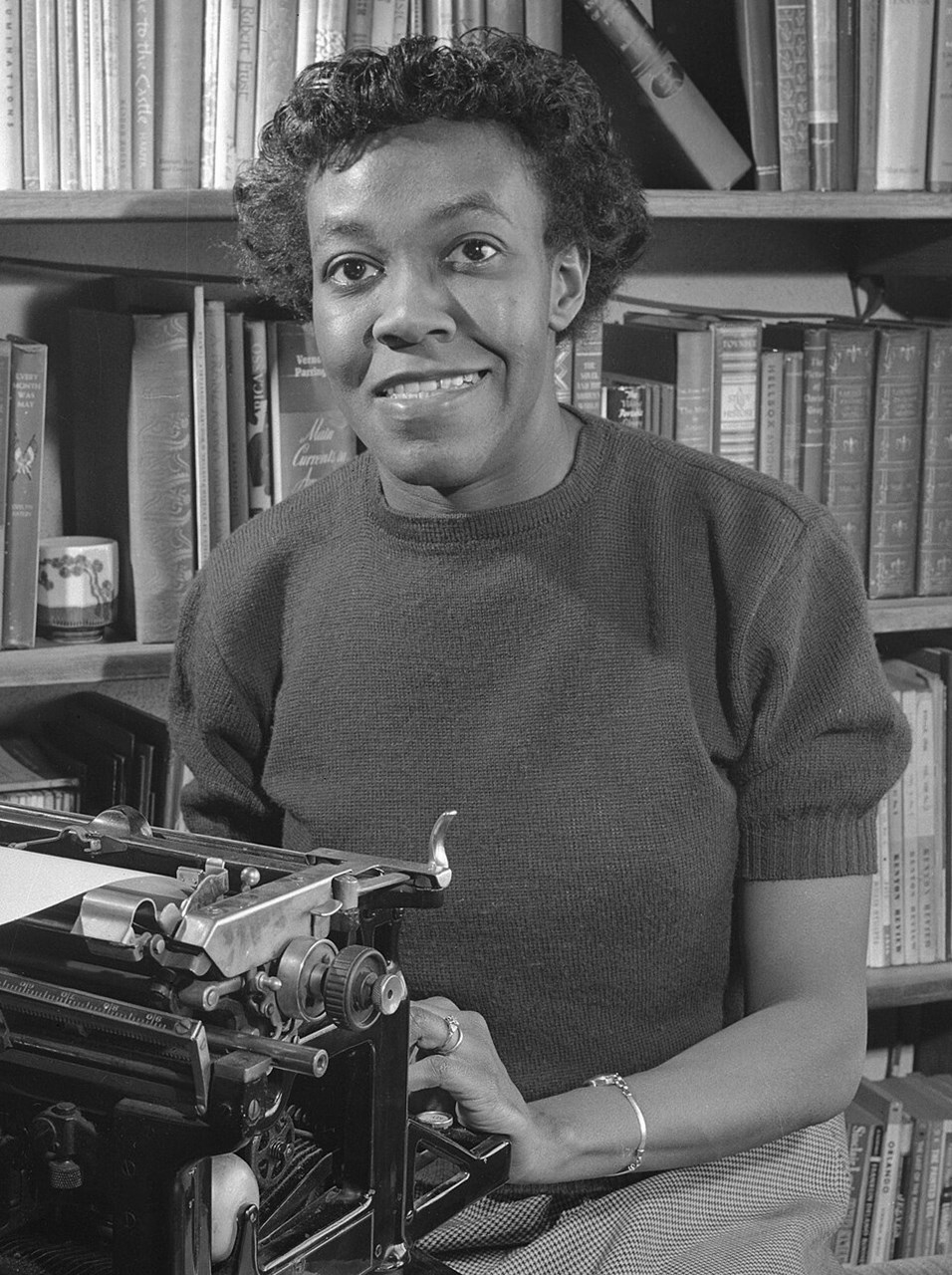 Photo of Gwendolyn Brooks distributed by ACME after she won the 1950 Pulitzer Prize for Poetry.ACME Newspictures via Wikimedia Commons
Gwendolyn Brooks once said, “I am not a scholar. I'm just a writer who loves to write and will always write.”[1] Brooks found her love of writing at a very early age and was first published in American Childhood at just 13 years old. She went on to pen numerous collections of poetry throughout her life and was widely celebrated for her writings on girl and womanhood, racism, and trauma. On May 1st, 1950, she became the first African American to receive the Pulitzer Prize for Poetry for her landmark work Annie Allen.
Gwendolyn Brooks was born on June 7th, 1917, in Topeka, Kansas. Her mother was a classically trained pianist and educator, and her father was a janitor who sacrificed his dream of becoming a doctor to earn a living to support his family. During the Great Migration Brooks’ family moved to Chicago, and she quickly fell in love with the city.
Living in the city, I wrote differently than I would have if I had been raised in Topeka, KS [...] I am an organic Chicagoan. Living there has given me a multiplicity of characters to aspire for.[2]
Brooks attended three different schools throughout her childhood, two integrated and one all-Black. Her varied experiences opened her eyes to the systemic and institutionalized racism that impacted the lives of Americans, particularly Black people. This inspired many of her writings on both girlhood and racial trauma. On writing about the “Black experience,” Brooks said
A Black poet can only write from the Black experience. What else can they write from? They are Black. Whatever they write, whether it's exclusively about the beauty of flowers or the horrors of war or the deliciousness of a piece of chocolate cake, it's still an expression by a Black person.[3]
After graduating junior college, Brooks worked tirelessly for the National Association for the Advancement of Colored People (NAACP) whilst working on her poetry.
When Brooks’ first book of poems A Street in Bronzeville was published in 1945, renowned American writer Richard Wright praised her work:
There is no self-pity here, not a striving for effects. She takes hold of reality as it is and renders it faithfully. [...] She easily catches the pathos of petty destinies; the whimper of the wounded; the tiny accidents that plague the lives of the desperately poor, and the problem of color prejudice among Negroes.[4]
The book received critical acclaim and solidified Brooks as one of America’s great poets. Only four years later she published Annie Allen, a ground-breaking collection of poetry about the journey of a young Black girl to womanhood. It was for Annie Allen that Brooks became the first ever African American recipient of the Pulitzer Prize for Poetry in 1950.
In 1961, Brooks was approached by novelist and professor at the University of Chicago Frank London Brown, who asked if she would be interested in teaching American Literature for a semester. The experience sparked a love of teaching, and she went on to teach courses at various colleges and universities across America. She championed the voices of young Black writers and spent several years advocating for Black authors, often offering personal mentoring.
Gwendolyn Brooks died aged eighty-three, at her home in Chicago on December 3rd, 2000. A beloved American artist, she received countless awards and forms and recognition throughout her life and beyond. As recently as 2022, The Morgan Library and Museum hosted Gwendolyn Brooks: A Poet’s Work in Community, an exhibition celebrating not only her poetry but her social impact.[5] Watch a video about the exhibition here.
Gwendolyn Brooks was not just a poet, but a pioneer. Her influence on the social landscape in the US throughout her life is undeniable, and her contributions to American literature fostered a deeper appreciation for both the experience of African Americans and their work.
Explore poems by Gwendolyn Brooks here.
[1] Hawkins, B. Denise. An Evening with Gwendolyn Brooks: The Pulitzer Prize-Winner and Poet Laureate Shuns Pretense, Invites Challenges [Online] Available https://www.jmu.edu/furiousflower/archives/94hawkins_brooks_intervi.shtml. 1994.
[2] Ibid.
[3] ii.
[4] Kent, George E. (1993). A Life of Gwendolyn Brooks. Lexington: University Press of Kentucky. pp. 54–55, 184. ISBN 0813108276.
Page created on 4/30/2026 11:20:49 AM
Last edited 5/14/2026 4:13:19 PM