Harrison Ford made his film debut in 1966: a 45-second scene as a hotel bellboy. Landing even that uncredited role took him fighting tooth and nail through the internal politics of Columbia Pictures — something he didn’t care for, nor was any good at. When the film was released, the vice-president of Columbia called him into the office. “You ain’t got it kid. You ain’t got it!” the executive told Ford. The movie, Dead Heat on a Merry-Go-Round, wasn’t a flop, but in due time it’d only be remembered as Ford’s first film. Years later, after Ford had become one of Hollywood’s biggest stars, that same executive sent him a short note at a party: “I missed.”
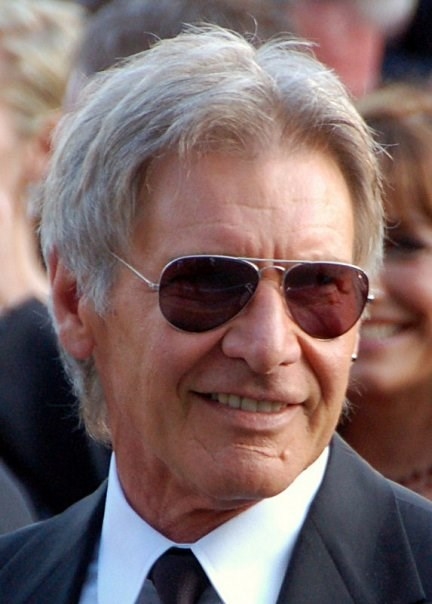 Harrison Ford at the Cannes film festivalGeorges Biard, CC BY-SA 3.0, via Wikimedia Commons
Born July 13, 1942, in the suburbs of Chicago to a radio actress and a former actor, the young Ford recalled his first ambitions to be “the guy who carried the coal from [my] house to the coal chute in a wheelbarrow.” Although he achieved the second-highest rank in Boy Scouts, and became his high school’s first radio broadcaster, Ford claimed he “never had a focused goal or ambition” growing up. By 1960, he was a listless philosophy and English student at Ripon College, described by his professors and peers as reserved and unremarkable. “If it wasn’t clinical depression I was suffering, it was something very close,” Ford stated. “The thought of facing classes, tests and other students seemed unbearable.”
Poor grades due to declining attendance, as well as a desire to get over his shyness, drove Ford to take a drama class in the final quarter of his senior year. His first time acting was on the stage of the Red Barn Theater. Though the theater didn’t do anything to save his grades — leaving college just days before his graduation — it achieved something greater. “It scared me something fierce,” Ford later recalled of his first time acting. Though the more he did it, and the more he conquered his fears, the more he grew to love it. “I began to experience the fun of it.”
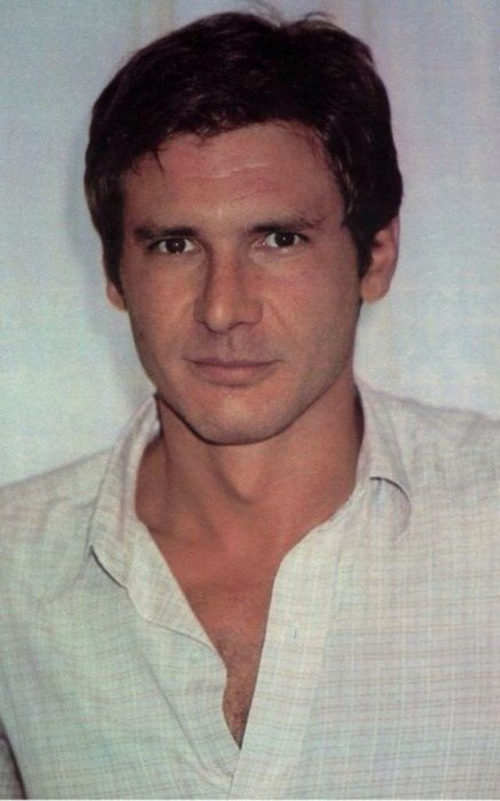 A young Harrison Ford, sometime in the late-1970sXdude gamer, CC BY-SA 4.0, via Wikimedia CommonsBy the summer of 1964, Ford was living in Los Angeles. He was working to penetrate the Hollywood scene — a reckless gamble in the minds of his former classmates back in Ripon, but he had a goal in mind. After a brief stint in local theater and getting by as a pizza deliveryman, he managed to land in Columbia’s New Talent Program. “It was 1964–1965 and Columbia [was] still playing 1920–1930. Horrible, worse than any factory,” Harrison said of the experience. Columbia’s Old Hollywood song-and-dance led him to butt heads with executives, relegating him to a number of minor roles in forgettable films. By the end of the decade, he was married with two sons and struggling to support his family. Convinced acting was going nowhere, he took to carpentry.
Though Ford quickly gained a reputation as a “Carpenter to the Stars.” He built bridges during this time, notably getting connected with talent agent Patricia McQueeney — who, in due time, would become Ford’s longtime manager — and, more pressingly, casting director Fred Roos. He would prove to be the figure who managed to get Ford actually into the limelight, namely through his connections with Francis Ford Coppola and George Lucas. Working with casting for American Graffiti, which was produced by Coppola and directed by Lucas, Roos managed to get Ford a role in the movie. The coming-of-age film was a commercial success, proving critical in reestablishing Ford in Hollywood and helping him forge relationships with two of the industry’s most influential filmmakers. For the first time since Ford had moved to LA, things were looking up for him on his acting journey. “It was as if the whole world changed.”
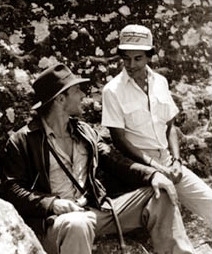 Harrison Ford on the set of Indiana Jones and the Temple DoomChandran Rutnam, CC BY-SA 3.0, via Wikimedia CommonsAfter a couple of minor collaborations with Coppola, Ford was back with Lucas, though not as an actor. Lucas was gearing up for his sci-fi epic Star Wars, and Ford was in the audition offices — building door frames. He had been hired as a carpenter at the behest of Roos. Casting for the roguish Han Solo was underway; Roos was confident that Ford was the man for the job, but Lucas was adamant about not reusing actors from American Graffiti. But as the casting continued and became more of a slog, Lucas finally began to crack and let Ford stand in as Han Solo during audition line readings. Seeing Roos’s vision, Lucas finally let Ford have the role officially. Released in 1977, Star Wars was a global phenomenon that launched Ford into international stardom.
His position was cemented four years later with the release of Raiders of the Lost Ark. As Indiana Jones, the adventurous archaeologist created alongside director Steven Spielberg and Lucas, Ford helped define another iconic franchise. The character's blend of intelligence, humor, and vulnerability distinguished him from traditional action heroes and left a lasting influence on adventure films. By the end of the 1980s, Ford was one of the world’s most successful actors, starring in some of the decade’s most popular movies.
Although the extraordinary commercial heights of the Star Wars and Indiana Jones years proved difficult to replicate, Ford built a remarkably durable career. He earned acclaim for performances in films such as Witness, The Fugitive, and Air Force One, demonstrating a versatility that extended beyond blockbuster franchises. In later years, he returned to several of his most famous roles, reprising Han Solo in Star Wars: The Force Awakens, Rick Deckard in Blade Runner 2049, and Indiana Jones in Indiana Jones and the Kingdom of the Crystal Skull.
Outside of acting, Ford used his star power for good, namely in his devotion to environmental conservation. Since 1991, he’s served as vice co-chair of the nonprofit Conservation International and has assisted numerous other environmental groups in raising awareness about climate change and habitat preservation. For his efforts he’s had three different animal species named after him, such as the ant species Pheidole harrisonfordi. Ford has also donated roughly half of his 800-acre Wyoming ranch to conservation efforts, ensuring that the land remains protected for future generations.
On March 1, 2026, Ford accepted the Screen Actors Guild Life Achievement Award at the 32nd SAG Awards. Reflecting on his journey, he reminded the audience that success had not come quickly. “I was not an overnight success. I struggled for about fifteen years — going from acting job to carpentry, and back to acting — until I finally got a part in a wildly successful film,” he said before going on to thank his mentors and collaborators — George Lucas, Steven Spielberg, Francis Ford Coppola, Fred Roos, and Pat McQueeney — for helping shape his career. “Success in this freedom comes with a certain responsibility,” Ford continued, “to keep the door open for the next kid — the next lost boy who’s looking for a place to belong. I am indeed a lucky guy.”
Page created on 6/12/2026 4:27:17 PM
Last edited 6/19/2026 12:31:55 AM
Jenkins, Garry. Harrison Ford: Imperfect Hero.Birch Lane Press, 1998.
Duke, Brad. Harrison Ford: The Films.McFarland & Company, 2008.