REPRINTED WITH PERMISSION FROM THE CHRISTIAN SCIENCE MONITOR
Poverty and homelessness are major concerns in Asheville, North Carolina. A 2025 ordinance passed by the Asheville City Council extending restrictions on panhandling was the spark that led poet and essayist Leslee Johnson to give a voice to the creativity of homeless writers.
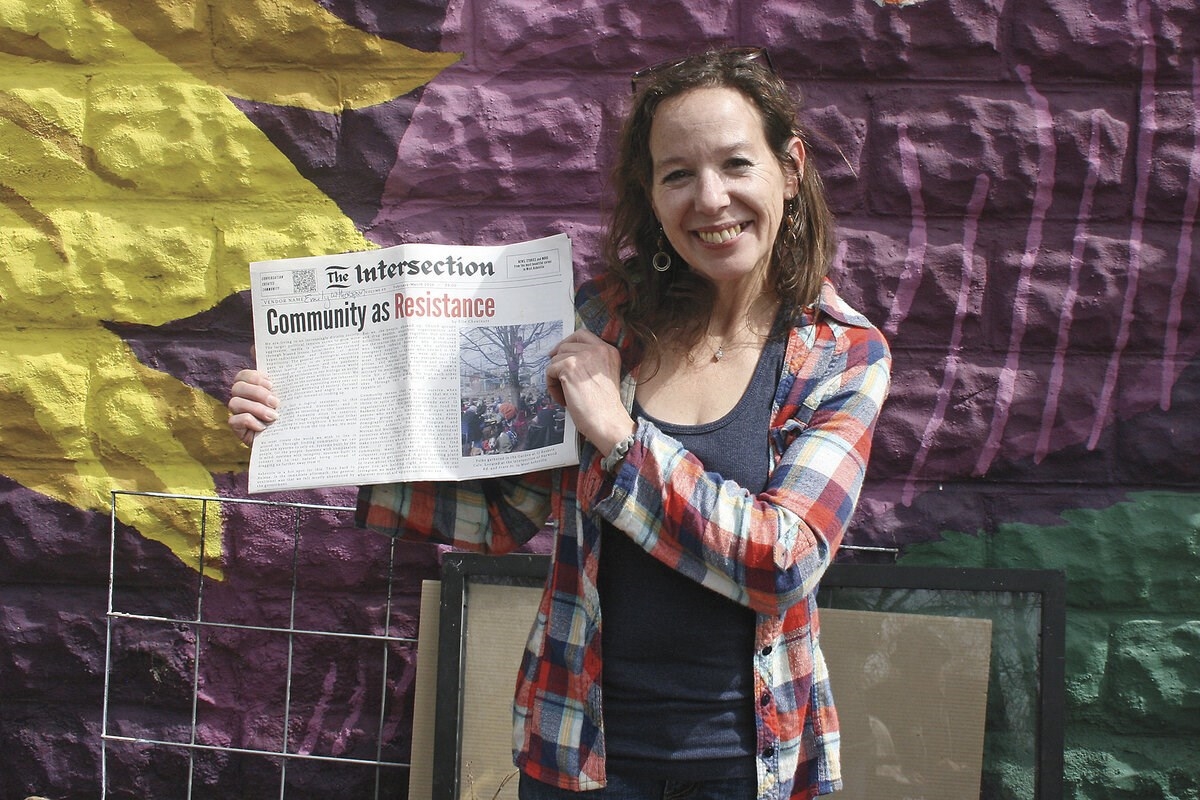 Leslee Johnson is the editor of The Intersection, a newspaper produced in Ashville, North Carolina, mostly by a group of writers and artists who are homeless or experiencing extreme poverty. Ms. Johnson is a lecturer at the Ashville campus of the University of North Carolina. David Conrads
| Asheville, N.C.
Every Saturday, 12 Baskets Café in Asheville, North Carolina, becomes a newsroom. Writers spread out around the large dining room tables – some typing on laptops, others working old-school on pads of paper.
On a recent weekend, Melissa Mayes is finishing an article on women experiencing poverty and homelessness in the city. Though she has never had to live on the street, Ms. Mayes, a retired nurse, is disabled, has difficulty affording groceries, and spent five years sleeping on friends’ couches before finally moving into her own federally subsidized apartment. The subject of women struggling to obtain food and housing is close to her heart.
“I see these beautiful souls,” she wrote in The Intersection, a broadsheet newspaper produced by the group of writers and artists who come to the café, most of whom are homeless or living in extreme poverty. “I have come to know certainties of who they are: brave, relentless, hopeful. Also, broken, yet always healing. They make me laugh with their keen observations, cry with their disappointments.”
That passage is from Ms. Mayes’ article, headlined “Have You Seen Her?,” in the April/May issue of The Intersection. Named for its home at the intersection of Haywood Road and State Street on the west side of the city, the publication is sponsored by the nonprofit Asheville Poverty Initiative (API), which also runs the café. The Intersection covers a wide range of topics and includes community news items, profiles, opinion pieces, poetry, and artwork.
The force behind the paper is Leslee Johnson, a poet, essayist, and lecturer in English on the Asheville campus of the University of North Carolina (UNCA) who began having lunch at 12 Baskets four years ago.
“It was a good place to eat and share meals with folks,” she says. “It was a place where I felt more comfortable and present than in some areas of my life.”
After learning she was a writer, some of the regular patrons opened up about their own writing projects. Ms. Johnson started a creative writing group, playfully dubbed the Moonlight Cheese Alliance, in which more than a dozen or so people meet at the café every Friday after lunch. Their poems, short essays, and artwork are published in a zine called The Oracle.
The seed to expand to a newspaper was planted when Ms. Johnson attended the Conference on Community Writing, a national gathering aimed at exploring writing as a tool for social change. She learned of a newspaper in Cincinnati written and sold by homeless and formerly homeless people.
“With the zine, we were doing something pretty close to the Cincinnati paper,” she says. “There was energy around expanding from literature and poetry to news and opinions and games and humor.”
But the true spark that brought The Intersection to life was a 2025 ordinance passed by the Asheville City Council extending restrictions on panhandling.
“When the panhandling ordinance was extended down Haywood Road, directly impacting a number of folks we serve every day, we knew we needed to step up and offer the paper,” says Ben Williamson, executive director of API.
Poverty and homelessness are major concerns in this city of about 95,000. Compared with other cities of its size, the cost of living is high in Asheville, and its tourism-driven economy supports many low-wage and seasonal jobs, and jobs without benefits. It is also one of the most expensive housing rental markets in the country.
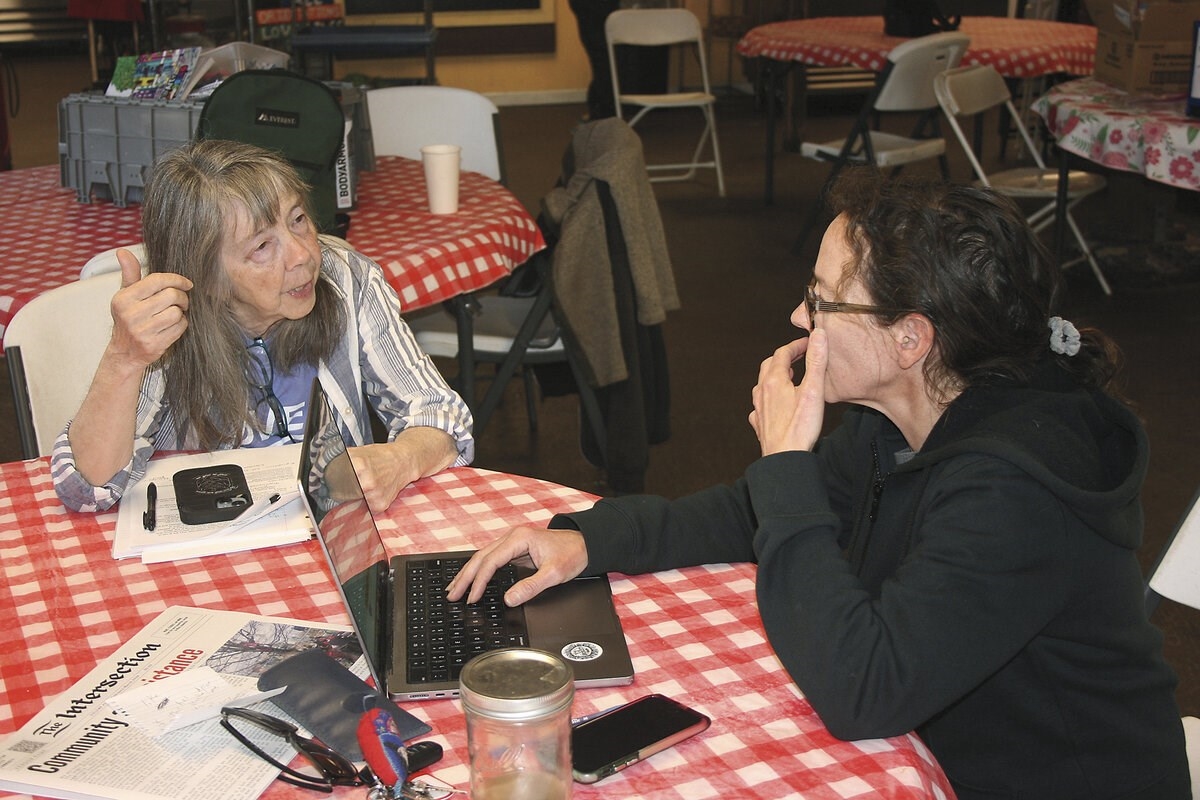 David ConradsLeslee Johnson (right) talks with contributor Melissa Mayes about a story for The Intersection, at 12 Baskets Café in Asheville, North Carolina.
For Ms. Johnson, The Intersection is one tool to help the city address these concerns.
“As part of Asheville Poverty Initiative, our umbrella organization, we exist to build community and educate about the realities of poverty,” she says. “Specifically, the street paper reduces fear and dismantles stereotypes by publishing news, opinion, and creative work by those living in deep poverty and homelessness. The paper also offers income opportunities to members of our community who cannot access traditional jobs.”
Sellers wear blue vests and lanyards identifying them as official vendors of The Intersection. API offers vendors, many of whom are also contributors, an initial 10 copies of the paper at no charge and subsequent copies for $1 each. Vendors sell the papers for $4 apiece.
Ms. Johnson is the editor, and Shelly Baker, API’s outreach and operations coordinator, handles design.
The Intersection’s first issue came out this past October with a print run of 300 copies. The issues always sell out. Income from sales and advertising offset the expense of producing the paper, which is subsidized by API.
The Intersection “empowers and engages folks who often aren’t invited to the table and don’t have a platform to speak out and share,” says Mr. Williamson.
Emily Witherspoon is a contributor and vendor for The Intersection. Formerly homeless for two years, she now lives in an apartment and works several part-time jobs. She enjoys selling the paper and appreciates the opportunity to earn extra money.
“It’s fun, and it’s legal,” she says. “You don’t have to stand there worrying about getting arrested. That means a lot.”
Mr. Williamson praises Ms. Johnson for launching and nurturing the growth of the Moonlight Cheese Alliance and The Intersection.
“I don’t have the words to adequately credit Leslee for everything she has meant and does ... for API,” he says. “She believes in the power of creativity, and how it can empower and be a force in a community and for individuals.”
Gary Ettari, chair of the English Department at UNCA and a longtime colleague of Ms. Johnson, says she combines a passion for language with a passion for working with marginalized communities.
“She is able to create and be involved with the communities that she values and gives so much to,” Dr. Ettari says. “The first word that comes to mind when thinking about her work is ‘inspiring.’”
In addition to her work with The Intersection and the Moonlight Cheese Alliance, Ms. Johnson directs UNCA’s Prison Education Program and has coordinated college-level classes and academic programming at Buncombe County Detention Facility in Asheville for the past year and a half.
“There is a lot of creativity and brilliance that goes unheard,” Ms. Johnson says. “If I’m in a position to create a space to shine light on that, I feel like that’s an obligation.”
Ultimately, Ms. Johnson hopes that The Intersection fosters change in community conversations in the Asheville area around the topics of affordable housing, addiction, mental health, and “ways we can support human beings as human beings, and not as societal problems.”
Page created on 6/9/2026 12:32:45 PM
Last edited 6/9/2026 1:10:35 PM