 |
| WWII Japanese American Veterans Memorial |
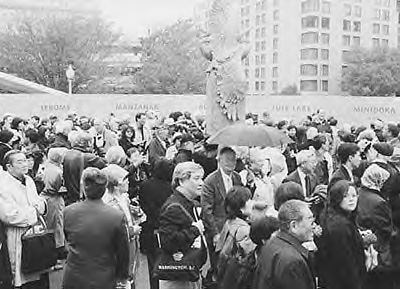
Rain was forecast for Washington D.C. this Thursday, but the threat of a downpour didn't discourage any of the 1,500 Japanese Americans and other guests from participating in the dedication of the National Japanese American Memorial to Patriotism.
The memorial honors Japanese Americans who served in the U.S. military in World War II and members of their families who were interned and subjected to discrimination during the conflict.
It was a patriot event. A U.S. Army Band provided stirring music as a color guard and a group of World War II Japanese American Veterans from Hawaii marched in. Veterans representing the Military Intelligence Service and the 442/100th Battalion, and their families stood up and snapped to attention as anthem was sung.
NBC Today news anchor Ann Curry emceed the ceremonies and introduced the speakers.
Attorney General Janet Reno told the audience that President Clinton had announced a plan to preserve the sites of the camps where the U.S. government interned 120,000 Japanese Americans during the war. The Interior Department is providing $5,000,000 to purchase land to protect the sites in Wyoming, Utah and Arkansas.
In his letter, Clinton said, "Americans must never forget this sad chapter in our history. We are diminished when any American is targeted unfairly because of his or her heritage."
The President also announced that he had signed legislation designating the U.S. federal courthouse in Seattle as the William Kenzo Nakamura United States Courthouse. Nakamura died in Italy in 1944 while providing cover for his retreating platoon. He was one of the people granted the Congressional Medal of Honor posthumously this year.
"This site will be as much a civil rights memorial as a war memorial," Reno stated. "It will be a reminder to us all about racism, about suffering, about injustice and courage."
Commerce Secretary Norman Mineta, who was also a featured speaker at the dedication, was a ten-year old boy when he and his family were evacuated and sent to Heart Mountain, Wyoming.
"When you think about a nation that apologizes for a wrong that it committed a number of years ago," he said, "and then to memorialize the event - the evacuation, the internment of Japanese Americans and to have it be dedicated is to me a real, real thrill."
A new survey commissioned by the memorial foundation and conducted by Peter D. Hart Research Associates, concludes that "nearly one-third of all Americans polled are unaware of the U.S. government's role in placing Japanese American citizens in internment camps during World War II."
Many of the people attending the dedication ceremony are hopeful this new memorial will help to educate the public of the contributions and sacrifices Japanese Americans made to this country during the war.
"This is very meaningful," said Dr. Harold Harada of Culver City. "It's most touching to me. I'm very impressed."
The memorial is located near the Capital on a triangular park bordered by Louisiana and New Jersey avenues and D Street.
It features stone panels that acknowledge the ten camps and quotes from some of the leaders who helped to win redress for the families sent to those desolate locations.
In a solemn ceremony, during the dedication, sand gathered from the ten campsites was poured together and placed in the ground for burial.
"This memorial is dedicated to all of the men who served, to their families who supported them and to those loved ones that endured great hardship," said Deputy Defense Secretary Rudi de Leon, as he addressed the crowd gathered for the dedication.
The names of more than 800 Japanese Americans who died for their country in World War II are etched on six stone panels. An honor guard of two Japanese American veterans laid a wreath before the wall. Some visitors fought back tears as they touched the names of fallen comrades and relatives. A traditional Japanese bell rang out, a time to remember the days of youth.
With his hands tightly gripped around his crutches, 442nd veteran Rudy Tokiwa of Sunnyvale spoke with pride as he talked about the memorial. He hopes many mainstream Americans will visit this memorial and learn about the contributions of Japanese Americans.
"When they come from the (different) states and see a wall like this," he said, "I feel they will understand that it wasn't just the whites that fought in the war, (but) that these guys that were put behind barbed wire fences also fought the war."
MIS veteran Harry Fukuhara of San Jose shared many of the same feelings.
"This is not just a Japanese American memorial," he stated. "It tells the story of our United States and the role the Japanese Americans played. I think it's a good story because it affects all Americans, not just the mainstream, but the minority groups. I'm very proud that I have been able to take part in this effort starting from World War II to this day."
Hiro Nishimura, a MIS veteran from Seattle, added "This is unbelievable. It's the ultimate triumph for Japanese Americans and our heritage. We're very, very proud of this occasion. It proves that democracy works."
During the dedication ceremonies, Rep. Robert Matsui (D-Sac.) used the occasion to personally thank many of the veterans and the internees for their service to this country.
"I look out at this audience today, and I see really truly America's heroes," the Sacramento lawmaker declared. "I speak to those of you like my mother and father who struggled when they were in their teens and twenties during that very dark days of World War II, because this day is really dedicated to all of you."
The attendees to the dedication represented a wide cross section of ages. Keith and Cecilia Terasaki of Los Angeles brought their two young children to witness the occasion.
"We think this is important because we are Japanese Americans," Keith stated. "I didn't know about this history growing up. A lot of the American people haven't heard about this. I hope our two children will grow up and recognize what some of their relatives and ancestors accomplished."
His wife offered her own thoughts. "I feel we should have respect for all the people who were in these camps," she said. "I hope this memorial will bring awareness in the future that these things shouldn't happen to other people again."
Work on the memorial isn't finished yet. Rear Admiral Melvin Chiogioji, Chairman of the Board of the National Japanese American Memorial Foundation, said that a decision was made to go on with the dedication because many of the veterans are passing away and any more delays might prevent many of them from witnessing this occasion.
Page created on 8/10/2014 6:48:26 PM
Last edited 8/10/2014 6:48:26 PM