Joseph Pulitzer first arrived in the United States in August 1864. He was a lanky, funny-looking seventeen-year-old; fluent in German, French, and Hungarian, but wholly unversed in English — an absolute oddity in a foreign land. At Deer Point in Boston, he had only recently been christened “Joseph Pulitzer.” Before that he was Pulitzer József — his surname first, in line with Hungarian custom. He arrived penniless, like so many immigrants before him, chasing the American Dream. Yet he caught it. It’s hard to imagine, but this impoverished outsider would go on to become the father of modern American journalism.
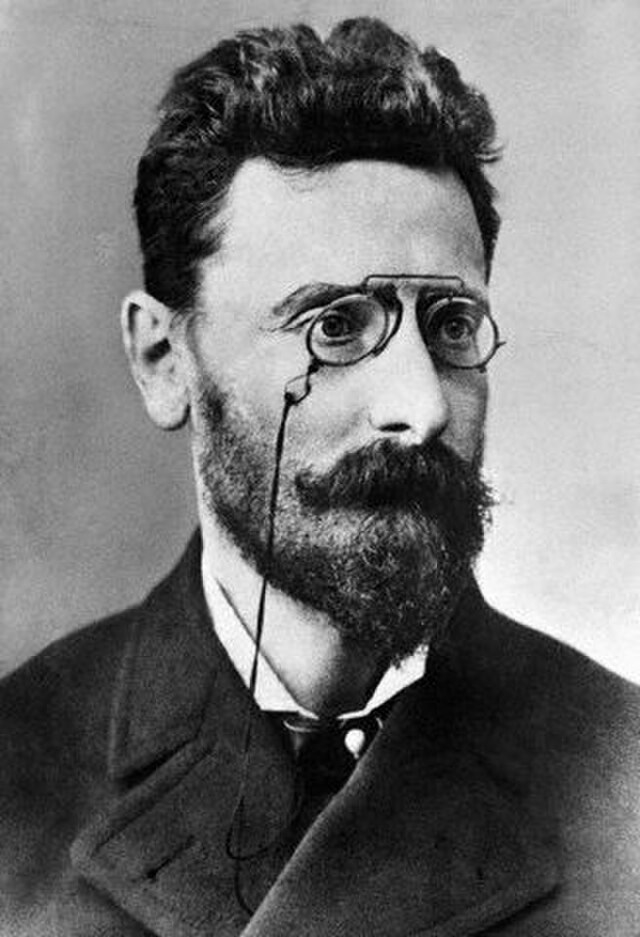 Photo portrait of Joseph PulitzerSee page for author, Public domain, via Wikimedia Commons
Pulitzer was born on April 10, 1847, in a town along the southern border of Hungary to a Magyar-Jewish family. Once wealthy, the family fell into poverty after his father’s death in 1858. The prolific journalist to-be first sought work in the military. Applying to several European armies, he was rejected each time due to his frail health and poor eyesight. Somehow he managed to find enlistment in Hamburg, Germany — not for the Germans, but for the Americans. After paying for his passage across the Atlantic, Pulitzer joined the Union cavalry in the American Civil War. His military career was uneventful and brief, lasting less than a year. Briefer still was his $200 signing bonus. Settling in New York City, he found himself competing with countless other immigrants and veterans for work and housing. In part because of his poor English, he wasn’t able to keep up. By 1865 he was sleeping on the streets of New York City. After having his coat stolen, he made the decision to leave the city. Selling his last possession — a handkerchief — he bought a train ticket to St. Louis, Missouri.
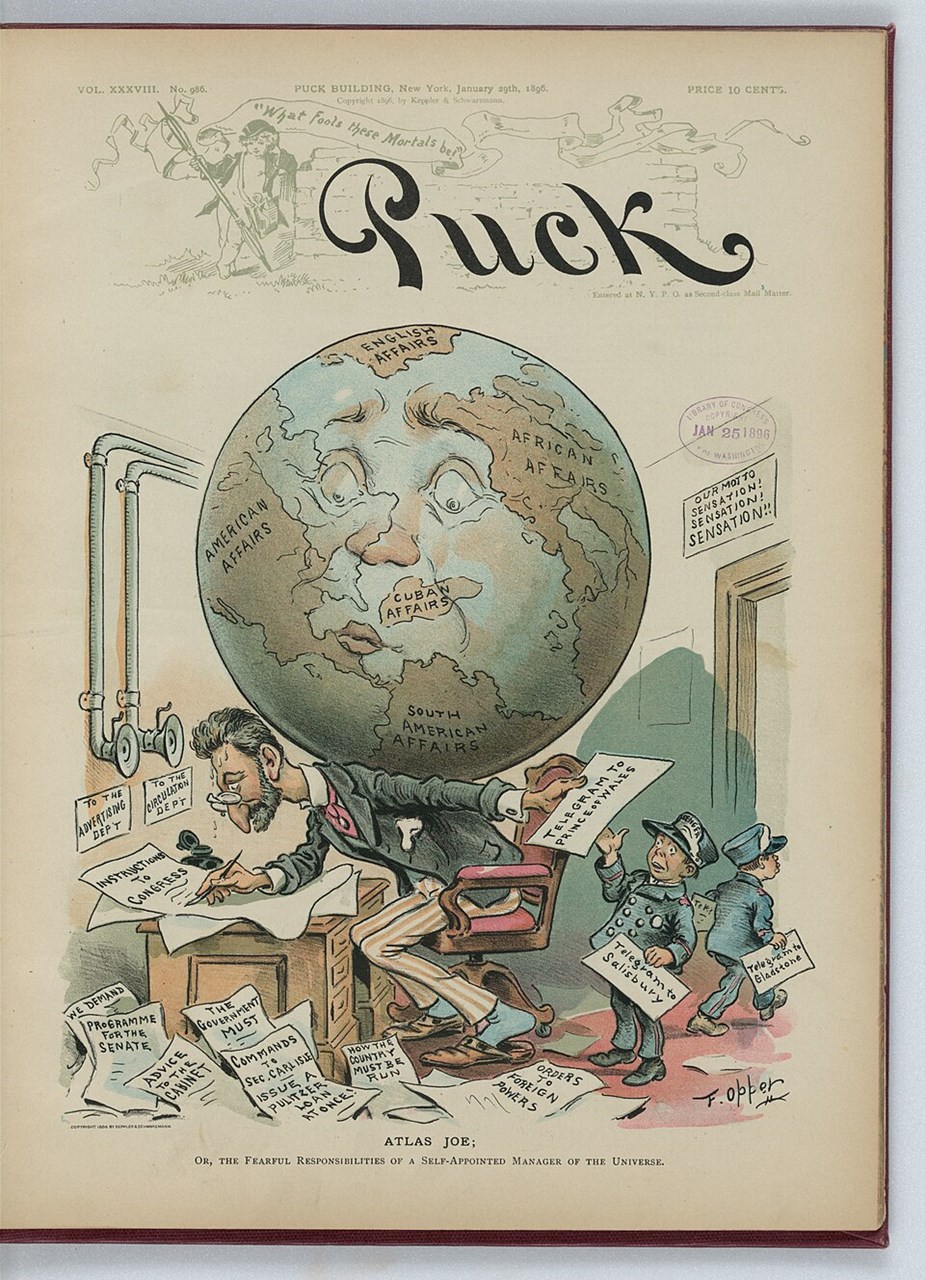 Illustration of "Atlas Joe," almost certainly based off of Pulitzer.Opper, Frederick Burr, 1857-1937, artist, Public domain, via Wikimedia Commons“The lights of St. Louis looked like a promised land to me,” Pulitzer later recalled. The city’s large German-speaking population gave him his first real sense of community in America. He worked a series of short-lived jobs — boilerman, hostler, waiter — and even studied law, eventually passing the bar, but finding little success as a lawyer. His fortunes changed when he became involved with the Westliche Post, a daily newspaper printed in German. Impressed by his earlier freelance work, the editors offered him a full-time reporting job in 1868. “It all seemed like a dream,” Pulitzer said of the offer years later.
In the newsroom, Pulitzer proved relentless. He worked tirelessly, doggedly pursuing and writing stories for sixteen hours a day. A sense of justice drove him. He published hard-hitting investigations about corrupt lobbyists, greedy politicians, and other abuses of power, establishing himself as a champion of the people. In 1878, after a series of business deals, Pulitzer acquired the struggling St. Louis Post-Dispatch; entering into the field of publishing, which he would soon dominate. Under his close leadership, the paper thrived and became known for its bold investigations and sharp editorials.
By the early 1880s, Pulitzer’s ambition had outgrown St. Louis. In 1883, while passing through New York City on his way to a vacation in Europe, he purchased the New York World. Rather than taking a vacation, the ever-enterprising Pulitzer relocated himself and his family to the city to begin transforming the paper. He introduced innovative techniques in reporting and production, including large, attention-grabbing headlines, full-page illustrations, and investigative “stunt” journalism designed to expose wrongdoing. One of his editors described him as a “one-man revolution.” The World became the best-selling newspaper in the country.
Pulitzer’s success, however, brought fierce competition. Rival publishers attacked him relentlessly. New York Sun editor Charles A. Dana and The Journalist founder Leander Richardson publicly targeted him with antisemitic rhetoric. His greatest foe, however, was William Randolph Hearst, publisher of the New York Journal-American. After poaching staff from Pulitzer’s paper, Hearst adopted many of his techniques, sparking an intense battle for readership. This rivalry escalated into what became known as “yellow journalism,” a style emphasizing exaggerated, sensationalist stories at all costs — even if it meant publishing lies and gossip. The Pulitzer-Hearst rivalry reached its peak in 1898 with the explosion of the USS Maine, wherein both of their papers published stories blaming Spain without sufficient evidence. Their reporting inflamed the public, and ultimately contributed to the outbreak of the Spanish-American War.
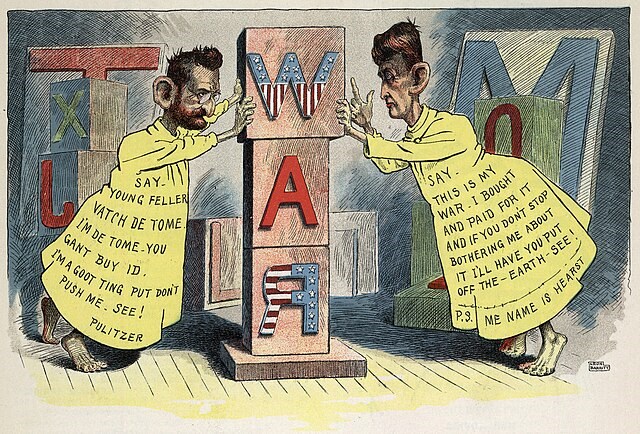 Satirical depiction of the Hearst-Pulitzer rivalry, with both dressed as the "Yellow Kid" that yellow journalism derives it's name from.Leon Barritt, Public domain, via Wikimedia CommonsThe experience left Pulitzer deeply disillusioned. After the war, he began to distance himself from the sensationalism he had helped popularize. The New York World shifted toward more responsible journalism, emphasizing accurate reporting and public service. Recognizing the power of the press, Pulitzer embarked on something of a penitent journey; believing the profession should be treated not merely as a trade, but as a profession guided by ethics, education, and accountability. To that end he became a strong advocate for formal training in journalism, contributing to the founding of the Missouri School of Journalism in 1908, and the Columbia University Graduate School of Journalism in 1912 (after bestowing Columbia a large gift in his will). “That all other professions and not journalism should have the advantage of special training seems to me contrary to reason,” his will states. Pulitzer’s legacy was ensured by founding the Pulitzer Prizes, awards still notable today for recognizing excellence in journalism and the arts.
Despite his success, Pulitzer’s health steadily declined. He suffered from asthma, insomnia, depression, and deteriorating eyesight to the point of being nearly blind. By 1890, just forty-three years old, he reluctantly withdrew from the newsroom and managed his publications from his mansion. Later in life, he developed hyperacusis, a condition that made him extremely sensitive to sound to the point of pain. Due to this he was forced to spend much of his time in soundproof rooms. Aboard his yacht on October 29, 1911, making the journey to his winter home, Pulitzer listened to his secretary read a biography of Louis XI — one of his idols. As the secretary read of the French King’s death, Pulitzer quietly spoke to him in German: “Leise, ganz leise” — “Softly, quite softly” — and passed away.
From a penniless immigrant to one of the most influential figures in American history, Joseph Pulitzer transformed journalism. His legacy endures not only in the institutions he helped build, but in the enduring belief that journalism is an essential pillar of a true democracy. In his own words, penned in 1904: “An able, disinterested, public-spirited press, with trained intelligence to know the right and courage to do it, can preserve that public virtue without which popular government is a sham and a mockery.”
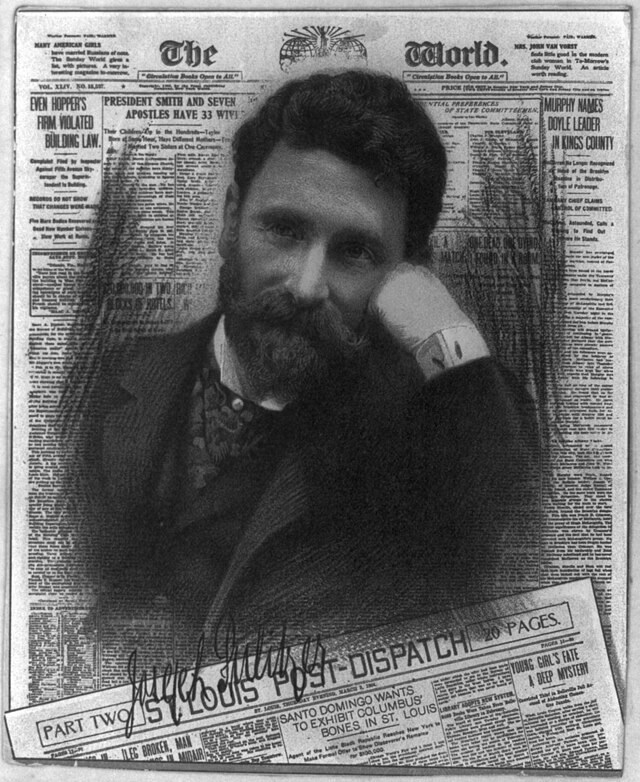 See page for author, Public domain, via Wikimedia CommonsPulitzer superimposed on a composite of his newspapers.
Page created on 4/11/2026 2:56:31 AM
Last edited 4/11/2026 4:00:24 PM
Brian, Denis. Pulitzer: A Life.
Topping, Seymour. Biography of Joseph Pulitzer. [Online] Available https://www.pulitzer.org/page/13988.
Pulitzer, Joseph. Extracts from the Will of Joseph Pulitzer. [Online] Available https://www.pulitzer.org/page/extracts-will-joseph-pulitzer.