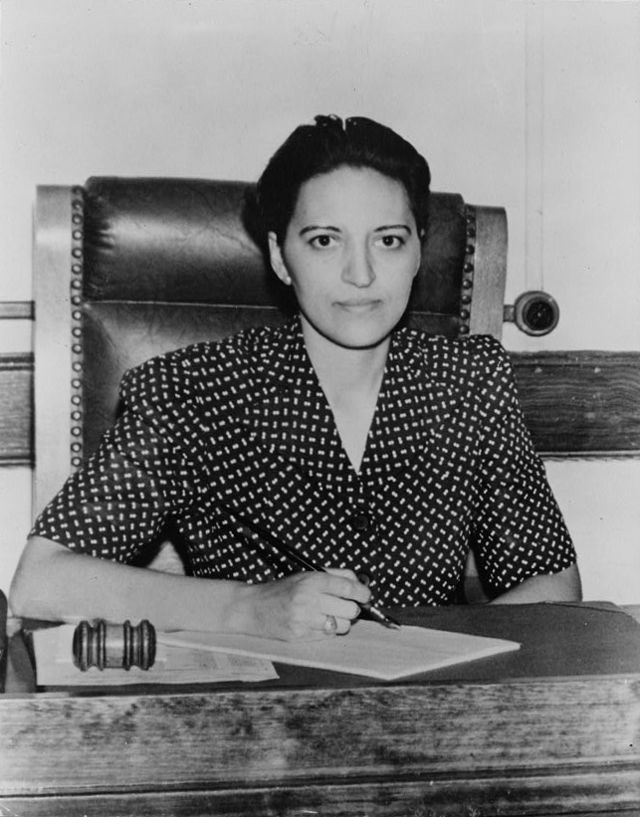
 Judge Jane Bolin, first black female to occupy a court bench.Employee of the Office of War Information via Wikimedia Commons
Jane Bolin was born to Gaius C. Bolin, a successful black lawyer, and Matilda Ingram Emery on April 11th, 1908, in Poughkeepsie, New York. As a child of interracial parents, Bolin was no stranger to discrimination. Growing up in the early 1900s, she was often turned away from local businesses because she was mixed race. This, combined with the time she spent frequenting her father’s law office, sparked her passion for social justice at a very young age.[1]
After graduating high school in Poughkeepsie, Bolin applied to Vassar College, but was rejected because they wouldn’t admit a black student. Instead, she enrolled at Wellesley College. Bolin was one of only two black freshman at the time, and both were ostracized by their white peers. They became friends and decided to live together off campus.[2]
Whilst as Wellesley, learning more about the struggles faced by African Americans, Bolin realized that she wanted to pursue a career in law. However, the professors at Wellesley did little to encourage her. In fact, many of them tried to deter her from applying to Yale due to her being a black woman. Even her father, who was himself a black lawyer, urged Jane to change her mind, fearing that becoming a lawyer would expose her to further prejudice.[3] However, Jane’s mind was set.
She was accepted into Yale, and at just twenty-three years old, became the first black woman to graduate from the university.[4] A year later, in 1932, Bolin passed the New York State Bar exam.
Bolin first went to work at her father’s firm for a short time before taking a job at the office of the New York City Corporation Counsel. On July 22, 1939, aged thirty-one, Bolin became the first ever black woman judge, and worked in the Domestic Relations Court. The next black woman judge would not be appointed for another twenty years.[5]
Throughout her career, Judge Bolin dedicated much of her time to the advocacy of women’s and children’s rights. She worked as a legal adviser to the National Council of Negro Women[6] and served on the boards of multiple organizations working to support women and children, particularly ethnic minorities, including the National Association for the Advancement of Colored People.
Judge Bolin retired in 1979 but continued to serve on the New York State Board of Regents and volunteered in public schools for several years as a reading instructor. She died on January 8th, 2007, aged ninety-eight. Four years after Bolin’s death, Dr. Jacqueline A. McLeod penned the first biography about Judge Bolin, Daughter of the Empire State: The Life of Judge Jane Bolin, detailing her life and legacy as a trailblazer, staunch advocate, and breaker of the glass ceiling.
[1] KC, Garima. The life and legacy of Judge Jane Bolin [Online] Available https://ignitenational.org/blog/the-life-and-legacy-of-judge-jane-bolin. 2021.
[2] Joe. Remembering Jane Bolin, First Black Female Judge in US History [Online] Available https://arthurashe.ucla.edu/2015/07/23/remembering-jane-bolin-first-black-female-judge-in-us-history/. 2015.
[3] Ibid.
[4] Goodwin, David. L. 1st African-American female judge 'showed the strength of the subtle' [Online] Available https://eu.poughkeepsiejournal.com/story/life/2017/02/13/african-american-female-judge-jane-matilda-bolin-poughkeepsie-high-school-williams-college-gaius-historical-society-of-the-new-york-courts/97851416/. 2026.
[5] Wolf, Julie. Judge Jane Bolin Battled Institutional Racism in NYC Courts for Decades [Online] Available https://www.theroot.com/judge-jane-bolin-battled-institutional-racism-in-nyc-co-1790854263. 2016.
[6] Ibid.
Page created on 4/10/2026 4:28:31 PM
Last edited 4/10/2026 4:32:34 PM