REPRINTED WITH PERMISSION FROM THE CHRISTIAN SCIENCE MONITOR
Cutting hair is not the point of the mentoring at Abdulmajid Bala’s shop in Kano, Nigeria. Instead, the real lessons are structure and a reason to be somewhere.
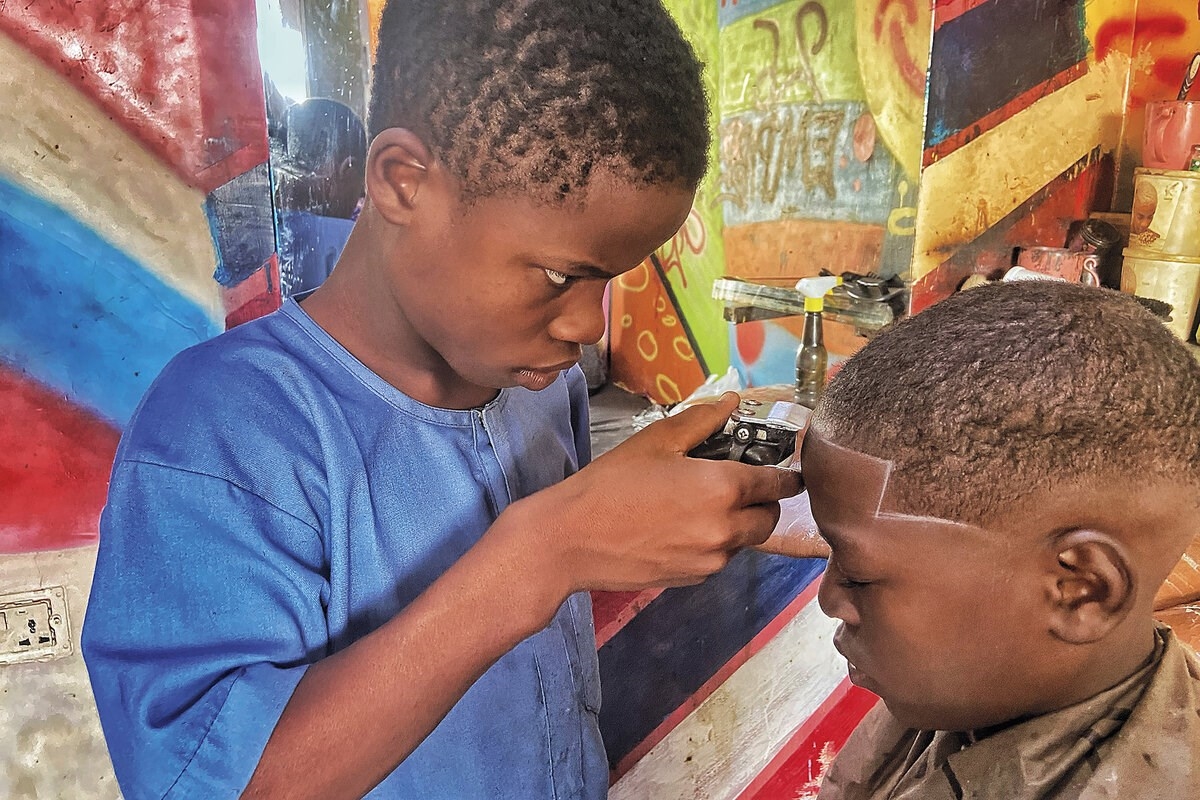 Ibrahim Khalil Yusuf, one of Abdulmajid Bala’s trainees, shaves another child’s hair at Mr. Bala’s shop. Boys are fed during training and given time and attention. Ogar Monday
| Kano, Nigeria
In a narrow room that smells of talcum powder and aftershave, four boys are crowded around a chair. With electric clippers buzzing in one hand, Abdulmajid Bala tends to a customer, who sits with his eyes closed in complete trust.
Suddenly, the clippers stop. Nothing is wrong; the barber just wants the boys to take in the lesson.
“You see what I did there?” Mr. Bala says in Hausa, the local language, as he tilts the clippers toward the curve behind the customer’s ear. The boys inch closer. Mr. Bala adjusts his grip and continues.
“Soft hand,” he says quietly. “Always soft hands near the skin.”
Mr. Bala has plied his trade in Kano’s Brigade neighborhood for more than two decades, and many say he is one reason that some boys here have not been swallowed into a life of crime. When a boy first wanders in from the streets lacking direction, Mr. Bala sits him in a chair, gives him a haircut, and talks. Then, when the boy keeps coming back, Mr. Bala puts clippers in his hand and teaches him a skill with which he can build a life.
“When a boy has a skill,” Mr. Bala says, “that life of crime is no longer attractive.”
Kano is Nigeria’s second-most populous city and the commercial capital of the country’s north. It is also a place where many young men grapple with unemployment and substance abuse.
The city has one of Nigeria’s highest concentrations of almajiri, boys who have been sent away from home for Quranic education but often end up on the street with no supervision. These boys, and others like them, provide a steady supply for gangs that have long terrorized neighborhoods across Kano.
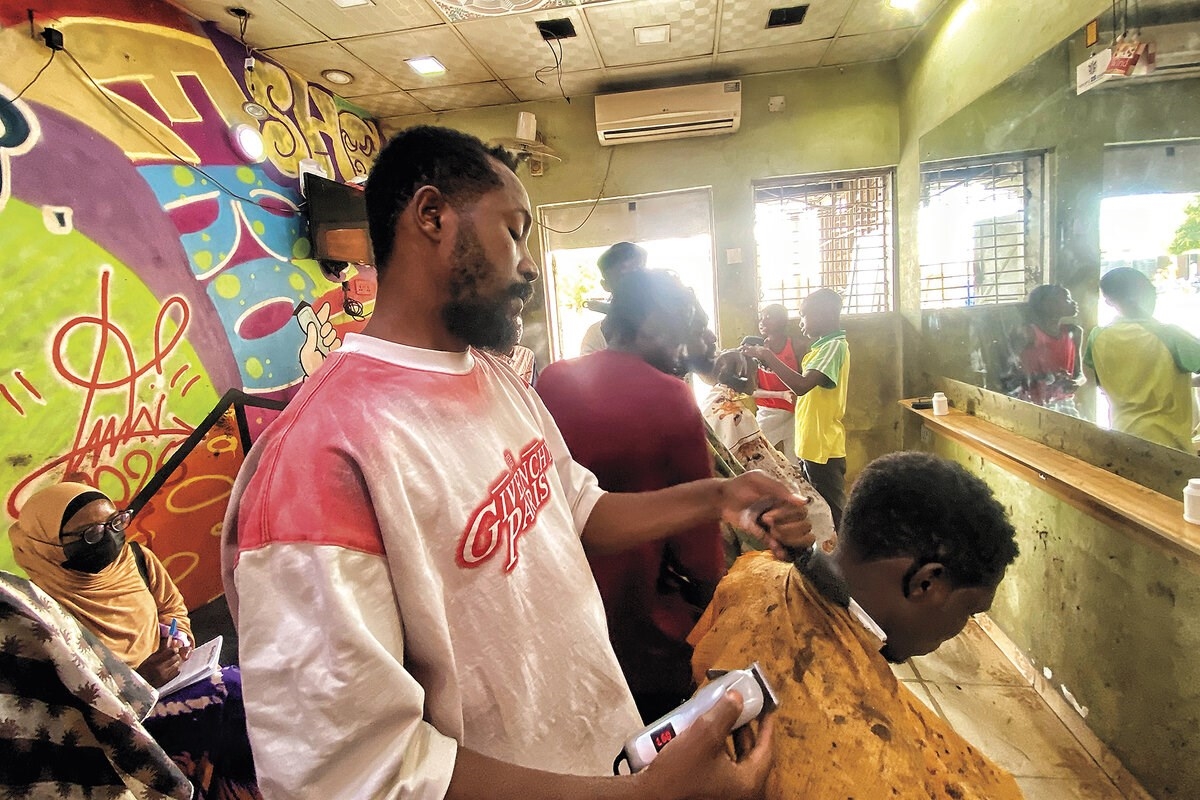 Ogar MondayAbdulmajid Bala works on a customer’s hair at his shop in the Brigade neighborhood of Kano, Nigeria, where he has been barbering since 2004.
The yan daba gangs, for example, trace their origins to the 1950s and ’60s, when political parties recruited young men as enforcers. The gangs later took root in the streets, offering vulnerable boys money and a sense of belonging.
Mr. Bala knows this story from the inside. He grew up in Brigade, and some of the boys he knew joined gangs. Some are dead, he says; others are in prison. Mr. Bala says he was fortunate to discover barbering around 1997 while working as an apprentice at a game store.
“I was curious about what I was going to learn each day, and I came back every day,” he says. “It kept me away from the wrong crowd.”
When Mr. Bala opened his shop in 2004, he immediately felt the pull to give something back. He says he began with the son of a neighbor, a boy who was always in bad company. Rather than watch him drift further, Mr. Bala took the boy under his wing. “I kept him busy,” he says.
He then began taking in other boys from the neighborhood, teaching them how to cut hair and how to understand what a customer wants. But barbering, he is quick to say, is not the point.
“I tell them, ‘This shop opens at 7. If you want to learn, be here at 7,’” he says. “That is the first lesson. Everything else comes after.”
The real lesson is structure. A fixed place to be. Someone who notices when you arrive and notices, equally, when you do not. Mr. Bala says he has trained at least 70 boys, ranging from 11 to 18 years old.
Some come in on their own. Others are brought by their mothers.
Hauwa Salisu lives a short walk from Mr. Bala’s shop. She brought her son Kabiru, who was then 13, after he began keeping company with older boys in the evenings. She was clear about what she needed.
“All I wanted was someone to help my son,” she says. “Someone to teach him not to end up on the street.”
Mr. Bala does not try to do everything himself. From time to time, he brings in respected members of the community to speak to the boys. That includes lawyers, doctors, even former gang members.
“One man cannot do it,” Mr. Bala says. “A boy needs to see many men who are living right. Many examples, not just me.”
Habeeb Muhammad Atta came through the shop as a teenager and never left. He now has his own chair inside the shop and is studying banking and finance at Kano State Polytechnic. “Mr. Bala did not just teach me barbering,” he says. “He taught me that I am responsible for my life and can make anything I want out of it.”
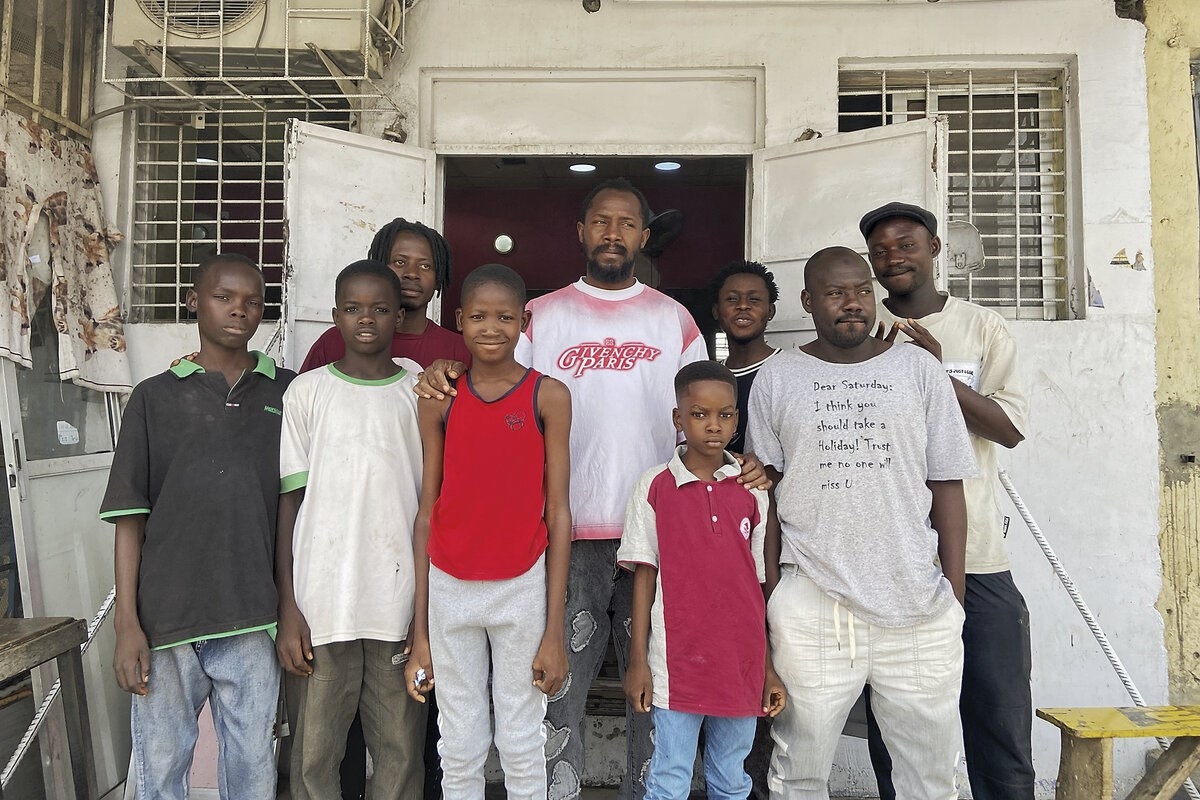 Ogar MondayMr. Bala (at center) stands outside the shop with some of the boys he mentors.
Some boys have gone back to the streets. Mr. Bala does not go after them. “I leave the door open,” he says. “They know where I am.”
Lawal Tukur has been a customer for six years and has watched many boys come through the shop. “You can see the difference,” he says. “They are not the same boys you see on the street corners. They carry themselves different.”
Every new boy starts by observing – sometimes for days – before he is allowed to touch the clippers. Then, he is permitted to practice cutting other kids’ hair. Mr. Bala corrects with love and praises when it’s deserved. Before a boy works on a paying customer’s hair, he has already practiced the same cut many times on a mannequin head fixed to a wooden stand near the back wall.
The boys are not paid during training, but they are fed. And they receive what Mr. Bala considers more valuable: time, attention, a reason to be somewhere.
At the end of each week, the boys sit together for what Mr. Bala calls simply “the talk.” No agenda. The conversation moves from how to handle a difficult customer and how to save part of every payment, to bigger questions about what kind of men the boys want to become.
“I do not give them all the answers,” Mr. Bala says. “Some answers, they have to find on their own. But I am here to offer them guidance.”
In the shop on a recent Saturday, one of the younger boys settles into the chair. He sits straight, chin up, trying to look unbothered. An older boy – clippers in hand, still learning – takes his position beside him. Mr. Bala stands back and watches, arms folded. The boy with the clippers glances over, and Mr. Bala nods for him to begin.
The clippers start buzzing again. The other kids giggle.
Outside, the noise of the city continues. But this boy is learning to keep his hand steady.
Page created on 7/10/2026 3:38:36 PM
Last edited 10/21/2026 7:01:24 PM