It was my sophomore year of high school when I was introduced to Kurt Vonnegut. He came to me by way of Mrs. Silmon — one of my favorite English teachers — for an assigned reading. “I think you’ll like him,” she said. That quickly became an understatement. With his conversational style, his witty prose, and unpredictable plot, I became enraptured by Vonnegut’s storytelling. It’s hard not to be. By the end of his career, Vonnegut cemented himself as one of the best satirists of his time and one of the greatest authors in American history.
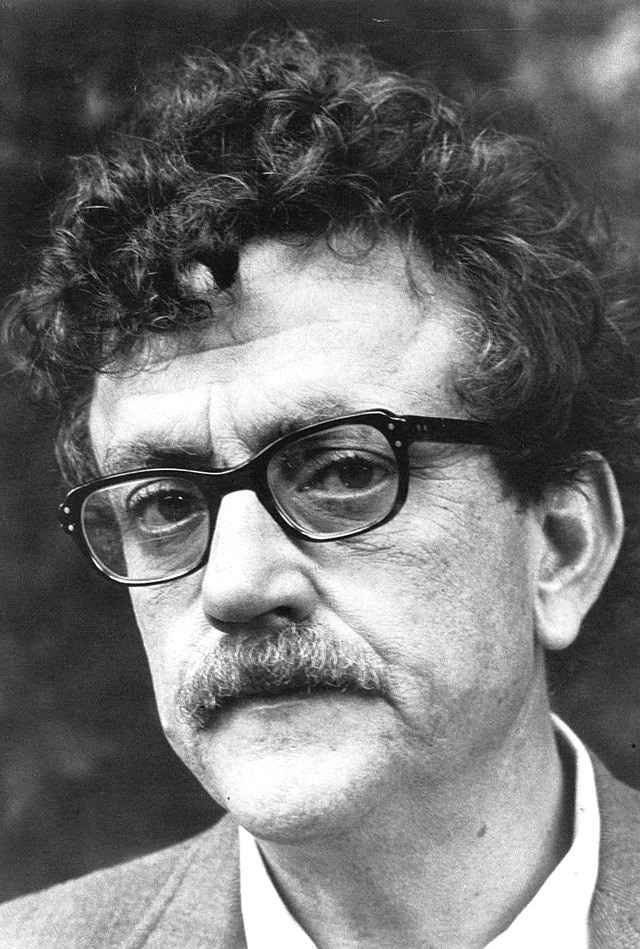 Photo of Kurt Vonnegut from an appearance on WNET-TV in 1972WNET-TV/ PBS, Public domain, via Wikimedia Commons
Born in 1922, Kurt Vonnegut was raised in Indianapolis, Indiana, during the Great Depression, and later went on to fight in World War II where he lived through the Allied firebombing of Dresden. When he finally got around to publishing his first short story — “Report on the Barnhouse Effect” — in 1950, and shortly thereafter threw himself wholly into writing, he was already poised to critique and satirize American society. This was already evident with his debut dystopian novel Player Piano — based on his time working for General Electric, and critiquing technocratic societies — but he didn’t really hit his stride until over a decade later with the publishing of Slaughterhouse-Five in 1969.
Slaughterhouse-Five was my introduction to Vonnegut — as it was for most people. Writing for a disillusioned American public reckoning with the failure and evolution of traditional American ideals, going through such major events such as the senseless violence in Vietnam and the radical change of the Civil Rights Movement, the writings of Vonnegut easily struck a chord with people. He gives a semi-autobiographical account of his own WW2 service through the character of Billy Pilgrim, a fatalist and possible time-traveling alien abductee, pointing out the complete absurdity and relentless nature of war and death.
But it’s not the themes that really grab me; it’s how Vonnegut does it. His writing is nothing short of magnificent. His prose is well and truly conversational — it’s relatively simple in nature, and even branches off into tangents here and there. Yet, still, there’s an underlying wisdom and emotional weight in his words; a constant lesson that he’s trying to instill. One that’s found every time he returns to the motif: “So it goes,” — said every time a character dies, or something is destroyed, or even when the whole universe blows up. There’s sillier stuff, too — at one point, Billy Pilgrim enters the latrines and comes across a fellow soldier who “had excreted everything but his brains.” Vonnegut immediately follows this unflattering portrait with: “That was I. That was me. That was the author of this book.” It’s all very human.
My all-time favorite book of his is Breakfast of Champions. By any objective standard, I don’t think it’s his best novel (that, I believe, is The Sirens of Titan), but the way I’ve always described Breakfast of Champions is that it’s Vonnegut at his most Vonnegut. Here is the plot: the chemically-imbalanced Dwayne Hoover runs into sci-fi author Kilgore Trout, and then goes on a rampage. You know that the rampage is coming at the very start — he tells you what exactly will happen, and who its victims are — and the rest of the book follows the lives of Dwayne and Kilgore in what feels like a haze of loosely-related tangents that poke fun at every aspect of American society. It’s overly self-indulgent — he throws everything he’s got, every little thread of a story he’s brainstormed, at the wall. And by all means, that feels like it shouldn’t work — and for most authors, I feel, it wouldn’t — but it does for him. Everything he touches is gold.
Kurt Vonnegut passed away in 2007, though he left behind an impressive legacy that continues to inspire writers to this day. Yours truly was heavily inspired by him — to this day, I try
to imitate his prose; he may as well be the coauthor of anything I pen. Back when Vonnegut was attending the University of Chicago, he wrote his (rejected) dissertation on the “shapes
of stories,” which tried to classify stories on an x-axis (beginning-end) and y-axis (good-bad). For a true masterpiece — Hamlet was his example — he said it couldn’t be crucified on a
cross of this design; that in pieces like Hamlet, events happen in the story, and you aren’t sure whether they are good or bad. Such is life. “Although I don’t believe in Heaven,” he said,
“I’d like to go up there to ask somebody in charge: Hey, what was the good news, and what was the bad news?” And one can only hope that he did.
Page created on 3/5/2026 9:31:41 AM
Last edited 3/8/2026 3:47:45 PM